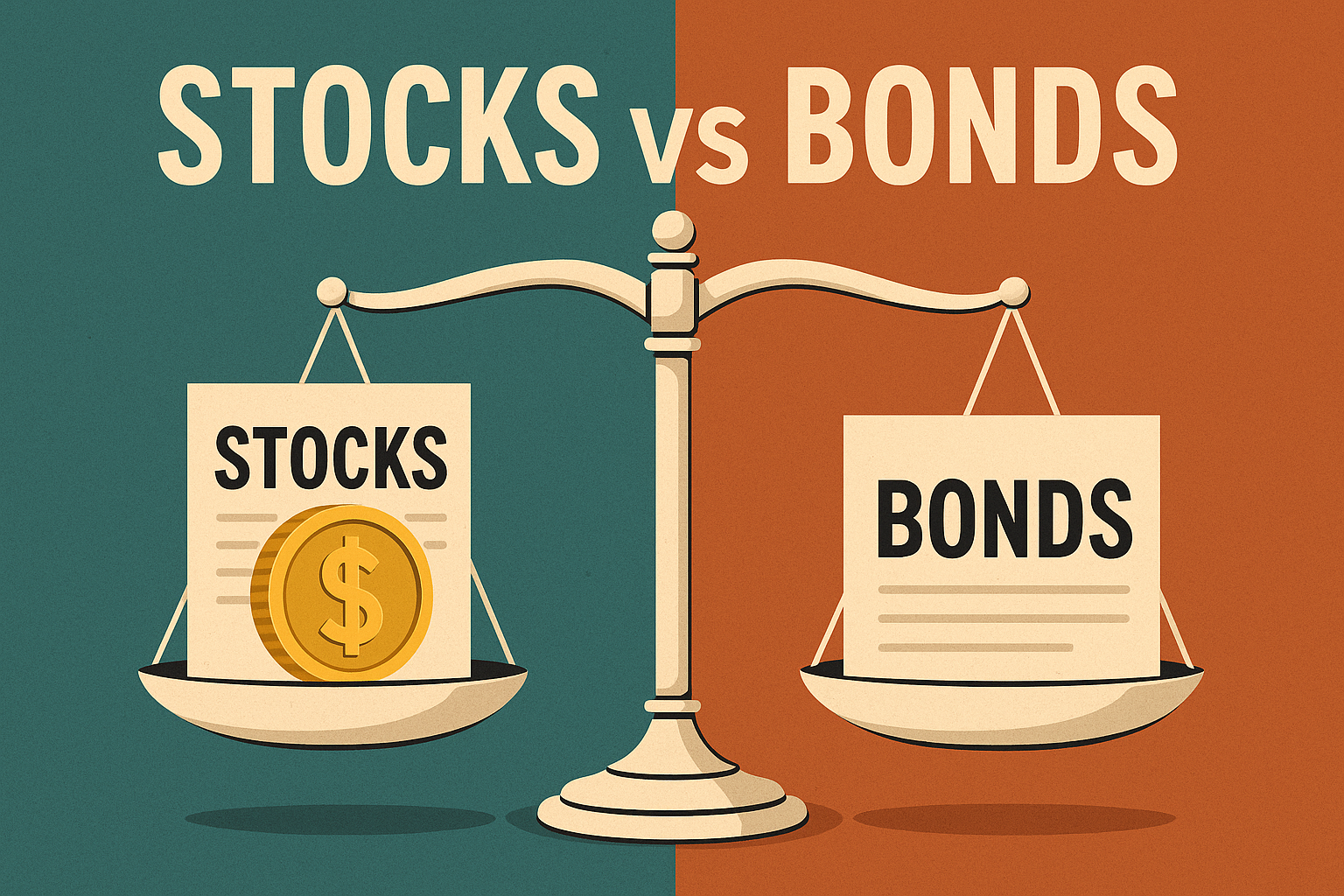
Picture this: You’ve just received a bonus at work, and instead of letting it sit in your savings account earning pennies, you want to make your money work for you. But here’s the million-dollar question—should you invest in stocks, bonds, or both? If you’re scratching your head, wondering what the difference even is, you’re not alone. Stocks vs Bonds is one of the most fundamental investment decisions you’ll ever make, and understanding the distinction can be the difference between building wealth and watching opportunities slip away.
In simple terms, stocks represent ownership in a company, while bonds are essentially loans you give to companies or governments. Both are powerful wealth-building tools, but they work in completely different ways, carry different risks, and serve different purposes in your investment portfolio. Whether you’re a complete beginner or someone looking to refine your investment strategy, this guide will break down everything you need to know to make informed decisions.
TL;DR
- Stocks vs Bonds represent two fundamental asset classes: stocks give you ownership in a company with higher growth potential but more risk, while bonds are debt instruments that provide steady income with lower risk
- Stocks historically outperform bonds over the long term (averaging 10% annually vs. 5-6% for bonds), but come with significantly higher volatility and risk
- Bonds provide stability and income through regular interest payments, making them ideal for conservative investors or those nearing retirement
- Diversification is key: Most investors benefit from holding both stocks and bonds in proportions that match their age, risk tolerance, and financial goals
- Your investment timeline matters: Longer time horizons favor stocks, while shorter timelines (under 5 years) typically call for more bond allocation
What Are Stocks? Understanding Equity Ownership
When you buy a stock, you’re purchasing a small piece of ownership in a company. Think of it like buying a slice of pizza—you own that slice, and if the pizza becomes more valuable (say it’s made with truffle oil), your slice is worth more too.
Stocks, also called equities or shares, represent fractional ownership in a corporation. As a shareholder, you have a claim on the company’s assets and earnings. If the company does well and grows, the value of your shares typically increases. If the company struggles, your shares can lose value.
How Stocks Make You Money
There are two primary ways stocks generate returns:
- Capital Appreciation: When the stock price increases from what you paid for it, you can sell it for a profit
- Dividends: Some companies distribute a portion of their profits to shareholders as regular cash payments
For example, if you bought 100 shares of a company at $50 per share ($5,000 total), and the price rises to $75 per share, your investment is now worth $7,500—a $2,500 gain. If that company also pays a $2 annual dividend per share, you’d receive $200 in dividend income each year.
Many investors focus on dividend investing as a way to earn passive income while also benefiting from potential stock price appreciation.
Types of Stocks
Common Stocks: These give you voting rights in company decisions and potential dividend payments. Most stocks you hear about are common stocks.
Preferred Stocks: These typically don’t have voting rights but offer priority when it comes to dividend payments and asset distribution if the company goes bankrupt.
Growth Stocks: Companies reinvesting profits for expansion rather than paying dividends (think Tesla or Amazon in their early years).
Value Stocks: Established companies trading below their intrinsic value, often paying regular dividends.
Understanding what moves the stock market can help you make better decisions about which stocks to buy and when.
What Are Bonds? Understanding Debt Securities
If stocks are like owning a piece of the pizza shop, bonds are like lending money to the pizza shop owner with the promise they’ll pay you back with interest.
Bonds are debt instruments where you loan money to a borrower (a corporation, municipality, or government) for a set period. In return, the borrower agrees to pay you regular interest payments (called the coupon) and return your principal when the bond matures.
How Bonds Work
When you purchase a bond, you’re essentially becoming a creditor. Here’s the basic structure:
- Face Value (Par Value): The amount the bond will be worth at maturity (typically $1,000)
- Coupon Rate: The annual interest rate the bond pays
- Maturity Date: When the bond expires, and you get your principal back
- Market Price: What the bond currently trades for (can be above or below face value)
For example, if you buy a $1,000 bond with a 5% coupon rate and a 10-year maturity, you’ll receive $50 per year in interest payments for 10 years, and then get your $1,000 back at the end.
Types of Bonds
Government Bonds: Issued by national governments (U.S. Treasury bonds are considered the safest investments in the world)
Municipal Bonds: Issued by state and local governments, often tax-exempt
Corporate Bonds: Issued by companies, offering higher yields but more risk than government bonds
High-Yield Bonds (Junk Bonds): Issued by companies with lower credit ratings, offering higher returns to compensate for higher risk
According to the U.S. Securities and Exchange Commission (SEC), bonds are generally considered less risky than stocks because bondholders have priority over stockholders if a company goes bankrupt.
Stocks vs Bonds: The Core Differences
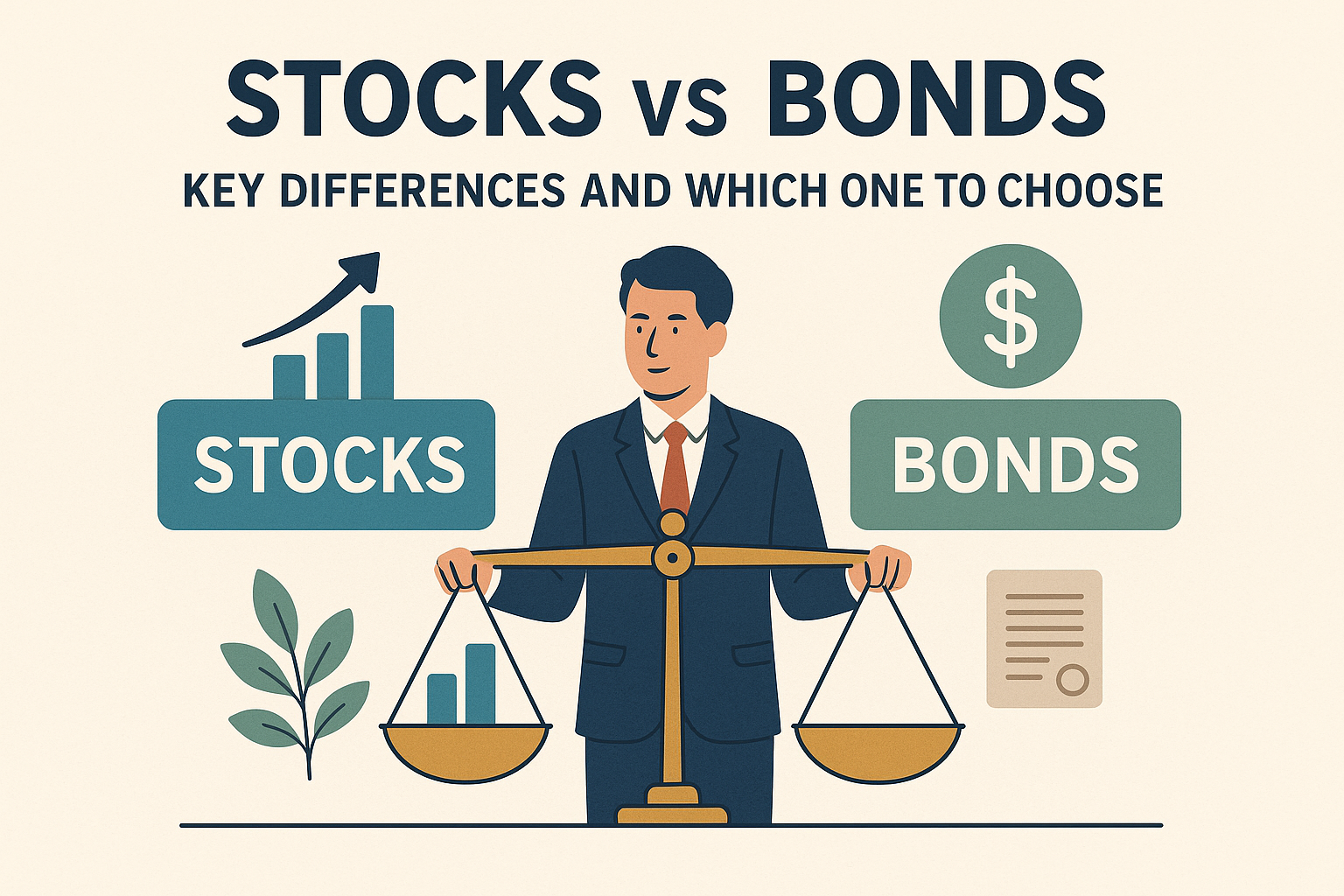
Let’s break down the fundamental distinctions between these two investment vehicles:
| Feature | Stocks | Bonds |
|---|---|---|
| What You Own | Ownership stake in a company | Debt obligation from borrower |
| Return Type | Capital gains + dividends | Interest payments (coupon) |
| Risk Level | Higher volatility and risk | Lower volatility and risk |
| Historical Returns | ~10% annually (long-term average) | ~5-6% annually (long-term average) |
| Income Predictability | Dividends can be cut or eliminated | Fixed interest payments (usually) |
| Priority in Bankruptcy | Last in line (after bondholders) | Higher priority than stockholders |
| Investment Horizon | Better for long-term (5+ years) | Suitable for shorter to medium-term |
| Inflation Protection | Generally better hedge | Fixed payments lose purchasing power |
| Tax Treatment | Capital gains rates; qualified dividends | Interest taxed as ordinary income |
| Liquidity | Generally highly liquid | Varies; some bonds less liquid |
Risk and Return: The Fundamental Trade-Off
The relationship between risk and return is the cornerstone of investing. In the Stocks vs Bonds debate, this principle is crystal clear: stocks offer higher potential returns but come with significantly more risk.
Stock Market Volatility
Stocks can experience dramatic price swings. During the 2008 financial crisis, the S&P 500 fell nearly 57% from its peak. Yet from 2009 to 2025, the market has experienced one of the longest bull runs in history, with the S&P 500 increasing more than 500%.
This volatility is why understanding the cycle of market emotions is crucial for stock investors. Many people lose money in the stock market not because stocks are inherently bad investments, but because they panic sell during downturns.
Bond Market Stability
Bonds are generally much more stable. If you hold a bond to maturity, you’ll receive your principal back (assuming the issuer doesn’t default). However, bond prices can still fluctuate based on interest rate changes.
Interest Rate Risk: When interest rates rise, existing bond prices fall (and vice versa). This is because new bonds will be issued with higher rates, making older bonds less attractive.
For example, if you own a bond paying 3% and new bonds start paying 5%, your bond becomes less valuable on the secondary market.
Measuring Risk
Standard Deviation: Stocks typically have a standard deviation of 15-20%, meaning their annual returns can vary widely. Bonds usually have a standard deviation of 3-6%.
Beta: Measures volatility compared to the overall market. Stocks have betas around 1.0 (moving with the market), while bonds often have betas near 0 (little correlation to stock market movements).
According to Morningstar research, a diversified portfolio of stocks has never lost money over any 20-period since 1926, highlighting why the time horizon is so critical.
Historical Performance: What the Data Shows
Understanding historical performance helps set realistic expectations, though past performance never guarantees future results.
Long-Term Stock Returns
From 1926 to 2025, U.S. stocks have delivered an average annual return of approximately 10% before inflation. This includes both spectacular bull markets and devastating bear markets.
- Best year: 1933 (+54%)
- Worst year: 1931 (-43%)
- Longest bull market: 2009-2020 (11 years)
- Longest bear market: 1929-1932 (3 years)
One reason why the stock market goes up over time is that it reflects the growth of the underlying economy and corporate earnings.
Long-Term Bond Returns
Government bonds have averaged around 5-6% annual returns over the same period, with much less volatility:
- Best year: 1982 (+32% for long-term Treasuries)
- Worst year: 2009 (-11% for long-term Treasuries)
- Typical annual volatility: 3-8%
The Power of Compounding
The difference between 10% and 5% might not sound massive, but over time, it’s enormous:
- $10,000 invested at 10% for 30 years: $174,494
- $10,000 invested at 5% for 30 years: $43,219
That’s a difference of over $130,000! This is why younger investors are typically advised to favor stocks for long-term growth. See our full guide on The Power of Compounding
Income Generation: Dividends vs Interest
Both stocks and bonds can generate regular income, but they do so differently.
Dividend Income from Stocks
Not all stocks pay dividends, but many established companies do. High dividend stocks can provide a steady income stream while also offering potential price appreciation.
Dividend Yield: Annual dividend per share divided by stock price. For example, if a stock trades at $100 and pays $4 annually in dividends, the yield is 4%.
Dividend Growth: Unlike bond interest, dividends can increase over time. Companies like Johnson & Johnson have increased their dividends for over 60 consecutive years.
Dividend Taxation: Qualified dividends are taxed at favorable capital gains rates (0%, 15%, or 20% depending on income), which is often lower than ordinary income tax rates.
Interest Income from Bonds
Bonds provide predictable income through regular coupon payments:
Fixed Payments: Most bonds pay the same amount every period (usually semi-annually)
Yield to Maturity (YTM): The total return you’ll receive if you hold the bond until it matures, accounting for the purchase price, coupon payments, and face value
Tax Considerations: Bond interest is typically taxed as ordinary income, which can be as high as 37% for high earners. Municipal bonds offer tax-free interest at the federal level (and sometimes state level).
Many investors seeking passive income streams use a combination of dividend stocks and bonds to create a diversified income portfolio.
Liquidity and Accessibility
Stock Liquidity
Most stocks, especially those of large companies, are highly liquid. You can buy or sell shares within seconds during market hours. The bid-ask spread (difference between buying and selling price) is typically very small for popular stocks.
Major stock exchanges like the NYSE and NASDAQ facilitate millions of transactions daily, ensuring you can enter or exit positions quickly.
Bond Liquidity
Bonds are generally less liquid than stocks:
Government Bonds: U.S. Treasuries are highly liquid and easy to trade
Corporate Bonds: Can be less liquid, especially for smaller issuances. You might face wider bid-ask spreads
Municipal Bonds: Often the least liquid, sometimes requiring you to hold until maturity
Bond Funds: Offer daily liquidity by pooling many bonds together, though the underlying bonds may not be as liquid
Tax Implications: Stocks vs Bonds
Tax efficiency can significantly impact your after-tax returns.
Stock Taxation
Capital Gains:
- Short-term (held less than 1 year): Taxed as ordinary income (up to 37%)
- Long-term (held more than 1 year): Taxed at preferential rates (0%, 15%, or 20%)
Dividends:
- Qualified dividends: Taxed at long-term capital gains rates
- Non-qualified dividends: Taxed as ordinary income
Tax-Loss Harvesting: You can sell losing stocks to offset gains, reducing your tax bill
Bond Taxation
Interest Income: Generally taxed as ordinary income at your marginal tax rate
Municipal Bonds: Interest is exempt from federal taxes and sometimes state taxes if you live in the issuing state
Bond Premium/Discount: Complex rules apply when bonds are purchased above or below face value
Tax-Advantaged Accounts: Holding bonds in IRAs or 401(k)s can defer taxes until withdrawal
According to the IRS, understanding the tax treatment of your investments is crucial for maximizing after-tax returns.
Portfolio Construction: How Much of Each?
The right Stocks vs Bonds allocation depends on several personal factors:
Age-Based Allocation
A traditional rule of thumb is to subtract your age from 110 to determine your stock allocation:
- Age 25: 85% stocks, 15% bonds
- Age 40: 70% stocks, 30% bonds
- Age 60: 50% stocks, 50% bonds
- Age 75: 35% stocks, 65% bonds
This approach gradually reduces risk as you approach retirement, when you have less time to recover from market downturns.
Risk Tolerance Assessment
Your emotional ability to withstand losses matters as much as your financial capacity:
Aggressive Investor: Comfortable with 80-100% stocks, can sleep soundly through 30%+ portfolio declines
Moderate Investor: Prefers 60-70% stocks, wants growth but needs some stability
Conservative Investor: Favors 30-50% stocks, prioritizes capital preservation over maximum returns
Very Conservative: 0-30% stocks, focused on income and safety
Time Horizon Considerations
Short-term goals (0-3 years): High bond allocation or cash equivalents. Stock volatility could devastate the funds you need soon
Medium-term goals (3-10 years): Balanced approach, perhaps 50-70% stocks
Long-term goals (10+ years): Can afford higher stock allocation to maximize growth potential
The Rebalancing Strategy
Markets will naturally shift your allocation over time. If stocks perform well, they’ll become a larger percentage of your portfolio, increasing your risk.
Annual Rebalancing: Once per year, sell some of the asset class that’s grown and buy more of the one that’s lagged, returning to your target allocation
Threshold Rebalancing: Rebalance whenever an asset class drifts more than 5-10% from its target
This disciplined approach forces you to “buy low and sell high” automatically.
Advantages and Limitations
Stocks: Pros and Cons
Advantages:
- Higher long-term returns: Historically outperform bonds and inflation over extended periods
- Ownership benefits: Voting rights and direct participation in corporate growth
- Inflation protection: Corporate earnings and stock prices tend to rise with inflation
- Liquidity: Easy to buy and sell during market hours
- Dividend growth potential: Income can increase over time
- Tax efficiency: Long-term capital gains receive favorable tax treatment
Limitations:
- High volatility: Prices can swing wildly, causing emotional stress
- No guaranteed returns: You can lose your entire investment if a company fails
- Requires research: Picking individual stocks demands time and knowledge
- Market timing risk: Buying at peaks can lead to years of negative returns
- Emotional challenges: Behavioral biases lead many to buy high and sell low
Bonds: Pros and Cons
Advantages:
- Predictable income: Fixed interest payments provide a steady cash flow
- Lower volatility: More stable prices reduce emotional stress
- Capital preservation: Principal returned at maturity (if no default)
- Diversification: Often moves inversely to stocks, balancing portfolios
- Seniority in bankruptcy: Bondholders get paid before stockholders
- Tax advantages: Municipal bonds offer tax-free interest
Limitations:
- Lower returns: Historically underperforming stocks over long periods
- Interest rate risk: Rising rates decrease bond values
- Inflation erosion: Fixed payments lose purchasing power over time
- Credit risk: Issuers can default, especially on lower-rated bonds
- Reinvestment risk: When bonds mature, you may have to reinvest at lower rates
- Tax inefficiency: Interest taxed as ordinary income (except munis)
- Opportunity cost: Money in bonds can’t participate in stock market gains
Real-World Example: Two Investors
Let’s compare two hypothetical investors to see how Stocks vs Bonds plays out in practice:
Sarah: The Aggressive Stock Investor
Profile: 28 years old, stable income, high risk tolerance, 35 years until retirement
Portfolio: 90% stocks (diversified index funds), 10% bonds
2008 Financial Crisis: Her $50,000 portfolio dropped to $30,000 (-40%)
Response: She continued contributing and didn’t sell
2025 Result: Her portfolio grew to over $450,000 through contributions and market recovery
Key Lesson: Time and discipline allowed her to benefit from stock market growth despite severe volatility
Robert: The Conservative Bond Investor
Profile: 62 years old, planning retirement in 3 years, low risk tolerance
Portfolio: 30% stocks, 70% bonds
2008 Financial Crisis: His $500,000 portfolio dropped to $425,000 (-15%)
Response: His bond allocation cushioned the blow, preserving capital
2025 Result: His portfolio grew to $850,000, providing a stable retirement income
Key Lesson: Bond allocation protected capital when he couldn’t afford major losses
Both approaches were appropriate for their situations. There’s no universal “right” answer in the Stocks vs Bonds debate—it depends entirely on your circumstances.
Common Mistakes to Avoid
1: All-or-Nothing Thinking
Many beginners think they must choose either stocks OR bonds. In reality, most investors benefit from holding both. Diversification across asset classes reduces overall portfolio risk.
2: Chasing Past Performance
Just because stocks had a great year doesn’t mean you should go 100% stocks. Similarly, don’t abandon stocks after a bad year—that’s when they’re often the best value.
3: Ignoring Your Timeline
Putting money you’ll need in two years into volatile stocks is a recipe for disaster. Match your investments to your time horizon.
4: Forgetting About Inflation
Bonds feel safe, but inflation can erode your purchasing power. A 3% bond yield is actually a loss if inflation is 4%.
5: Emotional Decision-Making
Panic selling stocks during downturns or abandoning bonds when stocks are soaring are both emotional reactions that hurt long-term returns. Having a plan and sticking to it is crucial.
6: Neglecting Fees
High fees on mutual funds or frequent trading costs can eat away at returns from both stocks and bonds. Low-cost index funds often outperform actively managed funds after fees.
7: Lack of Diversification
Putting all your money in your employer’s stock or a single bond issuer concentrates risk dangerously. Spread your investments across many securities.
For more insights on avoiding common pitfalls, check out these smart moves every investor should make.
Investment Vehicles: How to Buy Stocks and Bonds
Individual Securities
Individual Stocks: You can buy shares of specific companies through a brokerage account. This requires research and creates concentration risk.
Individual Bonds: Can be purchased through brokers, though minimum investments are often $1,000-$5,000. Corporate and municipal bonds can be harder to access than Treasuries.
Mutual Funds
Stock Mutual Funds: Pool money from many investors to buy a diversified portfolio of stocks. Professional managers select the holdings.
Bond Mutual Funds: Similarly, pool money to buy various bonds, providing instant diversification.
Pros: Professional management, diversification, accessibility
Cons: Management fees, potential tax inefficiency, lack of control
Exchange-Traded Funds (ETFs)
Stock ETFs: Trade like stocks but hold a basket of securities. Index ETFs track market benchmarks like the S&P 500.
Bond ETFs: Provide easy access to diversified bond portfolios with daily liquidity.
Pros: Low fees, tax efficiency, flexibility, diversification
Cons: Trading costs (usually minimal), potential tracking error
Target-Date Funds
These “set it and forget it” funds automatically adjust the Stocks vs Bonds ratio as you approach a target retirement date, becoming more conservative over time.
Pros: Automatic rebalancing, age-appropriate allocation, simplicity
Cons: One-size-fits-all approach, fees, and less customization
Robo-Advisors
Automated platforms like Betterment and Wealthfront create and manage diversified portfolios of stock and bond ETFs based on your goals and risk tolerance.
Pros: Low cost, automatic rebalancing, tax-loss harvesting
Cons: Limited customization, no human advisor relationship
Special Considerations for 2025
Interest Rate Environment
As of 2025, interest rates have stabilized after the Federal Reserve’s aggressive hiking campaign. This affects both stocks and bonds:
Impact on Bonds: Higher rates mean new bonds offer better yields than in the 2010s, making them more attractive for income investors
Impact on Stocks: Higher rates increase borrowing costs for companies, potentially slowing growth. However, they also signal economic strength
Inflation Outlook
Inflation has moderated from the 2022-2023 peaks but remains a concern:
Stocks: Generally provide better inflation protection as companies can raise prices
Bonds: Fixed payments lose purchasing power, though Treasury Inflation-Protected Securities (TIPS) adjust for inflation
Market Valuations
Stock valuations in 2025 are above historical averages, suggesting potentially lower future returns. This doesn’t mean avoid stocks, but temper expectations and ensure adequate bond allocation for stability.
How to Interpret Stocks vs Bonds Performance
Reading Stock Performance
Price-to-Earnings (P/E) Ratio: Compares the stock price to the company’s earnings. A higher P/E suggests growth expectations or overvaluation.
Dividend Yield: Annual dividend divided by stock price. Compare bond yields to assess relative attractiveness.
Total Return: Includes both price appreciation and dividends reinvested.
Reading Bond Performance
Yield: Current income return. Remember: bond prices and yields move inversely.
Duration: Measures sensitivity to interest rate changes. Higher duration means greater price volatility when rates change.
Credit Rating: Agencies like Moody’s and S&P rate bond safety from AAA (safest) to D (default).
Relative Valuation
Equity Risk Premium: The extra return stocks provide over “risk-free” government bonds. Historically, around 3-4%.
When stock yields (earnings yield = inverse of P/E) are much lower than bond yields, bonds become relatively more attractive, and vice versa.
Making Your Decision: Stocks, Bonds, or Both?
For most investors, the answer is both. Here’s a decision framework:
Choose Higher Stock Allocation If:
- You’re young (under 40) with decades until retirement
- You have a stable income and emergency savings
- You can emotionally handle 30%+ portfolio declines
- Your goal is maximum long-term growth
- You’re investing for goals 10+ years away
Choose Higher Bond Allocation If:
- You’re near or in retirement
- You need a predictable income
- You can’t afford significant losses
- You have short-term financial goals (under 5 years)
- Stock market volatility keeps you up at night
Choose a Balanced Approach If:
- You’re in your middle years (40-60)
- You want growth with moderate stability
- You have multiple goals with different timelines
- You’re unsure of your risk tolerance
- You want to sleep well regardless of market conditions
Remember, you can always adjust your allocation as circumstances change. Many investors start aggressively and gradually become more conservative as they age.
Getting Started: Action Steps
Ready to begin investing in stocks and bonds? Here’s your roadmap:
Step 1: Assess Your Situation
- Calculate your net worth and monthly cash flow
- Build an emergency fund (3-6 months of expenses)
- Pay off high-interest debt (credit cards, etc.)
- Define your financial goals and timelines
Step 2: Determine Your Asset Allocation
- Use the age-based formula as a starting point
- Adjust for your risk tolerance and goals
- Consider your overall financial picture (including pensions, real estate, etc.)
Step 3: Choose Your Investment Vehicles
- Beginners: Start with low-cost index funds or target-date funds
- Intermediate: Consider ETFs for more control and tax efficiency
- Advanced: Individual securities if you have time and expertise
Step 4: Open the Right Accounts
- 401(k): Maximize employer match first
- IRA: Tax-advantaged retirement savings
- Taxable brokerage: For goals before retirement
Step 5: Implement Your Strategy
- Set up automatic contributions (dollar-cost averaging)
- Purchase your chosen funds/securities
- Document your allocation and rebalancing plan
Step 6: Monitor and Rebalance
- Review quarterly, rebalance annually
- Adjust as life circumstances change
- Stay disciplined during market volatility
For beginners looking to dive deeper into investing fundamentals, exploring stock market basics is an excellent next step.
Disclaimer
The information provided on TheRichGuyMath.com is for educational and informational purposes only and does not constitute financial, investment, tax, or legal advice. Investing involves risk, including the potential loss of principal. Always consult with a qualified financial advisor or professional before making any financial decisions. Past performance is not indicative of future results.
About the Author
Max Fonji is a finance educator and investing strategist dedicated to helping beginners and intermediate investors understand money, investing, and wealth-building strategies with over a decade of experience. With a focus on clear, data-backed explanations, Max creates content that empowers readers to make informed financial decisions. Follow along at TheRichGuyMath.com for actionable guides, tips, and investment insights.