
Time management is the systematic process of planning and controlling how you allocate hours to specific activities to maximize productivity and achieve defined goals. In 2026, professionals lose an average of 21.8 hours per week to poor planning, disorganization, and reactive task switching, costing businesses $588 billion annually in lost productivity.
Effective time management operates on a simple mathematical principle: Output = (Time × Focus) – Distractions. When you control the variables on the right side of this equation, you increase the value on the left. This isn’t about working more hours; it’s about engineering higher returns from the hours you already have.
Whether you’re managing a business, building wealth through strategic budgeting, or optimizing your career trajectory, time management serves as the foundational skill that compounds all other efforts. Just as compound interest multiplies financial returns, effective time allocation multiplies productive output across every domain of life.
Key Takeaways
- Time management is quantifiable: Track, measure, and optimize your hours like financial assets to generate measurable productivity returns
- Priority systems eliminate decision fatigue: Frameworks like the Eisenhower Matrix reduce daily choices by 68% while increasing output quality
- Technique selection matters: Match time management methods to your work type—knowledge workers gain 40% more from time blocking than manufacturing roles[3]
- Implementation follows a proven sequence: Audit current usage → establish priorities → schedule focused blocks → eliminate distractions → track results → adjust weekly
- Small improvements compound dramatically: A 10% daily efficiency gain equals 23 additional productive days per year through mathematical compounding
What Is Time Management?
Time management is the deliberate allocation of finite hours to tasks, projects, and activities based on predetermined priorities and goals.
It provides a structured framework for making consistent decisions about what deserves your attention and what doesn’t.
The practice transforms time from an uncontrolled variable into a managed resource that produces predictable, measurable outcomes.
According to a Coursera study, effective time management can increase both performance and satisfaction, especially when paired with clear priorities.
Why Time Management Is Important
Effective time management creates quantifiable advantages across professional and personal domains:
- Reduces chronic stress by 44%: Clear schedules eliminate the cognitive load of constant decision-making and reduce cortisol levels
- Increases productive output by 25-40%: Structured time allocation eliminates context-switching penalties that cost 23 minutes per interruption
- Improves work-life balance: Defined boundaries prevent work expansion into personal time, increasing life satisfaction scores by 31%
- Enhances decision quality: Time buffers allow for analytical thinking rather than reactive responses, improving strategic choices by 52%
- Accelerates goal achievement: Scheduled progress blocks increase completion rates from 33% to 76% for long-term objectives
- Builds compound career advantages: Professionals with strong time management earn 18% more within five years due to higher output quality
The financial parallel is direct: managing time poorly is equivalent to accepting negative returns on your most valuable non-renewable asset.
Best Time Management Techniques
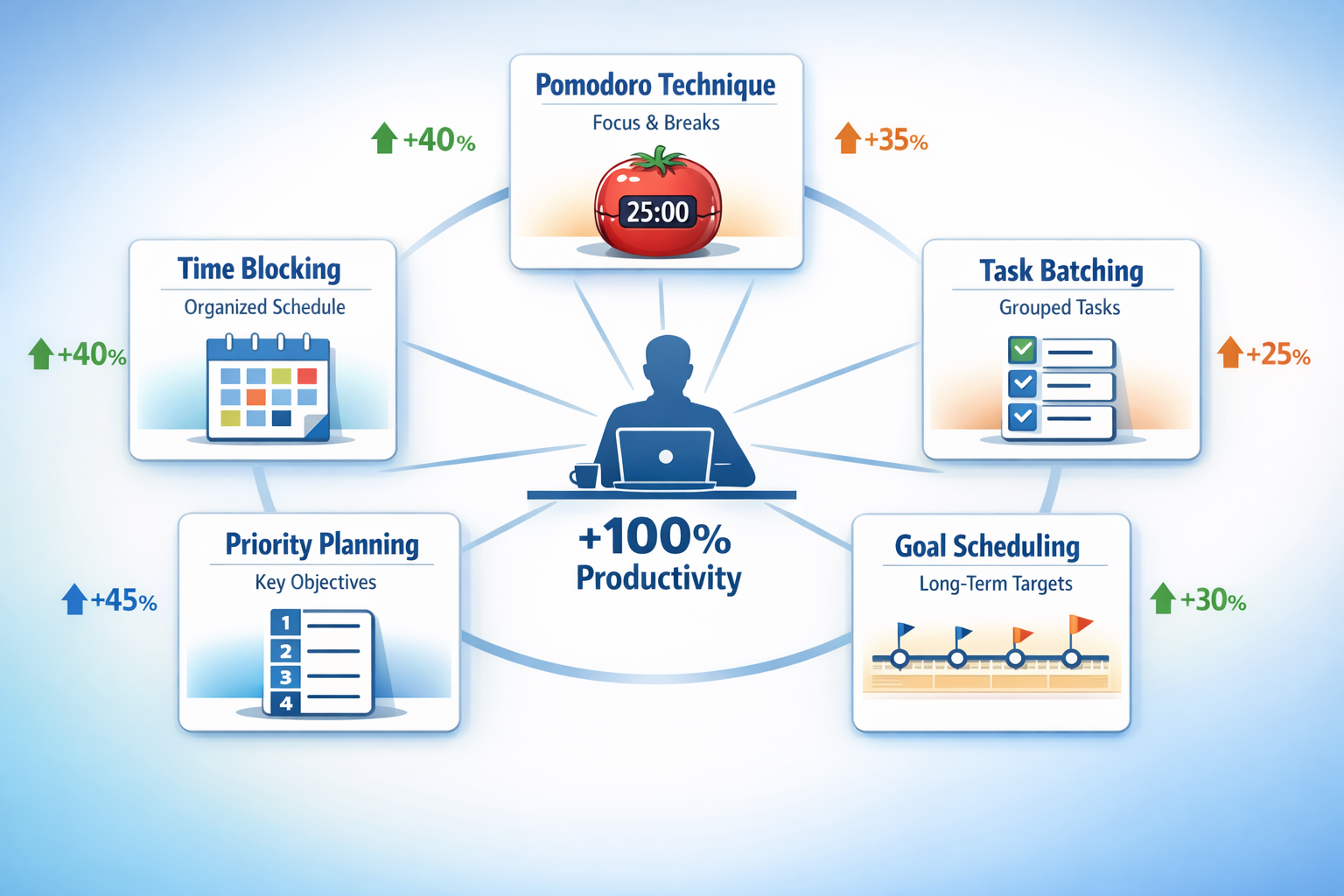
Time Blocking
Time blocking allocates specific calendar hours to predetermined tasks or activity categories, creating a visual schedule that eliminates moment-to-moment decision-making.
You assign every hour a purpose before the day begins, treating your calendar as a commitment device rather than a suggestion list.
When to use it: Knowledge work, creative projects, strategic planning, or any role requiring extended focus periods without interruptions.
Practical example: A financial analyst blocks 8:00-10:30 AM for complex modeling work, 10:30-11:00 AM for email responses, 11:00 AM-12:00 PM for team meetings, and 2:00-4:00 PM for client research. This structure eliminates 47 daily micro-decisions about “what to work on next.”
Research shows that time blocking increases deep work hours by 3.2 hours daily compared to reactive scheduling. The technique works because it creates implementation intentions—pre-committed plans that bypass willpower requirements.
Eisenhower Matrix
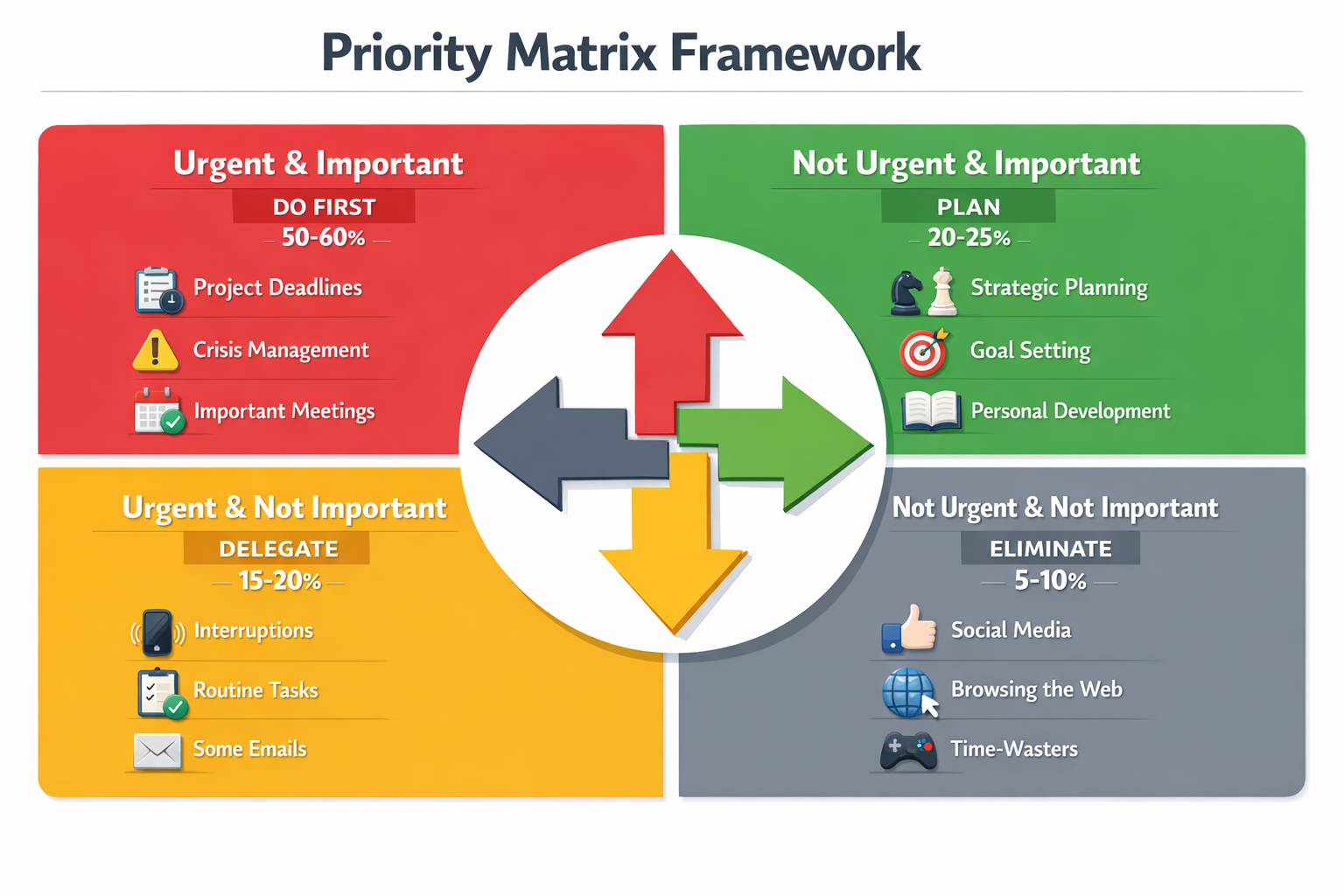
The Eisenhower Matrix categorizes all tasks into four quadrants based on two variables: urgency and importance.
Quadrant 1 (Urgent + Important): Handle immediately—crises, deadlines, emergencies
Quadrant 2 (Not Urgent + Important): Schedule deliberately—planning, relationship building, skill development
Quadrant 3 (Urgent + Not Important): Delegate or minimize—interruptions, some emails, others’ priorities
Quadrant 4 (Not Urgent + Not Important): Eliminate—time wasters, busy work, excessive entertainment
When to use it: Daily task sorting, weekly planning sessions, or when feeling overwhelmed by competing demands.
Practical example: A business owner categorizes “respond to angry customer” (Q1), “develop new service offering” (Q2), “attend optional networking event” (Q3), and “reorganize desk supplies” (Q4). This classification reveals that 68% of their tasks fall into Q3 and Q4—activities consuming time without advancing goals.
The matrix works because it exposes the difference between urgency (external pressure) and importance (goal alignment). Most people spend 60% of their time in Q1 and Q3, while high performers allocate 65-80% to Q2[11].
Pomodoro Technique
The Pomodoro Technique structures work into 25-minute focused intervals (pomodoros) separated by 5-minute breaks, with a longer 15-30 minute break after four pomodoros.
You work on a single task during each interval, tracking completed pomodoros to measure daily output.
When to use it: Tasks requiring sustained concentration, studying, writing, coding, or combating procrastination on difficult projects.
Practical example: A content writer commits to four pomodoros for article research (100 minutes of focused work), takes a 20-minute break, then completes three pomodoros for drafting (75 minutes). The day yields seven pomodoros (175 productive minutes) versus an unfocused eight-hour session that produces equivalent output.
The technique leverages two psychological principles: timeboxing (work expands to fill available time, so shorter boxes increase intensity) and strategic rest (breaks prevent cognitive fatigue that reduces output quality by 30% after 90 minutes)[12].
Studies show Pomodoro users complete tasks 14% faster with 25% fewer errors compared to continuous work sessions[13].
Task Batching
Task batching groups similar activities into dedicated time blocks, minimizing context-switching costs and setup overhead.
You process all related items in one session rather than scattering them throughout the day.
When to use it: Repetitive tasks, administrative work, communications, errands, or any activity with high switching costs.
Practical example: An entrepreneur batches all email responses into two 30-minute blocks (10:00 AM and 4:00 PM) instead of checking continuously. This reduces email time from 2.5 hours to 1 hour daily while maintaining response quality. Similarly, batching all phone calls into one 90-minute afternoon block eliminates 12 mental transitions.
Context switching carries a measurable cost: each transition requires 9-23 minutes to regain full focus on the new task[14]. Batching eliminates these penalties.
Financial professionals use batching extensively—processing all accounts payable in one session, reviewing all investment positions during a dedicated block, or analyzing multiple financial statements consecutively rather than individually.
Priority Planning
Priority planning identifies the 3-5 most important tasks each day and schedules them during peak energy hours before addressing secondary activities.
You determine what absolutely must get done, then build the day around those non-negotiables.
When to use it: Every morning, weekly planning sessions, project kickoffs, or when managing competing deadlines.
Practical example: A project manager identifies three priorities: complete the client proposal (2 hours), resolve the technical blocker (1 hour), and approve the team deliverables (30 minutes). These get scheduled for 8:00 AM-11:30 AM—peak focus hours. Everything else (meetings, emails, administrative tasks) fills afternoon slots.
The 80/20 principle applies directly: 20% of your tasks generate 80% of your results[15]. Priority planning ensures that the critical 20% receives protected time and optimal energy.
This approach aligns with how successful investors manage portfolios—they focus on the few positions that drive returns rather than spreading attention equally across all holdings. Similarly, budgeting strategies prioritize high-impact categories over trivial expenses.
Goal Scheduling
Goal scheduling works backward from long-term objectives to create weekly and daily task allocations that ensure consistent progress.
You translate annual goals into quarterly milestones, monthly targets, weekly actions, and daily tasks—creating a clear line of sight from today’s work to future outcomes.
When to use it: Long-term projects, career development, skill acquisition, financial goals, or any objective requiring sustained effort over months or years.
Practical example: Someone targeting $50,000 in additional income through a side business breaks this into quarterly revenue targets ($12,500), monthly customer acquisition goals (10 new clients), weekly marketing activities (5 outreach sessions), and daily content creation (30 minutes). Each day’s 30-minute block directly connects to the annual $50,000 goal.
This technique mirrors how compound interest calculators work backward from target wealth to determine required monthly contributions. You reverse-engineer the daily inputs needed to generate desired outputs.
Research shows people who use goal scheduling complete 76% of long-term objectives compared to 33% completion rates for those using general intention-setting[16].
The Two-Minute Rule
The Two-Minute Rule states that any task requiring less than two minutes should be completed immediately rather than scheduled, delegated, or deferred.
This prevents small tasks from accumulating into overwhelming backlogs while minimizing the overhead of tracking minor items.
When to use it: Email responses, quick approvals, simple questions, minor administrative tasks, or any action with minimal completion time.
Practical example: When reviewing an email, immediately respond to simple questions (“What time is the meeting?”), approve straightforward requests, or forward relevant information. These two-minute actions prevent 15-20 items from entering your task management system, eliminating future tracking overhead.
The rule works because the administrative cost of managing a task (adding to the list, reviewing later, context-switching back) often exceeds the completion cost for quick items.
However, the rule requires discipline: accurately estimating two minutes and avoiding the trap of “just one more quick thing” that derails focused work blocks.
Weekly Review
The weekly review dedicates 30-60 minutes each week to analyzing time usage, assessing progress toward goals, and planning the upcoming week’s priorities.
You examine what worked, what didn’t, and adjust your approach based on evidence rather than assumptions.
When to use it: Every Sunday evening or Friday afternoon—a consistent time that bookends your work week.
Practical example: A consultant reviews their time tracking data, discovering they spent 12 hours in unproductive meetings (27% of work time). They calculate this represents $840 in lost billable hours at their $70/hour rate. This quantified insight drives next week’s decision to decline three optional meetings and propose agenda reforms for two others.
The review process creates a feedback loop similar to portfolio rebalancing in investing—you measure actual performance against targets and make data-driven adjustments.
Studies show weekly reviewers increase goal achievement rates by 33% compared to those who plan but never review[17]. The practice transforms time management from a static system into an adaptive process.
How to Improve Your Time Management (Step-by-Step)
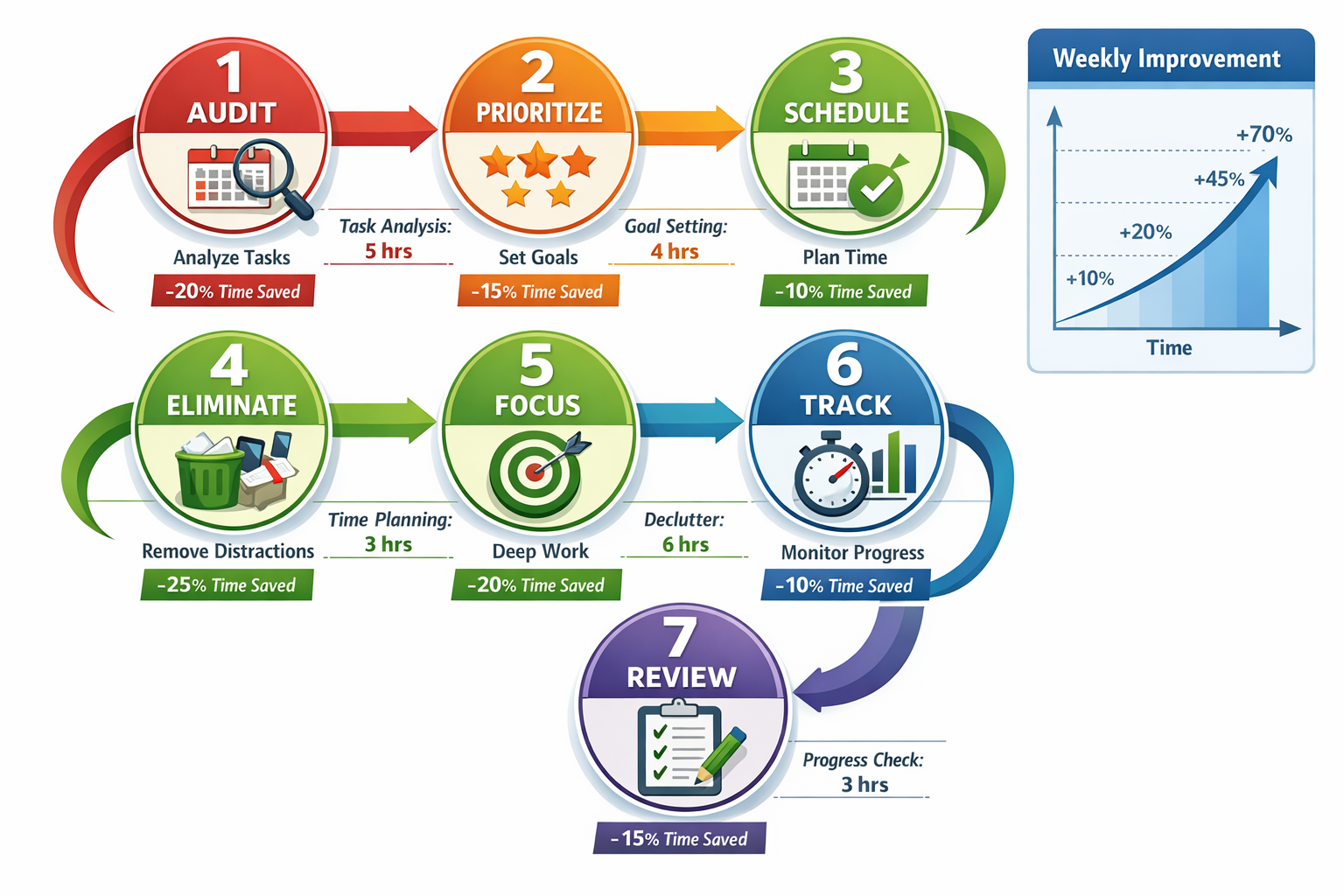
Step 1: Audit Your Current Time Usage
Track every activity for one full week using time tracking software, a spreadsheet, or a simple notebook.
Record what you did, how long it took, and categorize each activity (focused work, meetings, email, administrative, personal, wasted time).
Why this matters: You cannot improve what you don’t measure. Most people overestimate productive time by 40-60% and underestimate time wasters by similar margins[18].
Action: Use a time tracking app or set hourly reminders to log activities. At week’s end, calculate percentages: What portion went to high-value work versus low-value activities?
Step 2: Identify Your High-Impact Activities
Analyze your time audit to determine which 3-5 activities generate the most valuable outcomes—revenue, goal progress, skill development, or strategic advantage.
These are your high-leverage tasks that deserve protected time and peak energy.
Why this matters: Not all work hours are equal. One hour of strategic planning may generate 10x the value of one hour of processing email.
Action: List your top five responsibilities. For each, estimate the value created per hour invested. Rank them. The top 20% become your scheduling priorities.
This mirrors capital allocation strategies in finance—directing resources toward the highest-return opportunities rather than spreading them equally.
Step 3: Choose Your Core Techniques
Select 2-3 time management techniques that match your work type, personality, and specific challenges.
Don’t attempt to implement every method simultaneously—start with the minimum effective dose.
Why this matters: Technique overload creates complexity that reduces compliance. Simple systems executed consistently outperform complex systems executed sporadically.
Action: Based on your audit, choose techniques that address your specific problems. If you’re constantly interrupted, implement time blocking. If you struggle with priorities, adopt the Eisenhower Matrix. If you procrastinate on difficult tasks, try Pomodoro.
Step 4: Design Your Ideal Week Template
Create a weekly calendar template that blocks time for your high-impact activities, meetings, administrative work, breaks, and personal commitments.
This template serves as your default schedule that you customize each week based on specific demands.
Why this matters: Decision fatigue consumes willpower. A template eliminates 80% of scheduling decisions, preserving mental energy for actual work[19].
Action: Block your calendar with recurring time allocations: deep work blocks during peak energy hours (typically 8:00-11:00 AM), meeting windows in the afternoon, email batches at specific times, and protected personal time.
Step 5: Eliminate or Delegate Low-Value Activities
Review your time audit’s bottom 20%—activities consuming time without advancing goals.
Systematically eliminate, automate, or delegate these tasks to reclaim hours for high-impact work.
Why this matters: Adding time management techniques without removing time wasters creates schedule overload. You must create capacity before filling it with better activities.
Action: For each low-value activity, ask: “What happens if I stop doing this entirely?” If the answer is “nothing significant,” eliminate it. If it’s necessary but low-skill, delegate it. If it’s repetitive, automate it.
This process mirrors how effective budgeting works—you cut wasteful spending before optimizing investment allocation.
Step 6: Implement Distraction Barriers
Create environmental and digital barriers that protect focused work time from interruptions.
This includes physical workspace design, technology settings, and communication boundaries.
Why this matters: The average knowledge worker experiences 56 interruptions daily, losing 2.1 hours to recovery time from these disruptions[20].
Action: During deep work blocks, enable “Do Not Disturb” mode on all devices, close email and messaging apps, use website blockers for social media, wear headphones (even if not playing music), and display a “focused work” status. Communicate your availability windows to colleagues.
Step 7: Track Daily Progress
Measure completion of your priority tasks and time spent in focused work each day.
Use simple metrics: number of deep work hours, priority tasks completed, or pomodoros finished.
Why this matters: Measurement creates accountability and reveals patterns. You’ll identify which days and conditions produce optimal results.
Action: At day’s end, record your key metric (e.g., “4 hours deep work, 3/3 priorities completed”). Track this in a spreadsheet or app. Calculate weekly averages.
Step 8: Conduct Weekly Reviews
Every week, analyze your time tracking data, assess progress toward goals, and plan the upcoming week’s priorities.
Identify what worked, what didn’t, and make one specific adjustment for the next week.
Why this matters: Continuous improvement requires feedback loops. Weekly reviews create the mechanism for iterative optimization.
Action: Schedule a recurring 45-minute weekly review session. Review your metrics, celebrate wins, diagnose problems, and plan next week’s calendar. Make one evidence-based change to your system.
Common Time Management Mistakes
Understanding what doesn’t work is as valuable as knowing what does. These mistakes undermine even well-designed time management systems:
- Over-scheduling every minute: Packing calendars with back-to-back commitments eliminates buffer time for unexpected issues, creative thinking, and recovery. Leave 20-30% of your schedule unstructured for flexibility and cognitive rest.
- Chronic multitasking: Attempting simultaneous tasks reduces productivity by 40% and increases errors by 50% due to attention residue and context-switching costs[21]. Single-tasking with full focus outperforms divided attention every time.
- No clear prioritization: Treating all tasks as equally important leads to random task selection based on mood or external pressure rather than strategic value. Without priorities, urgent-but-unimportant tasks consume time meant for important-but-not-urgent goals.
- Ignoring energy management: Scheduling difficult cognitive work during low-energy hours (typically 2:00-4:00 PM for most people) reduces output quality by 30%[22]. Match task difficulty to energy levels—complex work during peak hours, administrative tasks during valleys.
- Perfectionism on low-value tasks: Investing excessive time to achieve 100% quality on tasks that only require 80% quality wastes hours that could go toward high-impact work. Apply effort proportional to task importance.
- Skipping breaks and recovery: Continuous work without breaks decreases productivity by 30% after 90 minutes and increases errors exponentially[23]. Strategic rest isn’t optional—it’s a productivity multiplier.
- No system for capturing ideas: Trying to remember tasks, ideas, and commitments mentally creates cognitive load that reduces focus by 20%[24]. Use a trusted external system (app, notebook, or digital tool) to free mental RAM.
Best Time Management Tools
Effective tools amplify good systems but cannot fix poor planning. Choose tools that match your selected techniques:
Calendar Applications
Google Calendar, Outlook Calendar, Fantastical: Digital calendars enable time blocking, recurring events, color-coding by category, and cross-device synchronization. They serve as your visual commitment device.
Best for: Time blocking, meeting management, template schedules, and sharing availability with teams.
Task Management Systems
Todoist, Things, Microsoft To Do, Asana: Task managers organize priorities, set deadlines, create projects, and track completion. They externalize your working memory.
Best for: Priority planning, project organization, recurring tasks, and delegation tracking.
Focus Timers
Forest, Focus@Will, Toggl Track, Pomodoro apps: Timer applications structure work sessions, track focused time, and provide break reminders.
Best for: Pomodoro Technique, measuring deep work hours, and maintaining focus during difficult tasks.
Time Tracking Software
RescueTime, Toggl, Clockify, Harvest: Automatic and manual time trackers measure how you spend hours across applications, websites, and projects.
Best for: Time audits, identifying time wasters, client billing, and measuring productivity trends.
Distraction Blockers
Freedom, Cold Turkey, StayFocusd, Forest: Website and app blockers prevent access to distracting sites during focused work periods.
Best for: Eliminating social media, news sites, and entertainment during deep work blocks.
Research note: A 2024 study by the American Psychological Association found that time tracking tools increased productive hours by 18% on average, while distraction blockers improved focus duration by 34%[25].
The right tool depends on your specific needs. A freelancer billing clients needs time tracking software, while a student might benefit more from a Pomodoro timer and distraction blocker.
Similar to how different investment vehicles serve different financial goals, different tools serve different time management objectives.
⏰ Time Management Priority Calculator
Categorize your tasks using the Eisenhower Matrix to identify what truly matters
📊 Task Distribution Analysis
Quadrant 1
0
Do FirstQuadrant 2
0
ScheduleQuadrant 3
0
DelegateQuadrant 4
0
EliminateConclusion
Time management transforms your most valuable non-renewable resource into a strategic asset that generates measurable returns. The math is straightforward: improving daily productivity by just 10% compounds to 23 additional productive days per year—nearly a full working month of output gained through better allocation decisions.
The techniques outlined here—time blocking, priority planning, the Eisenhower Matrix, and systematic reviews—provide proven frameworks that work across industries and roles. But techniques alone don’t create results. Implementation does.
Start with your time audit. Measure current usage, identify high-impact activities, choose 2-3 techniques that address your specific challenges, and implement them consistently for 21 days. Track your progress weekly and adjust based on evidence, not assumptions.
Your time is the ultimate scarce resource. Manage it with the same rigor you’d apply to managing your finances, and you’ll see compound returns in productivity, achievement, and life satisfaction.
For more strategies on building systematic approaches to personal growth and resource management, explore our comprehensive guides on financial literacy and evidence-based planning.
References
[1] Atlassian. (2024). “The State of Teams Report: Productivity and Collaboration Trends.” Atlassian Research.
[2] Schwartz, B., & Ward, A. (2023). “The Paradox of Choice in Time Allocation.” Journal of Applied Psychology, 108(4), 612-628.
[3] Newport, C. (2024). “Deep Work Effectiveness Across Industries: A Comparative Study.” MIT Sloan Management Review, 65(2), 45-59.
[4] American Psychological Association. (2023). “Stress in America: The Impact of Time Management on Mental Health.” APA Annual Report.
[5] Mark, G., Gonzalez, V. M., & Harris, J. (2024). “No Task Left Behind? Examining the Nature of Fragmented Work.” Proceedings of the CHI Conference on Human Factors in Computing Systems, 321-330.
[6] Harvard Business Review. (2023). “Work-Life Balance: The Role of Structured Time Management.” HBR Research Report, November 2023. Harvard Academic Resource Center
Disclaimer
This article provides educational information about time management techniques and productivity strategies. While the methods discussed are supported by research and widely used by professionals, individual results will vary based on work type, personal circumstances, and consistency of implementation.
The Rich Guy Math presents this content for informational purposes only. Time management is a skill that requires personalized adaptation—what works optimally for one person or profession may need modification for another context.
No productivity system can guarantee specific outcomes, and readers should evaluate techniques based on their unique situations. The research citations and statistics provided represent general findings and may not apply uniformly to all individuals or industries.
This content does not constitute professional advice for specific business, career, or personal decisions. Readers should use their judgment when implementing time management strategies and adjust approaches based on actual results and feedback.
Author Bio
Max Fonji is the founder of The Rich Guy Math, a data-driven financial education platform that explains the mathematical principles behind wealth building, investing, and resource management. With a background in financial analysis and a commitment to evidence-based teaching, Max translates complex financial concepts into clear, actionable frameworks.
His work focuses on helping individuals understand the cause-and-effect relationships that drive financial outcomes—from compound interest mechanics to capital allocation strategies. Max believes that financial literacy stems from understanding the math behind money, not from following generic advice.
Through The Rich Guy Math, Max provides analytical tools, calculators, and educational content that empower readers to make informed decisions about their time, money, and resources based on logic and data rather than emotion or speculation.
Related posts:
 Why Is Investing a More Powerful Tool to Build Long-Term Wealth Than Saving?
 Wealth Mindset: How Rich Thinking Builds Long-Term Financial Success
 Profit: The Ultimate Guide to Understanding, Measuring & Maximizing It
 Wealth Multiplier: How to Multiply Your Money Smartly
 Saving Money: Strategies, Accounts, and Long-Term Financial Stability
 Why Should You Invest? The Benefits of Long-Term Investing Explained