
The investing landscape has fundamentally shifted. Today’s investors want returns that align with their values, and ESG ETFs provide exactly that opportunity.
ESG ETFs are exchange-traded funds that invest in companies meeting specific Environmental, Social, and Governance criteria. These funds allow investors to build wealth while supporting businesses committed to sustainability, ethical labor practices, and responsible corporate leadership. For beginners seeking to understand how values-based investing works through data and evidence, ESG ETFs represent a practical entry point into responsible wealth building.
This guide explains the math behind ESG investing, how these funds operate, and the evidence-based framework for incorporating them into a diversified portfolio. If you’re new to investing, learning about ESG ETFs is an important step toward responsible investing—this article is part of our broader investing education framework.
Key Takeaways
- ESG ETFs screen companies based on environmental impact, social responsibility, and governance quality—not just financial metrics
- Lower costs than mutual funds make ESG ETFs accessible for beginners building long-term portfolios
- Diversification benefits allow exposure to hundreds of companies across sectors while maintaining ethical standards
- Performance data shows competitive returns compared to traditional ETFs, though results vary by fund and time period
- Greenwashing risks exist—understanding fund methodology and screening criteria is essential before investing
What Are ESG ETFs?
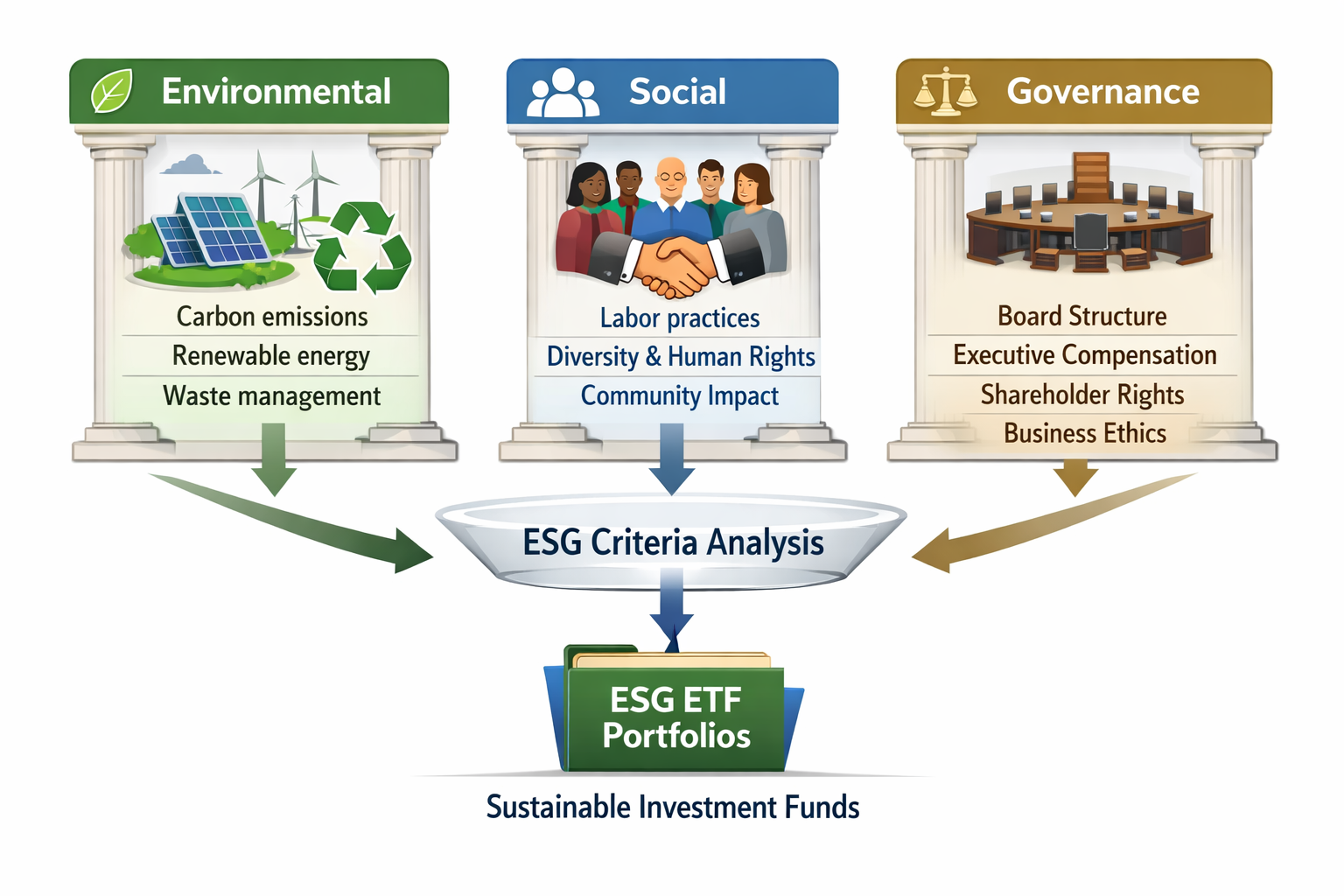
ESG stands for Environmental, Social, and Governance—three criteria used to evaluate companies beyond traditional financial metrics.
Environmental criteria examine how a company manages its impact on the natural world. This includes carbon emissions, energy efficiency, waste management, water usage, and commitment to renewable resources. Companies with strong environmental scores typically demonstrate measurable progress toward sustainability goals.
Social criteria assess how a company treats people. This covers labor practices, employee diversity and inclusion, workplace safety, community relations, human rights policies, and supply chain ethics. Companies score higher when they demonstrate fair treatment of workers and positive community impact.
Governance criteria evaluate corporate leadership and structure. This includes board composition, executive compensation alignment with performance, shareholder rights, transparency in financial reporting, and business ethics. Strong governance indicates management accountability and reduced risk of corporate scandals.
An exchange-traded fund (ETF) is an investment vehicle that holds a basket of securities, stocks, bonds, or other assets, and trades on stock exchanges like individual stocks. ETFs offer instant diversification because one share provides exposure to dozens or hundreds of underlying holdings.
ESG ETFs combine these concepts. These funds hold portfolios of companies that meet specific ESG standards while providing the liquidity, diversification, and cost efficiency of traditional ETFs. Instead of tracking broad market indices, ESG ETFs follow indices composed only of companies passing ESG screening criteria.
The screening process varies by fund provider. Some use negative screening (excluding companies in tobacco, weapons, or fossil fuels). Others employ positive screening (selecting companies leading their industries in ESG performance). Many funds combine both approaches with weighted scoring systems.
For a deeper understanding of how ETFs compare to other investment vehicles, explore our guide on the best ETFs to buy.
Takeaway: ESG ETFs provide diversified exposure to companies meeting measurable environmental, social, and governance standards while maintaining the structural benefits of exchange-traded funds.
How ESG ETFs Work
ESG ETFs operate through systematic processes that combine financial analysis with values-based screening.
Fund Structure and Company Selection
Most ESG ETFs follow a rules-based methodology:
Step 1: Universe Definition
The fund starts with a broad investment universe—typically all publicly traded companies in a specific market or sector. For example, a U.S. large-cap ESG ETF might begin with the 500 largest American companies.
Step 2: ESG Scoring
Independent rating agencies (MSCI, Sustainalytics, ISS ESG) assign scores to companies based on hundreds of data points. These scores measure performance across environmental, social, and governance categories. The scoring process examines:
- Carbon intensity and climate risk exposure
- Workplace diversity metrics and labor violation history
- Board independence and executive compensation structures
- Regulatory compliance and controversy records
Step 3: Screening and Exclusion
Companies failing minimum ESG thresholds get excluded. Common exclusions include:
- Fossil fuel producers and coal mining operations
- Tobacco manufacturers and distributors
- Weapons and defense contractors
- Companies with severe ESG controversies (environmental disasters, human rights violations, corruption scandals)
Step 4: Portfolio Construction
Remaining companies form the investable universe. The fund weights holdings based on market capitalization, ESG scores, or a combination of both factors.
Passive vs Active ESG ETFs
Passive ESG ETFs track predefined indices created by third-party providers. These funds automatically adjust holdings when the underlying index rebalances—typically quarterly or annually. Passive funds offer:
- Lower expense ratios (often 0.10% to 0.25%)
- Transparent methodology
- Predictable tracking of ESG benchmarks
Active ESG ETFs employ portfolio managers who select holdings based on proprietary research and ESG analysis. Active management allows:
- Deeper company-specific ESG due diligence
- Flexibility to respond to emerging ESG issues
- Potential for outperformance through security selection
Active ESG ETFs typically charge higher fees (0.40% to 0.75%) to cover research and management costs.
Fund Objectives and Index Tracking
ESG ETFs pursue different objectives:
- Broad market ESG exposure: Replicate traditional market indices while applying ESG filters
- Thematic ESG focus: Concentrate on specific themes like clean energy, gender diversity, or sustainable water
- Impact-oriented: Target measurable positive environmental or social outcomes alongside financial returns
Tracking error measures how closely a fund follows its benchmark index. Quality ESG ETFs maintain low tracking error (under 0.50% annually) while implementing ESG criteria.
Takeaway: ESG ETFs use systematic screening processes to build portfolios of companies meeting specific values-based criteria while maintaining the structural efficiency of index-based investing.
Benefits of ESG ETFs
ESG ETFs deliver multiple advantages that make them attractive for both value-driven and performance-focused investors.
Low-Cost Diversification
ESG ETFs provide instant exposure to hundreds of companies through a single investment. A typical broad-market ESG ETF holds 200-400 stocks across multiple sectors, reducing company-specific risk.
Cost comparison demonstrates the advantage:
- Average ESG ETF expense ratio: 0.20%
- Average actively managed ESG mutual fund: 0.75%
- Average traditional mutual fund: 1.00%
Over 30 years, a $10,000 investment growing at 8% annually faces dramatically different fee impacts:
- 0.20% fees: $96,600 final value
- 0.75% fees: $87,200 final value
- 1.00% fees: $83,400 final value
The 0.80% fee difference between ESG ETFs and traditional mutual funds costs investors $13,200 on a $10,000 initial investment—a 13.6% reduction in terminal wealth.
Ethical Investing Exposure
ESG ETFs align capital with values. Investors exclude industries they find objectionable while supporting companies demonstrating responsible practices.
This alignment creates psychological benefits. Research shows investors maintain discipline during market volatility when portfolios reflect personal values. The behavioral advantage reduces panic selling and improves long-term outcomes.
Long-Term Growth Potential
Evidence suggests ESG factors correlate with business quality and risk management. Companies with strong ESG profiles often demonstrate:
- Lower cost of capital due to reduced regulatory and reputational risk
- Higher employee productivity and retention from positive workplace cultures
- Reduced exposure to climate-related physical and transition risks
- Better governance structures that align management with shareholder interests
A 2020 meta-analysis of over 1,000 studies found that 58% showed positive correlations between ESG and financial performance, while only 8% showed negative correlations.[1]
Performance data from 2016 to 2026 shows many ESG ETFs matched or exceeded traditional broad-market returns. The MSCI USA ESG Select Index returned 12.4% annually versus 12.1% for the standard MSCI USA Index over this period.[2]
For investors focused on building wealth over decades, understanding compound growth remains essential regardless of ESG considerations.
Risk Management Through ESG Integration
ESG analysis identifies risks that traditional financial analysis might miss:
- Environmental risks: Climate change exposure, resource scarcity, pollution liabilities
- Social risks: Labor disputes, supply chain disruptions, consumer boycotts
- Governance risks: Fraud, corruption, misaligned incentives, poor capital allocation
Companies managing these risks effectively tend to experience fewer negative surprises that destroy shareholder value.
Accessibility for All Investors
ESG ETFs have no minimum investment requirements beyond the price of one share. Most trade between $30-$100 per share, making values-based investing accessible to beginners building portfolios gradually.
Fractional share trading at many brokerages further lowers barriers. Investors can purchase partial shares for as little as $1, enabling precise portfolio allocation regardless of account size.
Takeaway: ESG ETFs combine low costs, broad diversification, values alignment, and competitive long-term performance potential while providing accessible entry points for investors at all experience levels.
Risks and Limitations of ESG ETFs
ESG investing carries specific challenges that require investor awareness and due diligence.
Greenwashing and ESG Criteria Subjectivity
Greenwashing occurs when companies or funds exaggerate their ESG credentials without substantive practices to support claims.
The problem stems from inconsistent ESG definitions. No universal standard exists for what qualifies as “sustainable” or “responsible.” Different rating agencies assign vastly different ESG scores to the same companies:
- Tesla receives top ESG scores from some agencies for electric vehicle leadership
- Other agencies rate Tesla poorly due to workplace safety controversies and governance concerns
- The correlation between major ESG rating providers averages only 0.61—far lower than the 0.99 correlation between traditional credit rating agencies[3]
This inconsistency creates confusion. Two ESG ETFs can hold completely different portfolios while both claiming ESG focus.
Due diligence requirements:
- Review fund methodology documents to understand specific screening criteria
- Examine the top 10 holdings to verify alignment with personal values
- Check third-party ESG ratings for the fund itself (not just holdings)
- Verify whether the fund excludes specific industries important to you
Possible Underperformance vs Traditional ETFs
ESG screening reduces the investable universe. Excluding entire sectors (energy, defense, tobacco) creates concentration risk and potential tracking error versus broad market indices.
Historical performance challenges:
During 2021-2022, traditional energy stocks significantly outperformed the broader market as oil prices surged. ESG ETFs excluding fossil fuel companies underperformed by 5-8 percentage points during this period.[4]
The concentrated tech exposure in many ESG ETFs (due to high ESG scores for companies like Microsoft, Apple, and Alphabet) created volatility during the 2022 tech correction.
Sector concentration risk:
Many ESG ETFs are overweight technology (25-35% of portfolio) and underweight energy (0-3%) compared to broad market indices. This concentration amplifies sector-specific risks.
Understanding broader investment risks helps contextualize ESG-specific challenges within overall portfolio management.
Limited Selection of High-Quality ESG ETFs
While ESG ETF launches have accelerated, the category remains smaller than traditional ETF offerings:
- Over 3,000 total ETFs trade in U.S. markets
- Approximately 150 focus specifically on ESG criteria
- Only 30-40 have sufficient assets under management (over $500 million) to ensure liquidity and competitive pricing
Smaller funds face challenges:
- Higher expense ratios due to the inability to spread fixed costs across large asset bases
- Wider bid-ask spreads that increase trading costs
- Tracking error from less efficient portfolio construction
- Closure risk if assets decline below viable operating levels
Lack of Standardization and Transparency
ESG fund marketing often uses vague language. Terms like “sustainable,” “responsible,” and “impact” lack precise definitions, making comparison difficult.
Some funds engage in “ESG-lite” approaches:
- Excluding only the most controversial 5-10% of companies
- Applying minimal ESG screens that don’t meaningfully change portfolio composition
- Marketing traditional funds with minor ESG overlays as dedicated ESG products
The SEC has proposed rules requiring standardized ESG fund disclosures, but as of 2026, enforcement remains inconsistent.[5]
Potential for Values Misalignment
Even well-constructed ESG ETFs may hold companies some investors find objectionable. A fund might:
- Include defense contractors that don’t manufacture controversial weapons
- Hold companies with improving but still imperfect ESG scores
- Invest in industries like alcohol or gambling not universally excluded
Investors must verify specific holdings match personal values rather than assuming the “ESG” label guarantees alignment.
Takeaway: ESG ETFs face challenges, including inconsistent standards, potential underperformance during specific market conditions, limited high-quality options, and risks of greenwashing that require careful fund selection and ongoing monitoring.
ESG ETFs vs Traditional ETFs
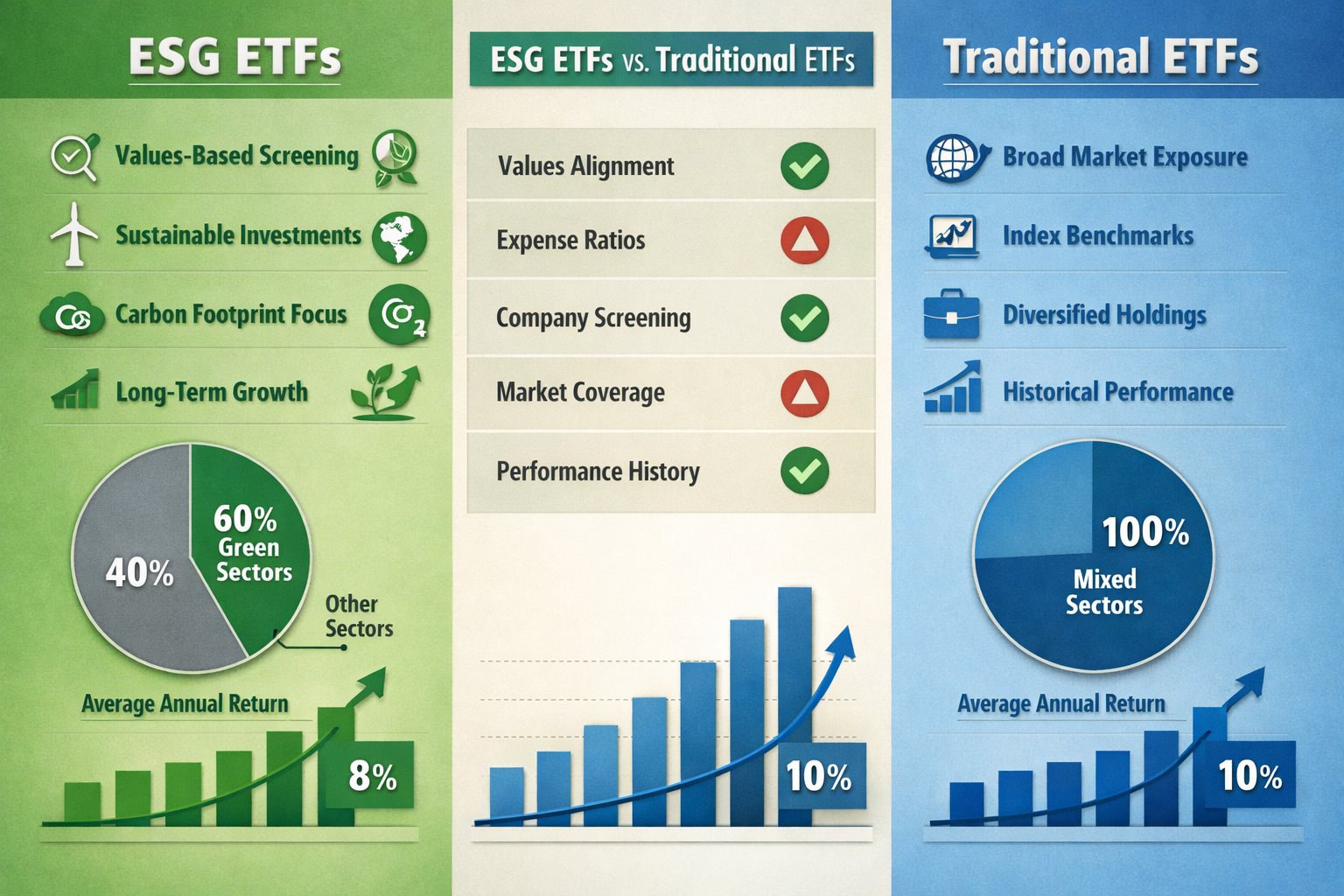
Understanding the differences between ESG and traditional ETFs helps investors make informed allocation decisions.
| Feature | ESG ETF | Traditional ETF |
|---|---|---|
| Screening Criteria | Applies environmental, social, and governance filters to exclude companies failing ESG standards | No values-based screening; includes all companies meeting market cap or sector criteria |
| Investment Universe | Reduced universe (typically 200-400 companies after screening) | Full market exposure (500-3,000+ companies depending on index) |
| Expense Ratio | 0.15% – 0.50% (slightly higher due to ESG research costs) | 0.03% – 0.20% (lowest costs for broad market indices) |
| Sector Exposure | Underweight or excludes energy, defense, tobacco; overweight technology, healthcare | Market-cap weighted across all sectors |
| Performance Drivers | Company ESG quality, sector tilts, screening methodology | Broad market returns, pure capitalization weighting |
| Liquidity | Moderate to high (lower for smaller ESG funds) | Very high (especially for large-cap broad market funds) |
| Diversification | Good but reduced due to exclusions | Maximum diversification across available securities |
| Values Alignment | Good, but reduced due to exclusions | No values consideration; purely financial optimization |
Performance Comparison: The Evidence
Long-term performance data shows ESG ETFs can compete with traditional counterparts, though results vary by time period and market conditions.
2016-2026 annualized returns (representative funds):
- MSCI USA ESG Select ETF: 12.4%
- S&P 500 Index Fund: 12.1%
- MSCI World ESG Leaders: 11.8%
- MSCI World Index: 11.5%
However, shorter periods show divergence:
2021 (energy rally year):
- S&P 500 Index: +28.7%
- S&P 500 ESG Index: +24.3%
2022 (tech correction year):
- S&P 500 Index: -18.1%
- S&P 500 ESG Index: -19.6%
The evidence suggests ESG screening doesn’t inherently reduce returns over full market cycles, but creates different risk exposures that affect performance during specific market environments.
Cost-Benefit Analysis
The typical 0.10% – 0.20% expense ratio premium for ESG ETFs costs investors:
On $100,000 invested over 30 years at 8% annual returns:
- 0.05% traditional ETF fee: $943,000 final value
- 0.20% ESG ETF fee: $920,000 final value
- Cost of ESG screening: $23,000 (2.4% of terminal wealth)
Investors must decide whether value alignment and potential ESG risk mitigation justify this cost.
For context on how different investment strategies compare across various dimensions, exploring automated investment platforms provides an additional perspective.
When to Choose ESG ETFs
ESG ETFs make sense for investors who:
- Prioritize values alignment and want portfolios reflecting environmental or social commitments
- Believe ESG factors predict risk and prefer companies managing these issues proactively
- Accept modest cost premiums (0.10% – 0.20%) for screening and research
- Have long-term horizons that allow ESG factors to influence business outcomes
- Want a simple implementation of values-based investing without individual stock research
Traditional ETFs remain appropriate for investors who:
- Prioritize the absolute lowest costs and maximum tax efficiency
- Want pure market exposure without values-based exclusions
- Prefer maximum diversification across all sectors and industries
- Focus exclusively on financial metrics in investment decisions
Takeaway: ESG ETFs trade modest cost increases and sector concentration for values alignment and ESG risk management, while traditional ETFs maximize diversification and minimize costs through unrestricted market exposure.
How to Invest in ESG ETFs: A Step-by-Step Guide
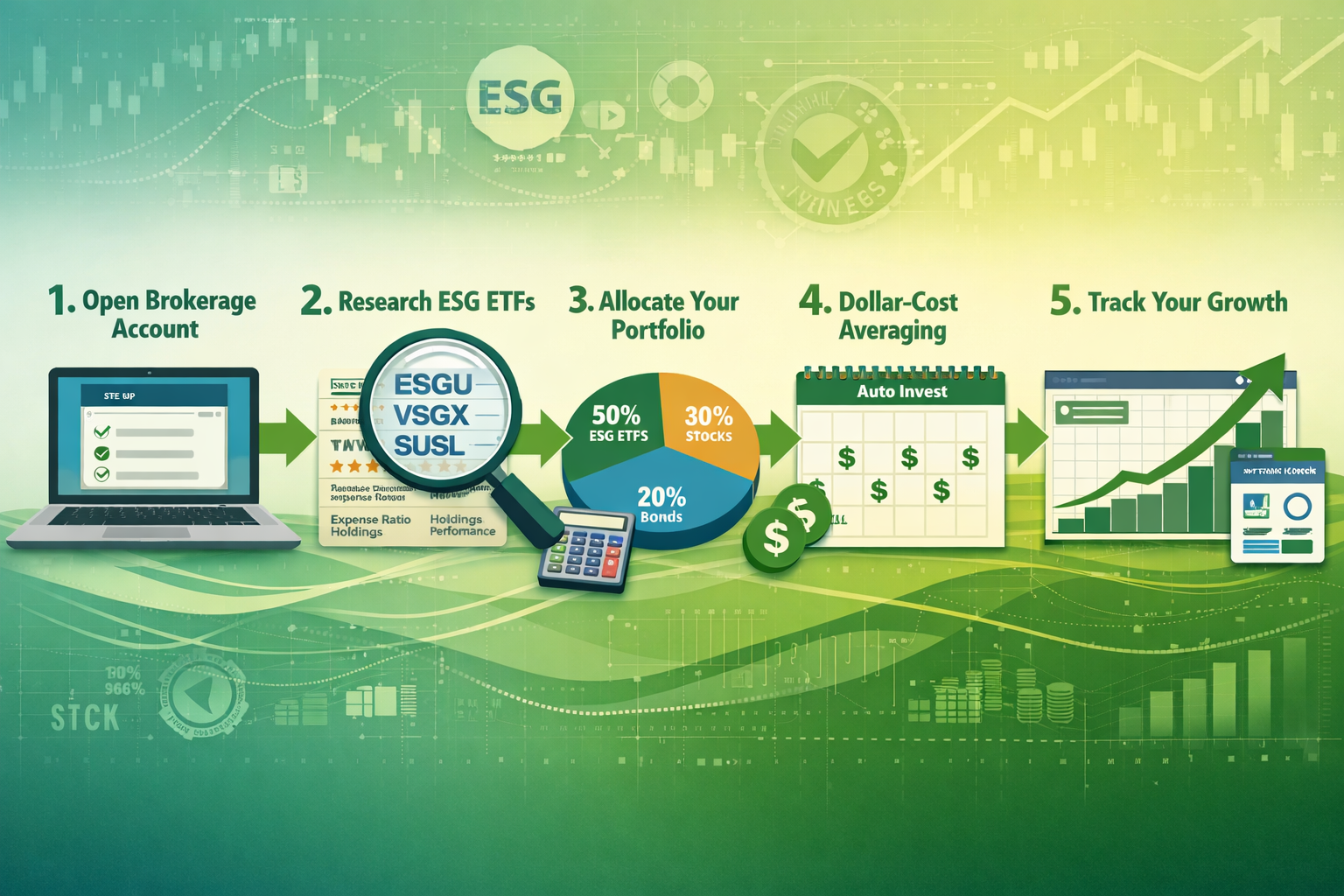
Implementing ESG ETF investing requires systematic research and portfolio construction.
Step 1: Open a Brokerage Account
ESG ETFs trade on major stock exchanges, requiring a brokerage account for purchase.
Choosing a broker:
- Commission-free trading: Most major brokers (Fidelity, Charles Schwab, Vanguard, E*TRADE) eliminated stock and ETF trading commissions
- Account minimums: Many brokers require no minimum deposit to open accounts
- Fractional shares: Platforms like Fidelity and Schwab allow purchasing partial ETF shares
- Research tools: Quality brokers provide ESG fund screening tools and analysis
Account types matter:
- Taxable brokerage accounts: Maximum flexibility but no tax advantages
- Traditional IRAs: Tax-deferred growth; contributions may be tax-deductible
- Roth IRAs: Tax-free growth and withdrawals in retirement
- 401(k) plans: Some employers now offer ESG fund options in retirement plans
For beginners establishing investment accounts, our comprehensive investing for beginners guide provides foundational guidance on account selection and setup.
Step 2: Research ESG ETFs
Not all ESG ETFs are created equal. Systematic research identifies funds matching your objectives.
Key research criteria:
Expense Ratio:
Lower costs compound to significant savings over decades. Target funds charge under 0.25% annually. Compare similar funds—a 0.15% difference in fees costs $45,000 on a $100,000 portfolio over 30 years.
ESG Methodology:
Review fund prospectuses to understand:
- Which ESG rating provider does the fund use (MSCI, Sustainalytics, ISS)
- Screening approach (negative exclusions, positive selection, or both)
- Specific industries excluded
- Weighting methodology (market-cap, ESG-score, or hybrid)
Holdings Analysis:
Examine top 10 holdings (typically 20-30% of fund assets). Verify these companies align with your values. Check for controversial holdings that might conflict with your ESG priorities.
Performance History:
Review 3-year, 5-year, and 10-year returns (if available). Compare against:
- Relevant traditional benchmark (S&P 500 for large-cap U.S. funds)
- Peer ESG funds with similar strategies
- Fund’s stated benchmark index
Assets Under Management (AUM):
Larger funds (over $500 million in assets) typically offer:
- Better liquidity and tighter bid-ask spreads
- Lower closure risk
- More efficient portfolio management
Popular ESG ETF categories:
- Broad U.S. market: ESGU (iShares ESG Aware MSCI USA), VSGX (Vanguard ESG U.S. Stock)
- International developed: VSGX (Vanguard ESG International Stock)
- Emerging markets: ESGE (iShares ESG Aware MSCI EM)
- Thematic ESG: ICLN (iShares Global Clean Energy), SHE (SPDR Gender Diversity Index)
For comparison with other investment vehicles, explore our analysis of the best dividend ETFs to understand how ESG funds compare to income-focused alternatives.
Step 3: Decide Portfolio Allocation
ESG ETFs should fit within a comprehensive asset allocation strategy.
Allocation approaches:
100% ESG Portfolio:
Some investors commit entirely to ESG investing across all holdings. This approach maximizes value alignment but limits the investment universe and may increase concentration risk.
Core-Satellite Strategy:
- Core holdings (70-80%): Broad market traditional ETFs for maximum diversification and low costs
- Satellite holdings (20-30%): ESG ETFs providing values alignment and thematic exposure
Gradual Transition:
Start with a 10-20% ESG allocation and increase over time as you evaluate performance and comfort level.
Asset class considerations:
ESG principles apply across asset classes:
- U.S. stocks: 40-50% of equity allocation
- International stocks: 20-30% of equity allocation
- Bonds: ESG bond ETFs (green bonds, social bonds) for fixed income exposure
- Real estate: ESG-focused REIT ETFs for property exposure
Understanding how different allocations affect long-term outcomes connects to broader principles of the 4% rule through systematic investment.
Step 4: Execute Your Purchase
Once you’ve selected funds and determined allocation, execute trades through your brokerage platform.
Market orders vs. limit orders:
- Market orders: Execute immediately at the current market price; use for liquid ETFs with tight spreads
- Limit orders: Specify maximum purchase price; use for smaller ETFs with wider spreads to control costs
Bid-ask spreads matter:
The spread represents the difference between buying and selling prices. A $50 ETF with a $0.05 spread (0.10%) costs less to trade than one with a $0.25 spread (0.50%).
Timing considerations:
Avoid trading in the first and last 15 minutes of market sessions when spreads widen. Mid-day trading (10:30 AM – 3:30 PM Eastern) typically offers the best execution.
Step 5: Implement Dollar-Cost Averaging or Lump-Sum Investment
Two primary approaches exist for funding ESG ETF positions:
Dollar-Cost Averaging (DCA):
Invest fixed amounts at regular intervals (monthly, quarterly) regardless of market conditions.
Advantages:
- Reduces timing risk by spreading purchases across market cycles
- Psychologically easier for beginners nervous about market volatility
- Automates investing discipline
Disadvantages:
- Historically underperforms lump-sum investing about 66% of the time
- Keeps capital in cash, earning lower returns duringthe investment period
- Creates more taxable events in taxable accounts
Lump-Sum Investing:
Invest available capital immediately in full allocation.
Advantages:
- Maximizes time in market, capturing an average 10% annual equity returns
- Reduces transaction complexity
- Historically superior returns in rising markets
Disadvantages:
- Requires emotional discipline to invest large amounts during uncertainty
- Exposes the entire investment to immediate market risk
- Can lead to regret if the market declines shortly after the investment
Research shows lump-sum investing outperforms dollar-cost averaging in approximately 68% of 10-year periods, with an average outperformance of 2.3% annually.[6]
For a detailed analysis of these approaches, see our comparison of dollar-cost averaging strategies vs lump-sum investing.
Step 6: Monitor and Rebalance
ESG ETFs require periodic review to maintain alignment with objectives.
Quarterly review checklist:
- Verify fund holdings haven’t changed dramatically
- Check for ESG controversies involving top holdings
- Review performance versus benchmark and peer funds
- Confirm expense ratios haven’t increased
Annual rebalancing:
Market movements shift portfolio allocations over time. If your target allocation is 60% stocks / 40% bonds, strong equity performance might shift this to 70% / 30%.
Rebalancing process:
- Calculate current allocation percentages
- Compared to the target allocation
- Sell overweighted assets and buy underweighted assets to restore targets
- Consider tax implications in taxable accounts (harvest losses, avoid short-term gains)
Tax-loss harvesting opportunities:
When ESG ETF positions decline, sell at a loss to offset capital gains elsewhere. Immediately purchase a similar (but not substantially identical) ESG ETF to maintain market exposure while capturing the tax benefit.
Takeaway: Successful ESG ETF investing follows a systematic process—open appropriate accounts, research funds thoroughly, determine strategic allocation, execute efficiently, choose an investment timing approach, and maintain discipline through regular monitoring and rebalancing.
Popular ESG ETF Options in 2026
Understanding specific fund options helps investors make informed selections.
Broad Market ESG ETFs
iShares ESG Aware MSCI USA ETF (ESGU)
- Assets: $15.2 billion
- Expense ratio: 0.15%
- Methodology: Optimizes ESG characteristics while maintaining similar sector weights and risk profile to parent MSCI USA Index
- Holdings: 300+ companies, including Microsoft, Apple, Alphabet, Amazon
- Best for: Investors wantingan ESG tilt without significant tracking error versus the broad market
Vanguard ESG U.S. Stock ETF (ESGV)
- Assets: $8.7 billion
- Expense ratio: 0.09%
- Methodology: Excludes companies in adult entertainment, alcohol, tobacco, weapons, fossil fuels, gambling, and nuclear power
- Holdings: 1,400+ companies providing broad diversification
- Best for: Cost-conscious investors seeking extensive diversification with basic ESG screening
International ESG ETFs
iShares MSCI EAFE ESG Optimized ETF (ESGD)
- Assets: $3.1 billion
- Expense ratio: 0.20%
- Coverage: Developed markets (Europe, Australasia, Far East)
- Holdings: 600+ international companies
- Best for: International diversification with ESG criteria
Thematic ESG ETFs
iShares Global Clean Energy ETF (ICLN)
- Assets: $4.8 billion
- Expense ratio: 0.42%
- Focus: Solar, wind, and renewable energy companies globally
- Volatility: Higher than the broad market due to sector concentration
- Best for: Aggressive investors with strong climate change convictions
SPDR SSGA Gender Diversity Index ETF (SHE)
- Assets: $420 million
- Expense ratio: 0.20%
- Focus: U.S. companies with the highest gender diversity in leadership
- Methodology: Selects companies with the most women in senior positions
- Best for: Investors prioritizing workplace diversity
ESG Bond ETFs
iShares ESG Aware U.S. Aggregate Bond ETF (EAGG)
- Assets: $1.2 billion
- Expense ratio: 0.10%
- Holdings: Investment-grade U.S. bonds with ESG screening
- Best for: Fixed income allocation with ESG criteria
Takeaway: ESG ETF selection should match investment objectives, with broad-market funds providing diversified core exposure and thematic funds offering concentrated value-based positioning for satellite allocations.
Tax Implications of ESG ETF Investing
Understanding tax treatment optimizes after-tax returns.
Tax Efficiency of ETFs
ETFs enjoy structural tax advantages over mutual funds due to the “in-kind” creation and redemption process.
How it works:
When investors sell mutual fund shares, the fund may need to sell underlying securities to raise cash, triggering capital gains distributed to all shareholders. ETFs avoid this through in-kind transfers with authorized participants, deferring capital gains until investors sell shares.
Result: ETFs typically distribute fewer capital gains than comparable mutual funds.
2016-2026 average annual capital gains distributions:
- Actively managed mutual funds: 4.2% of NAV
- Index mutual funds: 0.8% of NAV
- ETFs: 0.3% of NAV[7]
Dividend Taxation
ESG ETFs distribute dividends from underlying holdings. Tax treatment depends on dividend classification:
Qualified dividends:
- Taxed at long-term capital gains rates (0%, 15%, or 20%, depending on income)
- Must meet holding period requirements (60+ days)
- Most U.S. corporate dividends qualify
Ordinary dividends:
- Taxed at ordinary income rates (10% – 37%)
- Includes REITs, foreign dividends without tax treaties, and short-term holdings
Capital Gains Treatment
Profits from selling ESG ETF shares receive capital gains treatment:
Short-term capital gains (held < 1 year):
- Taxed as ordinary income (10% – 37%)
Long-term capital gains (held ≥ 1 year):
- Taxed at preferential rates (0%, 15%, or 20%)
Tax optimization strategies:
- Hold in tax-advantaged accounts: IRAs and 401(k)s eliminate annual dividend and capital gains taxes
- Harvest tax losses: Sell declining positions to offset gains elsewhere
- Donate appreciated shares: Deduct fair market value while avoiding capital gains tax
- Hold for long-term treatment: Wait 12+ months before selling to access lower rates
For a broader context on tax-efficient wealth building, understanding capital gains tax strategies provides an essential foundation.
Takeaway: ESG ETFs offer superior tax efficiency compared to mutual funds, but investors should optimize holding location and selling strategy to minimize tax drag on long-term returns.
Common Mistakes to Avoid When Investing in ESG ETFs
Learning from common errors improves outcomes.
Mistake 1: Assuming “ESG” Guarantees Values Alignment
The ESG label doesn’t ensure a fund matches your specific values. Always review actual holdings.
Solution: Download the fund’s complete holdings list (available on fund websites) and verify the top 20-30 positions align with your priorities.
Mistake 2: Ignoring Expense Ratios
A 0.50% expense ratio versus 0.15% costs $105,000 on a $100,000 investment over 30 years at 8% returns.
Solution: Compare expense ratios among similar ESG funds. Avoid paying premium fees for similar exposure.
Mistake 3: Chasing Recent Performance
Thematic ESG ETFs (clean energy, gender diversity) experience boom-bust cycles. Buying after a strong performance often precedes underperformance.
Example: Clean energy ETFs surged 140% in 2020, then declined 35% in 2021 as investors rotated to value stocks.
Solution: Focus on long-term fundamentals and strategic allocation rather than recent returns.
Mistake 4: Overlooking Diversification
Concentrating exclusively in ESG ETFs without traditional diversification creates unnecessary risk.
Solution: Maintain balanced exposure across:
- Domestic and international stocks
- Large-cap and small-cap companies
- Stocks and bonds
- ESG and traditional funds (if appropriate for your strategy)
Mistake 5: Failing to Rebalance
Market movements shift allocations away from targets, increasing risk or reducing returns.
Solution: Rebalance annually or when allocations drift 5+ percentage points from targets.
Mistake 6: Trading Too Frequently
Excessive trading generates costs and taxes while reducing returns.
Research shows: The average investor underperforms buy-and-hold strategies by 2-3% annually due to poor timing.[8]
Solution: Establish allocation, execute plan, and maintain discipline through market cycles.
Takeaway: Avoiding common mistakes, assuming ESG labels guarantee alignment, ignoring costs, chasing performance, lacking diversification, neglecting rebalancing, and overtrading significantly improve long-term ESG investing outcomes.
The Future of ESG Investing
ESG investing continues evolving as regulatory frameworks develop and investor demand grows.
Regulatory Developments
SEC ESG Disclosure Rules:
The Securities and Exchange Commission proposed standardized ESG fund disclosure requirements in 2022, with final rules expected in 2026-2027. These regulations will require:
- Clear fund naming conventions (funds using “ESG” must apply substantial ESG criteria)
- Detailed methodology disclosures in prospectuses
- Annual reporting on ESG metrics and portfolio impact
International Standards:
The European Union’s Sustainable Finance Disclosure Regulation (SFDR) established a classification for ESG funds in 2021, creating precedent for global standardization.
Growing Institutional Adoption
Institutional investors increasingly incorporate ESG factors:
- 79% of institutional investors consider ESG in investment decisions (up from 48% in 2017)[9]
- $35 trillion in global assets under management apply ESG criteria (2026 estimate)
- Major pension funds (CalPERS, New York State Common) mandate ESG integration
Technology and Data Improvements
ESG analysis benefits from technological advancement:
Satellite imagery tracks corporate environmental impact in real-time (deforestation, emissions, water usage)
Natural language processing analyzes corporate disclosures, news, and social media for ESG controversies
Blockchain verification enables transparent supply chain tracking for social and environmental claims
These tools reduce greenwashing and improve ESG data quality.
Climate Change as Investment Risk
Physical climate risks (extreme weather, sea-level rise) and transition risks (policy changes, technology disruption) increasingly affect company valuations.
ESG ETFs focusing on climate resilience and low-carbon business models position investors for this transition.
Takeaway: ESG investing will continue maturing through improved regulation, institutional adoption, better data and technology, and increasing recognition of climate-related financial risks.
💚 ESG ETF Cost Comparison Calculator
Compare long-term costs between ESG and traditional ETFs
📊 Investment Comparison Results
| Metric | ESG ETF | Traditional ETF |
|---|---|---|
| Total Contributions | $0 | $0 |
| Total Growth | $0 | $0 |
| Total Fees Paid | $0 | $0 |
| Effective Annual Return | 0% | 0% |
| Fee Impact on Returns | 0% | 0% |
💡 Insight: This calculator demonstrates the long-term cost impact of expense ratio differences between ESG and traditional ETFs. While ESG ETFs typically charge 0.10%-0.20% more than traditional alternatives, the actual dollar impact depends on your investment amount and time horizon. Consider whether values alignment and ESG risk management justify this cost for your specific situation.
Conclusion
ESG ETFs provide a practical framework for aligning investment portfolios with environmental, social, and governance values while pursuing competitive long-term returns. These funds combine the structural advantages of ETFs—low costs, tax efficiency, liquidity, and diversification—with systematic screening processes that exclude companies failing ESG standards.
The evidence shows ESG investing doesn’t require sacrificing returns. While specific market conditions create performance divergence, long-term data demonstrates ESG ETFs can match or exceed traditional benchmarks when properly selected and managed.
Success requires systematic research to identify funds with transparent methodologies, reasonable costs, and holdings matching personal values. Investors must remain aware of greenwashing risks, sector concentration effects, and the subjective nature of ESG ratings while maintaining disciplined allocation and rebalancing practices.
ESG ETFs work best as components of diversified portfolios constructed around clear financial goals and risk tolerance. Whether implementing a 100% ESG approach or using ESG funds as satellite positions within broader allocations, the key is matching fund selection to specific objectives while controlling costs and maintaining a long-term perspective.
To learn more about investing fundamentals and building a diversified portfolio that aligns with your values and financial goals, explore our comprehensive investing education hub.
Disclaimer
This article provides educational information about ESG ETFs and should not be considered personalized investment advice. Investing involves risk, including potential loss of principal. Past performance does not guarantee future results.
ESG investing involves subjective criteria that vary by fund provider. No standardized definition of “sustainable,” “responsible,” or “ESG” exists, and funds marketed with these terms may hold different portfolios and pursue different objectives.
Before investing in ESG ETFs, consider your financial situation, investment objectives, risk tolerance, and time horizon. Review fund prospectuses, which contain detailed information about investment objectives, risks, fees, and expenses. Consult with qualified financial, tax, and legal professionals regarding your specific circumstances.
The author and The Rich Guy Math are not registered investment advisors and do not provide personalized investment recommendations. All investment decisions remain the sole responsibility of individual investors.
Author Bio
Max Fonji is the founder of The Rich Guy Math, a data-driven financial education platform that explains the mathematics behind wealth building, investing, and risk management. With a background in financial analysis and a commitment to evidence-based investing education, Max breaks down complex financial concepts into clear, actionable frameworks that empower readers to make informed decisions.
Max’s approach combines quantitative analysis with practical application, helping investors understand not just what to do, but why specific strategies work through numbers, logic, and empirical evidence. His work focuses on financial literacy, valuation principles, and systematic wealth-building strategies accessible to investors at all experience levels.
References
[1] Friede, G., Busch, T., & Bassen, A. (2015). “ESG and financial performance: aggregated evidence from more than 2000 empirical studies.” Journal of Sustainable Finance & Investment, 5(4), 210-233.
[2] MSCI. (2026). “MSCI USA ESG Select Index Performance Report.” MSCI Index Performance Data.
[3] Berg, F., Koelbel, J. F., & Rigobon, R. (2022). “Aggregate Confusion: The Divergence of ESG Ratings.” Review of Finance, 26(6), 1315-1344.
[4] Morningstar. (2022). “Sustainable Funds U.S. Landscape Report.” Morningstar Research. www.morningstar.com
[5] U.S. Securities and Exchange Commission. (2025). “Enhanced Disclosures by Certain Investment Advisers and Investment Companies about Environmental, Social, and Governance Investment Practices.” Federal Register. www.sec.gov
[6] Vanguard Research. (2016). “Dollar-cost averaging just means taking risk later.” Vanguard Investment Strategy Group. investor.vanguard.com
[7] Morningstar. (2026). “Tax Cost Ratio Analysis: ETFs vs. Mutual Funds.” Morningstar Direct Database. www.morningstar.com
[8] Barber, B. M., & Odean, T. (2000). “Trading Is Hazardous to Your Wealth: The Common Stock Investment Performance of Individual Investors.” The Journal of Finance, 55(2), 773-806.
[9] CFA Institute. (2025). “Future of Sustainability in Investment Management.” CFA Institute Research Foundation. www.cfainstitute.org
Frequently Asked Questions About ESG ETFs
Are ESG ETFs profitable?
Yes, ESG ETFs can be profitable and have demonstrated competitive long-term returns compared to traditional ETFs. Historical data from 2016–2026 shows many broad-market ESG ETFs matched or slightly exceeded traditional benchmark returns, with the MSCI USA ESG Select Index returning 12.4% annually versus 12.1% for the standard MSCI USA Index.
Performance varies by fund and market cycle. ESG ETFs excluding energy stocks underperformed during 2021–2022 when oil prices surged, while outperforming during periods led by technology stocks, which many ESG funds overweight.
Long-term profitability depends more on expense ratios, diversification, and consistent investing discipline than ESG screening itself. Low-cost, diversified ESG ETFs with transparent methodologies offer competitive return potential while aligning with investor values.
How do I pick the right ESG ETF?
Selecting the right ESG ETF requires evaluating several factors:
- Define your ESG priorities: Identify which issues matter most, such as climate impact, labor practices, or governance.
- Review methodology: Read the prospectus to understand screening criteria, ESG data providers, and exclusion policies.
- Analyze holdings: Review the top holdings to confirm companies align with your expectations.
- Compare costs: Target expense ratios below 0.25% for broad-market ESG ETFs.
- Evaluate size and liquidity: Prefer funds with at least $500 million in assets.
- Assess performance: Compare 3- and 5-year returns against relevant benchmarks.
- Verify transparency: Choose funds with clear reporting on ESG metrics and portfolio composition.
For most investors, broad-market ESG ETFs from major providers like Vanguard, iShares, and State Street offer the best balance of cost, diversification, and transparency.
Can ESG ETFs outperform traditional ETFs?
ESG ETFs can outperform traditional ETFs, but performance differences are usually modest and vary by market cycle rather than showing consistent outperformance.
Potential advantages include:
- Stronger risk management and resilience during market downturns
- Exposure to high-quality businesses with sustainable competitive advantages
- Reduced regulatory and reputational risk
Potential disadvantages include:
- Reduced investable universe
- Sector concentration risk
- Higher expense ratios for some funds
Research shows no consistent performance penalty for ESG investing. Investors should expect competitive returns with different risk characteristics rather than guaranteed outperformance.
What’s the difference between ESG ETFs and socially responsible investing (SRI)?
ESG investing evaluates environmental, social, and governance factors as financial risk indicators, integrating them into investment analysis to identify well-managed companies.
Socially responsible investing (SRI) applies values-based exclusions, avoiding specific industries like tobacco, weapons, or gambling regardless of financial performance.
Most modern ESG ETFs combine both approaches by excluding controversial industries while favoring companies with strong ESG profiles. Investors should focus on fund methodology rather than labels.
Do ESG ETFs charge higher fees than traditional ETFs?
ESG ETFs typically charge slightly higher fees than traditional ETFs, though the gap has narrowed significantly as competition has increased.
Typical expense ratios:
- Traditional broad-market ETFs: 0.03% – 0.10%
- Broad-market ESG ETFs: 0.09% – 0.25%
- Thematic ESG ETFs: 0.40% – 0.75%
Higher costs reflect ESG data licensing, additional research, and more complex portfolio construction. Over long periods, even small fee differences compound significantly.
To minimize costs, prioritize broad-market ESG ETFs from major providers and avoid niche or actively managed ESG funds unless the strategy clearly justifies the higher fees.