
Credit cards rank among the most widely used financial instruments in the world, and among the most misunderstood. In 2025, Americans held over 540 million credit card accounts, according to data from the Federal Reserve and TransUnion. By early 2026, that number continues to climb as digital payments accelerate, and new fintech issuers enter the market.
At its core, a credit card is a revolving credit account. It allows the cardholder to borrow money up to a predetermined limit, repay what was spent, and borrow again. Unlike a fixed-term loan with a clear end date, a credit card creates a continuous cycle of credit access, one that can either build wealth or erode it, depending entirely on how the math is managed.
Understanding what a credit card is goes far beyond swiping plastic or tapping a phone. It means comprehending the interest calculations, utilization ratios, fee structures, and payment timing that determine whether a credit card functions as a strategic financial tool or an expensive trap.
This guide breaks down every essential mechanic, from how transactions flow behind the scenes to how daily compounding interest works against unpaid balances, with data-driven explanations designed for beginners and experienced cardholders alike.
Building credit is easier once you understand how the credit system actually works. Start with our full credit card guide for beginners before choosing a strategy.
Key Takeaways
- Credit cards are revolving credit lines that reset monthly, unlike installment loans with fixed repayment schedules.
- Paying the statement balance in full by the due date avoids all interest charges through the grace period mechanism.
- Credit utilization below 30% (ideally below 10%) has the strongest positive impact on credit scores.
- APR converts to a daily interest rate that compounds on unpaid balances, making minimum payments one of the most expensive borrowing decisions in consumer finance.
- Different card types serve different goals — rewards cards for spending optimizers, secured cards for credit builders, and balance transfer cards for debt consolidation.
What Is a Credit Card?
A credit card is a payment tool issued by a financial institution, typically a bank or credit union, that provides access to a revolving line of credit. When a cardholder uses a credit card, they are borrowing money from the issuer with an obligation to repay it, either in full each month (avoiding interest) or over time (incurring interest charges).
How Revolving Credit Works
The word “revolving” is the key distinction. Here is how the fundamental mechanics operate:
- The card issuer approves a credit limit, for example, $5,000.
- The cardholder can spend up to that amount across purchases.
- As the cardholder repays the borrowed amount, the available credit replenishes.
- The cycle repeats indefinitely, with no fixed end date.
This differs significantly from an installment loan (such as a car loan or mortgage), where a borrower receives a lump sum once and makes fixed monthly payments until the balance reaches zero.
The revolving structure gives credit cards their flexibility and their risk. There is no forced payoff date, which means balances can persist for years if only minimum payments are made.
Credit Cards vs Debit Cards
The distinction matters more than many beginners realize:
- Debit cards withdraw money directly from a linked checking account. The cardholder spends their own funds in real time.
- Credit cards allow the cardholder to spend the bank’s money, which must be repaid later.
This difference creates two important consequences. Credit cards offer the ability to build credit history and earn rewards, neither of which debit cards provide. However, credit cards also introduce the risk of accumulating high-interest debt that debit cards cannot generate.
Credit Cards vs Personal Loans
| Feature | Credit Card | Personal Loan |
|---|---|---|
| Credit type | Revolving | Installment |
| Access to funds | Ongoing, up to credit limit | One-time lump sum |
| Repayment schedule | Flexible (minimum to full) | Fixed monthly payments |
| Interest rate (typical) | 18–28% APR | 8–15% APR |
| End date | None (revolving) | Predetermined |
Personal loans generally carry lower interest rates because they have structured repayment timelines. Credit cards charge higher rates in exchange for the flexibility of revolving access, a tradeoff that benefits disciplined users and penalizes those who carry balances.
Bottom line: A credit card is a neutral financial tool. The math behind payment timing, interest rates, and utilization percentages determines whether it builds or destroys wealth.
How Credit Cards Work Behind the Scenes
Every credit card transaction involves four key participants working in coordinated sequence within seconds: the cardholder, the merchant, the card network, and the issuing bank.
The Transaction Flow: Step by Step
Step 1 — Authorization
The cardholder swipes, inserts, or taps a card at checkout. The merchant’s payment terminal sends a request through the card network (Visa, Mastercard, American Express, or Discover) to the issuing bank. The request asks one question: Does this account have sufficient available credit for this transaction?
Step 2 — Approval or Decline
The issuing bank checks the account’s credit limit, current balance, and account status. An approval or decline message travels back through the network to the merchant’s terminal — typically in under three seconds.
Step 3 — Settlement
At the end of each business day, merchants submit batches of approved transactions. The card network facilitates fund transfers from issuing banks to merchant bank accounts, minus interchange fees (typically 1.5–3.5% of each transaction).
Step 4 — Billing
The issuing bank posts the transaction to the cardholder’s account and includes it in the next monthly statement.
How Credit Card Companies Make Money
Card issuers generate revenue through three primary channels:
- Interest charges on carried balances — the single largest revenue source, accounting for the majority of issuer profits.
- Interchange fees are collected from merchants on every transaction.
- Cardholder fees — including annual fees, late payment fees, foreign transaction fees, and cash advance fees.
According to the Consumer Financial Protection Bureau (CFPB), credit card companies collected over $130 billion in interest and fees from U.S. consumers in 2025. This figure underscores why issuers design minimum payment structures that encourage balance-carrying behavior.
The Grace Period: The Most Valuable Feature Most People Ignore
Most credit cards offer a grace period — typically 21 to 25 days from the statement closing date to the payment due date. During this window, no interest accrues on purchases if the cardholder pays the full statement balance by the due date.
This creates an interest-free float period. The cardholder effectively uses the bank’s money for up to 55 days (the billing cycle plus the grace period) without paying a single cent in interest.
The grace period is the mechanism that makes credit cards free to use for disciplined cardholders, and it is the feature that separates those who profit from credit cards from those who pay dearly for them.
Key insight: The credit card system is engineered to profit from cardholders who carry balances. Understanding the authorization-settlement-billing cycle, and exploiting the grace period, is the foundation of using credit cards safely.
Credit Card Interest Explained: APR, Daily Compounding, and Real Costs
APR (Annual Percentage Rate) represents the yearly cost of borrowing on a credit card. However, credit card interest does not compound annually; it compounds daily, which makes the effective cost of carrying a balance higher than the stated APR suggests.
How APR Converts to Daily Interest
Credit card issuers calculate interest using the Daily Periodic Rate (DPR):
DPR = APR ÷ 365
For a card with a 22.99% APR (close to the national average in 2026):
- DPR = 22.99% ÷ 365 = 0.063% per day
How Daily Compounding Works Against Cardholders
Each day a balance remains unpaid, the issuer multiplies the outstanding balance by the DPR and adds that interest to the balance. The next day, interest is calculated on the new, slightly higher amount. This is compound interest working in the issuer’s favor.
Example calculation:
- Starting balance: $3,000
- APR: 22.99%
- DPR: 0.063%
- Day 1 interest: $3,000 × 0.00063 = $1.89
- Day 2 balance: $3,001.89 → Day 2 interest: $1.89
- After 30 days: approximately $57.20 in interest charges
Over a full year with no payments, that $3,000 balance would grow to approximately $3,768, an effective annual cost that exceeds the stated 22.99% APR due to daily compounding.
Why Minimum Payments Are a Mathematical Trap
Minimum payments typically equal 1–3% of the outstanding balance or $25–$35, whichever is greater. The math reveals why this structure benefits issuers, not cardholders.
Scenario: $5,000 balance at 22.99% APR with 2% minimum payment
- Initial minimum payment: $100
- Interest portion of that payment: ~$96
- Principal reduction: ~$4
At this rate:
- Total repayment time: Over 40 years
- Total interest paid: More than $14,000
- Total cost: Nearly $19,000 for a $5,000 purchase
This is why financial literacy experts consistently identify minimum payments as one of the most expensive borrowing decisions available to consumers.
Variable APR vs Fixed APR
The vast majority of credit cards in 2026 carry variable APRs tied to the Prime Rate (approximately 8.5% as of early 2026). When the Federal Reserve adjusts the federal funds rate, credit card APRs adjust accordingly — typically within one to two billing cycles.
Fixed APRs exist but are rare. Even with a “fixed” rate, issuers can change terms with 45 days’ written notice under federal regulations.
Different APR Types on a Single Card
Most credit cards apply different APRs depending on the transaction type:
| Transaction Type | Typical APR Range (2026) |
|---|---|
| Purchases | 18–27% |
| Balance transfers | 0–22% (promotional rates common) |
| Cash advances | 25–30% |
| Penalty APR | Up to 29.99% |
Cash advances deserve special attention: they carry no grace period, meaning interest begins accruing immediately from the transaction date, and they often include an upfront fee of 3–5%.
2026 data point: According to Federal Reserve data, the average credit card APR reached 23.4% in Q1 2026 — the highest level in over three decades. Understanding how credit card interest works has never been more financially consequential.
We break this down step-by-step in our guide to credit card APR and interest calculations.
Statement Balance vs Current Balance: The Distinction That Saves Thousands
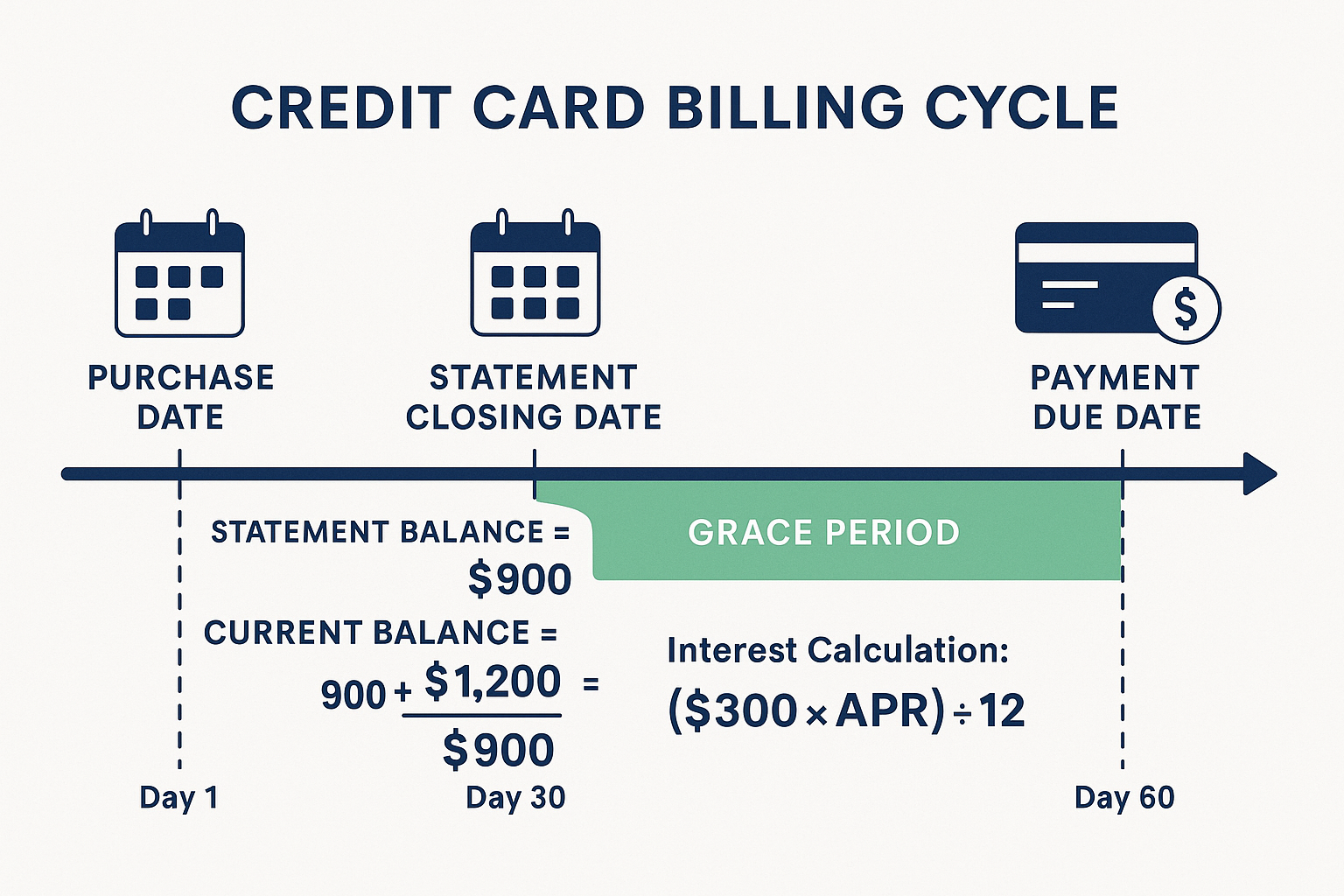
The difference between the statement balance and the current balance determines whether a cardholder pays interest or avoids it entirely. Despite its importance, this distinction remains one of the most commonly misunderstood concepts in credit card management.
What Is the Statement Balance?
The statement balance is the total amount owed when the billing cycle closes. It appears on the monthly statement and represents all transactions posted during that specific billing period (typically 28–31 days).
This number is locked in on the statement closing date and does not change, regardless of new purchases made afterward.
What Is the Current Balance?
The current balance reflects what the cardholder owes right now, including all transactions since the last statement closed. It changes daily as new purchases post and payments are applied.
Why the Statement Balance Is the Critical Number
To maintain the grace period and pay zero interest, the cardholder must pay the statement balance in full by the due date. Paying only a portion, even a large portion, triggers interest charges on the unpaid amount.
The Billing Cycle Timeline
Understanding the timeline eliminates confusion:
- Days 1–30: Billing cycle (transactions accumulate)
- Day 30: Statement closing date (statement balance is set and reported)
- Days 31–51: Grace period (21–25 days to pay without interest)
- Day 51: Payment due date
Practical example:
- Statement closing date: March 15
- Statement balance: $1,500
- Payment due date: April 9
- Current balance on April 1: $1,800 (includes $300 in new purchases made after March 15)
To avoid interest: Pay at least $1,500 (the statement balance) by April 9. The $300 in new purchases will appear on the next statement with its own grace period.
These terms make more sense once you understand the billing timeline, explained in our billing cycle and due date guide.
When the Grace Period Disappears
If any portion of the statement balance carries over to the next cycle, the grace period is lost. All new purchases begin accruing interest immediately from the transaction date — not the statement closing date- until two consecutive statement balances are paid in full.
To restore the grace period:
- Pay the current statement balance in full.
- Pay the following statement balance in full.
- The grace period reinstates on the subsequent billing cycle.
Key principle: The statement balance determines interest charges. The current balance reflects real-time debt. Always reference the statement balance when making payments to maintain interest-free status.
Credit Card Utilization and Its Impact on Credit Scores
Credit utilization — the percentage of available credit currently in use accounts for approximately 30% of a FICO credit score calculation. It is the second most influential scoring factor after payment history, and it is also the fastest factor to change.
The Utilization Formula
Utilization Rate = (Total Credit Card Balances ÷ Total Credit Limits) × 100
Example:
- Card A: $400 balance / $2,000 limit
- Card B: $800 balance / $5,000 limit
- Card C: $0 balance / $3,000 limit
- Total balances: $1,200
- Total limits: $10,000
- Utilization: 12%
Optimal Utilization Ranges for Credit Scores
Data from FICO and credit bureau research indicate the following impact ranges:
| Utilization Range | Score Impact |
|---|---|
| Below 10% | Excellent (strongest positive effect) |
| 10–29% | Good (positive effect) |
| 30–49% | Fair (neutral to mildly negative) |
| 50–74% | Poor (notable negative impact) |
| 75%+ | Very poor (severe negative impact) |
Per-Card vs Overall Utilization
Credit scoring models evaluate both dimensions:
- Overall utilization: Total balances across all cards divided by total combined limits.
- Per-card utilization: Each card’s balance divided by its own limit.
Maxing out a single card while keeping others at zero can damage a score even when overall utilization appears reasonable. Distributing balances across multiple cards or keeping all individual card utilization low produces better scoring outcomes.
The Reporting Date Strategy
Most issuers report balances to credit bureaus on the statement closing date, not the payment due date. This creates a strategic opportunity:
- Make a payment before the statement closes to reduce the balance that gets reported.
- This lowers reported utilization without sacrificing the grace period.
Example timing strategy:
- Statement closes: April 15
- Payment due: May 10
- Action: Pay down the balance before April 15 so the reported balance is low.
- Result: Lower utilization reported to bureaus, higher credit score.
The Zero Utilization Paradox
Counterintuitively, 0% utilization does not maximize credit scores. Scoring models prefer to see some evidence that credit is being used responsibly. A utilization rate between 1% and 9% consistently produces the highest scores in FICO modeling.
Impact Magnitude
Reducing utilization from 75% to below 30% can increase credit scores by 50 to 100 points, according to FICO research. This makes utilization management one of the fastest and most controllable levers for credit score improvement.
These factors come from the broader credit scoring system covered in our complete credit guide.
Types of Credit Cards and How to Choose the Right One
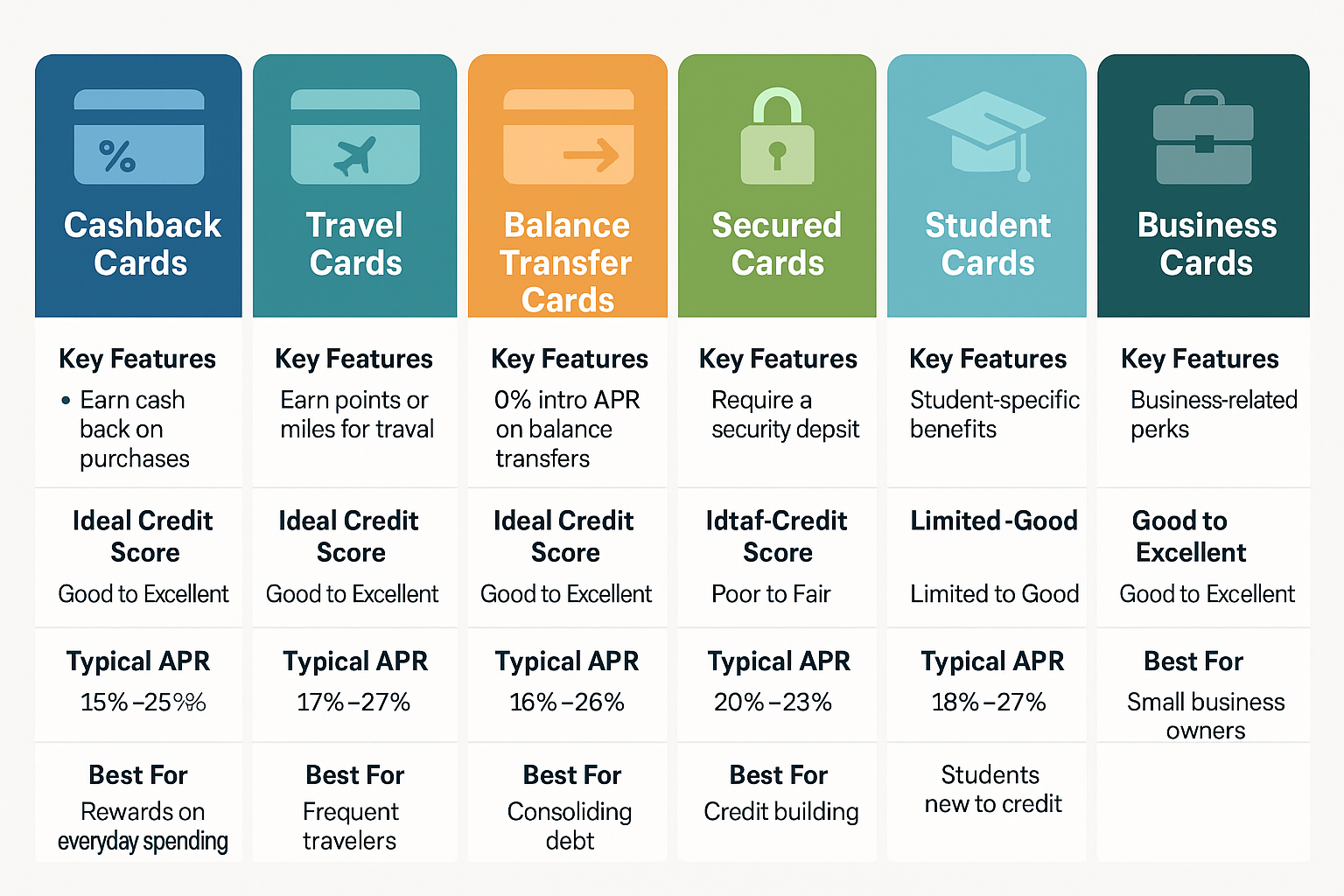
Not all credit cards serve the same purpose. Selecting the right card depends on financial goals, spending habits, and current credit standing.
Rewards Credit Cards
Designed for cardholders who pay balances in full each month, rewards cards return a percentage of spending as cash back, points, or travel miles. Common structures include:
- Flat-rate cards: 1.5–2% cash back on all purchases.
- Category cards: Higher rates (3–5%) in rotating or fixed categories like groceries, dining, or gas.
- Travel cards: Points or miles redeemable for flights, hotels, and travel expenses, often with premium perks.
Best for: Disciplined spenders who never carry a balance. Rewards only generate net value when no interest is paid.
Secured Credit Cards
Secured cards require a refundable security deposit (typically $200–$500) that serves as the credit limit. They are designed for individuals with no credit history or damaged credit.
Best for: Credit builders, recent immigrants, and those recovering from financial setbacks. Many secured cards upgrade to unsecured cards after 6–12 months of responsible use.
Balance Transfer Cards
These cards offer 0% introductory APR on transferred balances for a promotional period (typically 12–21 months). A balance transfer fee of 3–5% usually applies.
Best for: Cardholders consolidating high-interest debt. The math works when the transfer fee is significantly less than the interest that would accrue on the original card during the promotional period.
Student Credit Cards
Tailored for college students and young adults with limited credit history, student cards typically feature lower credit limits, no annual fees, and basic rewards structures.
Best for: Young adults establishing their first credit accounts.
Business Credit Cards
Designed for business expenses, these cards often offer higher credit limits, expense tracking tools, and rewards categories aligned with business spending (office supplies, advertising, travel).
Best for: Small business owners and freelancers who want to separate personal and business finances.
| Card Type | Best For | Typical Rewards | Ideal Credit Score | Annual Fee Range |
|---|---|---|---|---|
| Cashback | Simplicity, everyday spending | 1.5-5% cash back | 670+ | $0-$95 |
| Travel | Frequent travelers, point optimizers | 2-5x points on travel/dining | 690+ | $0-$550 |
| Balance Transfer | Paying down existing debt | 0% APR for 12-21 months | 670+ | $0-$95 |
| Secured | Building/rebuilding credit | Limited or none | Any/None | $0-$50 |
| Student | College students, first card | 1% cashback, education tools | Limited/None | $0 |
| Business | Business owners, expense tracking | 2-5x on business categories | 680+ | $0-$450 |
Takeaway: Match your card type to your financial situation and spending patterns. A travel card makes no sense if you rarely travel, just as a balance transfer card offers no value if you carry no debt.
How to Use a Credit Card Safely: Practical Rules
Safe credit card use comes down to a handful of principles applied consistently:
Rule 1: Pay the Statement Balance in Full Every Month
This single habit eliminates all interest charges and keeps the grace period active. Autopay set to “statement balance” is the most reliable method.
Rule 2: Keep Utilization Below 30% (Ideally Below 10%)
Monitor balances relative to credit limits. Make mid-cycle payments if spending approaches the threshold before the statement closing date.
Rule 3: Never Use Cash Advances
Cash advances carry the highest APR, no grace period, and upfront fees. They are almost always the most expensive way to access money.
Rule 4: Review Statements Monthly
Check every transaction for accuracy and unauthorized charges. Federal law limits liability for fraudulent charges to $50 under the Fair Credit Billing Act, and most issuers offer $0 fraud liability — but only if fraud is reported promptly.
Rule 5: Avoid Opening Too Many Cards Too Quickly
Each credit card application generates a hard inquiry on the credit report, which temporarily reduces the credit score by 5–10 points. Multiple applications in a short period signal risk to lenders.
Rule 6: Understand Every Fee Before Applying
Read the Schumer Box — the standardized disclosure table required on all credit card applications. Key items to review:
- Purchase APR
- Annual fee
- Late payment fee
- Foreign transaction fee
- Balance transfer fee
- Cash advance fee and APR
Credit Card Fees Explained
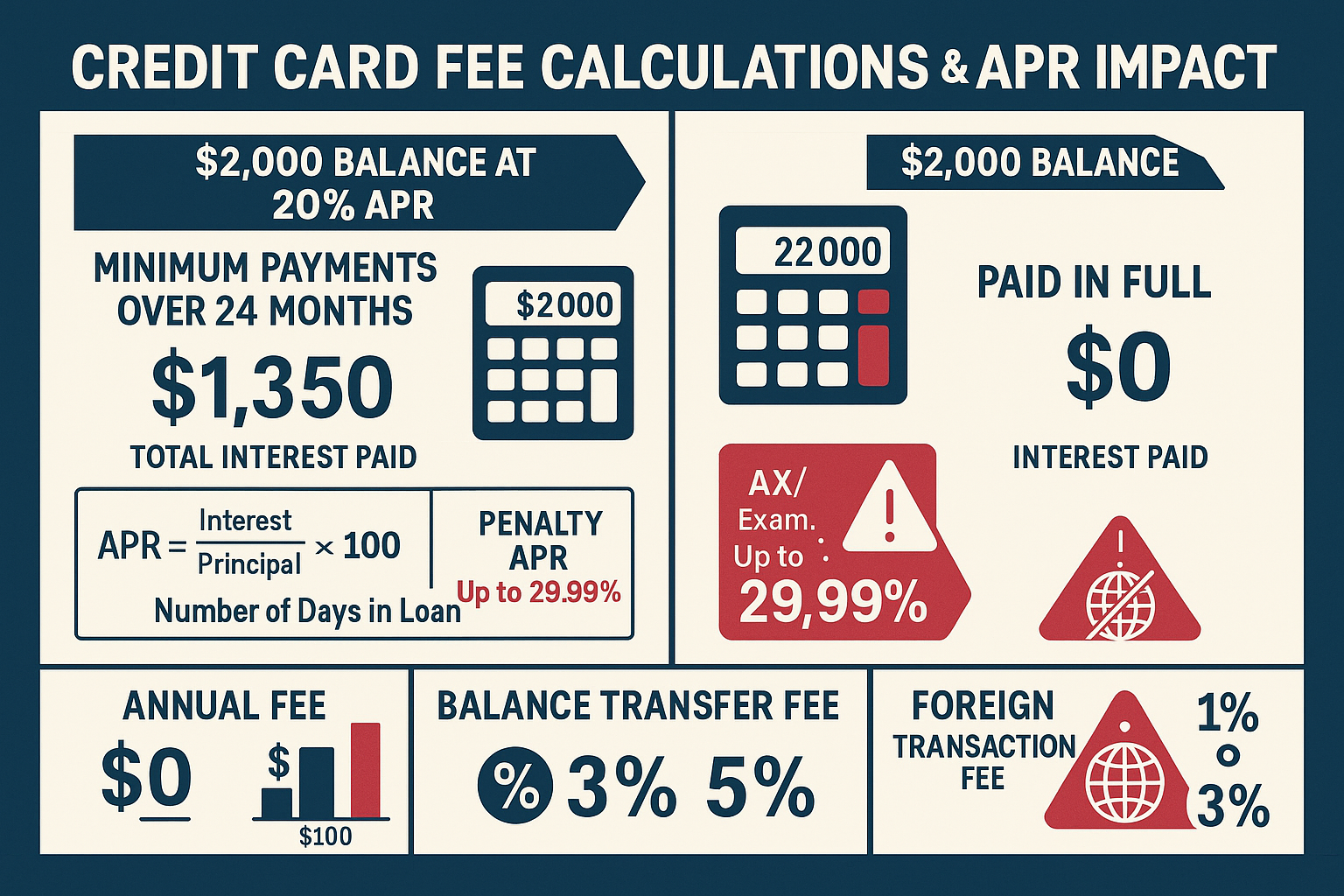
Credit card fees represent the true cost of borrowing and directly impact whether a card generates value or drains wealth. Understanding fee structures requires examining both the mathematics and the timing.
Annual Percentage Rate (APR)
APR represents the annualized interest rate charged on unpaid balances. Unlike APY, which includes compounding effects, APR shows the simple annual rate.
Most credit cards use variable APRs tied to the Prime Rate plus a margin:
APR = Prime Rate + Margin
As of 2025, with the Prime Rate at approximately 8.5%, a card with a 15% margin charges 23.5% APR.
Credit cards typically compound interest daily, making the effective rate slightly higher than the stated APR:
Daily Periodic Rate = APR ÷ 365
For a 23.5% APR:
- Daily rate = 23.5% ÷ 365 = 0.0644% per day
Interest calculation:
- Average daily balance × Daily rate × Days in billing cycle
Penalty APR kicks in when you miss payments, often jumping to 29.99%. This rate can apply indefinitely and to existing balances, dramatically increasing borrowing costs.
Annual Fees
Annual fees range from $0 to $550+ for premium travel cards. The value equation is simple:
Net Value = (Rewards Earned + Benefits Used) – Annual Fee
A $95 annual fee card that generates $300 in cashback delivers $205 net value. A $550 travel card might offer $300 in annual travel credits, airport lounge access worth $200+, and enhanced earning rates that justify the fee for frequent travelers.
For beginners, start with no-annual-fee cards to avoid this fixed cost while learning credit card management.
Balance Transfer Fees
Balance transfer fees typically run 3-5% of the transferred amount, with a minimum of $5-$10. This upfront cost must be weighed against interest savings.
Decision formula:
If (Current Interest Cost) > (Transfer Fee + New Interest Cost), the transfer makes sense.
Example:
- $8,000 balance at 22% APR = $1,760 annual interest
- Transfer fee at 3% = $240
- New card: 0% for 18 months, then 18% APR
- If paid off in 18 months: Save $1,760 – $240 = $1,520
Foreign Transaction Fees
Foreign transaction fees (typically 3%) apply to purchases made in foreign currencies or processed by foreign banks. On a $3,000 international trip, this fee costs $90.
Many travel cards waive foreign transaction fees, making them essential for international spending.
Late Payment Fees
Late payment fees can reach $40 per occurrence. More damaging than the fee itself is the potential trigger of penalty APR and the negative impact on your credit score.
Setting up autopay for at least the minimum payment eliminates this risk.
The Minimum Payment Trap: A Case Study
Consider a $2,000 balance at 20% APR with a minimum payment of 2% of the balance or $25, whichever is greater:
Paying Minimum Only:
- Month 1: $2,000 balance, $40 minimum payment ($33.33 interest, $6.67 principal)
- Month 2: $1,993.33 balance, $39.87 minimum payment
- Time to pay off: 11 years, 9 months
- Total interest paid: $2,387.54
- Total amount paid: $4,387.54
Paying $100 Monthly:
- Time to pay off: 24 months
- Total interest paid: $420.68
- Total amount paid: $2,420.68
Paying Full Balance:
- Time to pay off: Immediate
- Total interest paid: $0 (if within grace period)
- Total amount paid: $2,000
The minimum payment structure is designed to maximize issuer profit through extended repayment periods. The math proves that even modest increases in payment amounts dramatically reduce total interest costs.
Insight: Every dollar above the minimum payment goes entirely to principal reduction, accelerating payoff and cutting total interest. Even an extra $25 monthly can cut years off your repayment timeline.
The Opportunity Cost of Rewards Chasing
While rewards optimization can generate significant value, it carries opportunity costs:
- Time spent researching and managing multiple cards
- Risk of overspending to earn rewards (spending $100 to earn $5 is a net loss)
- Complexity in tracking categories and rotating bonuses
- Potential for missed payments when managing multiple accounts
The optimal strategy balances reward maximization with simplicity. For most people, 2-3 well-chosen cards covering primary spending categories deliver 80% of maximum value with 20% of the complexity.
Takeaway: Rewards are genuine value, but only when spending aligns with your budget. A 5% return on unnecessary spending is still a 95% loss. Focus rewards optimization on purchases you’d make regardless, treating rewards as a bonus rather than a reason to spend.
How to Choose the Best Credit Card
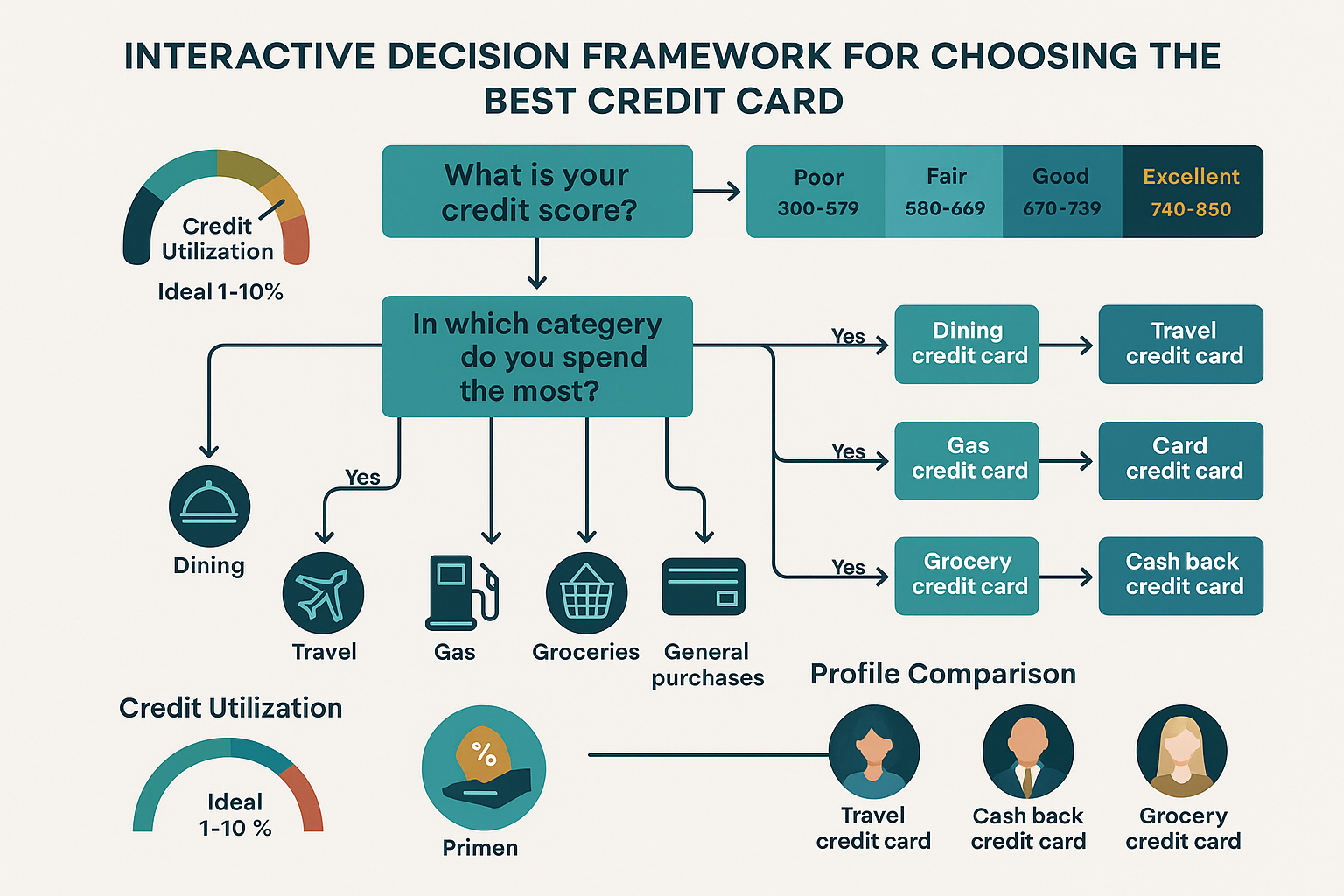
Selecting the optimal credit card requires matching card features to your spending patterns, credit profile, and financial goals. A systematic decision framework eliminates choice paralysis and ensures you extract maximum value.
The Decision Framework
Step 1: Assess Your Credit Profile
Your credit score determines which cards you qualify for:
- Excellent (750+): Access to all cards, including premium travel cards
- Good (700-749): Most cards available, some premium cards
- Fair (650-699): Mainstream cards, limited premium options
- Building (600-649): Secured cards, student cards, basic unsecured cards
- Poor (<600): Secured cards, credit-builder products
Check your score before applying to avoid hard inquiries on applications you won’t be approved for.
Step 2: Analyze Your Spending Patterns
Review 3-6 months of spending across categories:
- Groceries: $____
- Dining: $____
- Gas: $____
- Travel: $____
- General purchases: $____
This data reveals which category bonuses deliver the most value.
Step 3: Calculate Potential Returns
For each card under consideration:
Annual Value = (Category 1 Spending × Category 1 Rate) + (Category 2 Spending × Category 2 Rate) + … – Annual Fee
Example:
- Card A: 5% groceries, 3% gas, 1% other, $95 annual fee
- Monthly spending: $600 groceries, $200 gas, $1,200 other
- Annual value: ($600 × 12 × 0.05) + ($200 × 12 × 0.03) + ($1,200 × 12 × 0.01) – $95
- Annual value: $360 + $72 + $144 – $95 = $481
Compare this calculation across multiple cards to identify the highest net value.
Step 4: Consider Secondary Benefits
Beyond earning rates, evaluate:
- Purchase protection: Extended warranties, return protection
- Travel benefits: Trip cancellation insurance, rental car coverage, lounge access
- Cell phone protection: Reimbursement for damaged phones
- Fraud protection: Zero liability policies
These benefits have real monetary value when used. A card with $600 cell phone protection could save you $1,000 on a replacement.
Step 5: Evaluate Long-Term Fit
Consider whether the card aligns with your financial trajectory:
- Will your spending patterns remain stable?
- Are you building credit for a major purchase (home, car) in the next 6-12 months?
- Does the card grow with you (upgrade paths, increased limits)?
Three Real-World Profiles
Profile 1: Sarah – Graduate Student
- Credit score: 680 (limited history)
- Monthly spending: $800 ($400 groceries, $200 dining, $200 other)
- Goal: Build credit, earn modest rewards
- Optimal card: Student cashback card with 2% groceries, 1% other, no annual fee
- Annual value: ($400 × 12 × 0.02) + ($400 × 12 × 0.01) = $96 + $48 = $144
Profile 2: Marcus – Young Professional
- Credit score: 740
- Monthly spending: $3,500 ($600 groceries, $500 dining, $400 travel, $2,000 other)
- Goal: Maximize rewards, start travel hacking
- Optimal card: Travel card with 3x dining/travel, 1x other, $95 annual fee
- Annual value: ($900 × 12 × 0.03 × $0.015 value per point) + ($2,600 × 12 × 0.01 × $0.015) – $95
- Annual value: $486 + $468 – $95 = $859
Profile 3: Jennifer – Established Professional
- Credit score: 800
- Monthly spending: $6,000 ($800 groceries, $800 dining, $1,200 travel, $3,200 other)
- Goal: Optimize returns across categories, travel perks
- Optimal strategy: Multi-card approach
- Card 1: 5% groceries, no annual fee → $480 annual value
- Card 2: 4x dining/travel, $95 annual fee → $1,152 value – $95 = $1,057 net
- Card 3: 2% everything else, no annual fee → $768 annual value
- Total annual value: $2,305
Decision Checklist
Before applying, verify:
- Credit score meets minimum requirements
- Calculated annual value exceeds annual fee by at least 2x
- Spending categories align with card bonuses
- No major credit applications planned in the next 6 months
- Ability to pay full balance monthly (if carrying balance, focus on low APR instead of rewards)
- Understanding of all fees and terms
Takeaway: The “best” credit card is entirely personal. A premium travel card with a $550 annual fee might be optimal for someone spending $50,000 annually on travel, but terrible for someone spending $5,000. Run the math for your specific situation rather than following generic recommendations.
How to Apply for a Credit Card Safely
The credit card application process involves multiple decision points that affect your credit score and approval odds. Strategic application practices maximize approval chances while minimizing credit damage.
Hard Inquiries vs Soft Inquiries
Hard inquiries (hard pulls) occur when you formally apply for credit. These inquiries (Hard vs Soft Inquiries):
- Appears on your credit report for 24 months
- Affect your credit score for 12 months
- Typically, reduce scores by 3-5 points each
- Multiple inquiries for the same type of credit within 14-45 days count as one inquiry (for mortgages/auto loans, not credit cards)
Soft inquiries occur when:
- You check your own credit
- Lenders pre-qualify you for offers
- Employers conduct background checks
- Existing creditors review your account
Soft inquiries don’t affect your credit score and aren’t visible to other lenders.
Pre-Approval vs Approval
Pre-qualification or pre-approval uses soft pulls to estimate approval odds based on limited information. These are marketing tools that indicate likely approval but aren’t guarantees.
Pre-approval benefits:
- No credit score impact
- Reveals likely approval before hard inquiry
- Shows potential credit limit and terms
Always check pre-approval status before formally applying. Most major issuers offer pre-qualification tools on their websites.
Formal approval requires a hard inquiry and a full application. Approval depends on:
- Credit score and history
- Income and employment
- Existing debt obligations (debt-to-income ratio)
- Recent credit inquiries
- Relationship with the issuing bank
Required Documents and Information
Standard application requirements include:
Personal Information:
- Full legal name
- Date of birth
- Social Security number
- Current address (and duration at address)
- Phone number and email
Financial Information:
- Annual gross income (include all sources: salary, bonuses, investment income, alimony)
- Monthly housing payment (rent or mortgage)
- Employment status and employer name
Additional Information (sometimes):
- Bank account information
- Assets and savings
- Existing credit card accounts
Be accurate and honest. Overstating income constitutes fraud, while understating income reduces approval odds and potential credit limits.
Application Timing Strategy
Space applications appropriately:
- Wait 3-6 months between credit card applications
- Avoid applications within 6-12 months of major credit needs (mortgage, auto loan)
- Don’t apply for multiple cards on the same day (appears desperate to lenders)
Optimal application timing:
- After credit score improvements (paid down debt, removed derogatory marks)
- When income has increased
- After establishing 6+ months of history with current cards
- During promotional periods (elevated sign-up bonuses)
What Happens After Application
Instant approval: Many applications receive automated approval within seconds based on an algorithmic assessment of your credit profile.
Pending review: Some applications require manual review, taking 7-14 days. This often occurs when:
- Your credit profile is borderline
- Income verification is needed
- You have a limited credit history
- Recent inquiries or new accounts raise flags
Denial: If denied, you’ll receive an adverse action letter within 7-10 days explaining the denial reasons. Common reasons include:
- Insufficient credit history
- Too many recent inquiries
- High debt-to-income ratio
- Derogatory marks (late payments, collections)
- Low credit score
After denial, wait at least 6 months before reapplying and address the specific denial reasons.
Post-Approval Steps
Once approved:
- Activate your card immediately upon receipt
- Set up online account access for payment management
- Configure autopay for at least the minimum payment
- Add a card to the budgeting tools for spending tracking
- Store card information securely (never share PIN or CVV)
- Review terms and conditions to understand fees, rates, and benefits
Insight: The application process itself is a screening mechanism. Issuers want customers who understand credit and use it responsibly. Demonstrating knowledge through strategic application, timing, and accurate information provision increases approval odds and initial credit limits.
Tips for Smart Credit Card Use
Strategic credit card management transforms these tools from potential debt traps into wealth-building instruments. The following practices optimize value while minimizing risk.
Automate Payments
Manual payment management creates unnecessary risk of missed payments, late fees, and credit score damage. Autopay eliminates this risk.
Three autopay strategies:
- Full statement balance (optimal): Pays entire balance automatically, avoiding all interest charges
- Minimum payment (safety net): Prevents late payments but allows interest to accrue on the remaining balance
- Fixed amount: Pays a set amount monthly, useful for structured debt paydown
Set autopay for the full statement balance if you maintain sufficient checking account funds. This guarantees zero interest charges while protecting your payment history.
Implementation:
- Link your primary checking account to each credit card
- Schedule payments 2-3 days before due date (buffer for processing delays)
- Monitor autopay confirmations monthly
- Maintain an adequate checking balance to prevent overdrafts
Track Spending in Real-Time
Credit cards disconnect spending from immediate payment, creating psychological distance that can lead to overspending. Real-time tracking maintains spending awareness.
Tracking methods:
Mobile app monitoring: Check card apps daily to review recent transactions
Budgeting software: Link cards to tools like YNAB, Mint, or Personal Capital for automated categorization
Spreadsheet tracking: Manual entry forces engagement with spending patterns
Weekly reviews: Schedule 15 minutes weekly to review all card transactions
The goal is to maintain the same spending awareness you’d have with cash or debit cards. If you wouldn’t purchase with cash, don’t make it with credit.
Never Carry a Balance (If Possible)
The mathematical reality of credit card interest makes carrying balances one of the most expensive forms of borrowing available.
Interest cost comparison on $5,000 borrowed for one year:
- Credit card at 20% APR: $1,000+ in interest
- Personal loan at 10% APR: $500 in interest
- Home equity line at 7% APR: $350 in interest
- 0% balance transfer card: $0-$150 (transfer fee only)
If you must carry a balance, transfer it to a 0% promotional rate card or consolidate with a lower-rate personal loan. Never pay 18-25% APR when alternatives exist.
Optimize Category Spending
Once you’ve selected cards based on category bonuses, actively route spending to maximize returns:
- Groceries → 5% grocery card
- Dining → 3-4% dining card
- Travel → 3-5x travel points card
- Everything else → 2% flat-rate card
This requires minimal effort, storing the right card in your wallet or digital wallet for each category, but it can double or triple reward earnings.
Leverage Purchase Protections
Credit cards offer consumer protections that debit cards and cash don’t provide:
Fraud protection: Zero liability for unauthorized charges under federal law
Extended warranties: Adds 1-2 years to manufacturer warranties
Purchase protection: Covers damage or theft of new purchases for 90-120 days
Return protection: Refunds for items that merchants won’t accept as returns
Price protection: Refunds if price drops within 60-90 days (less common now)
Use credit cards for large purchases to access these protections. A $1,500 laptop with extended warranty protection provides $200+ in value.
Monitor Credit Reports
Review credit reports from all three bureaus (Equifax, Experian, TransUnion) annually at AnnualCreditReport.com. Check for:
- Unauthorized accounts
- Incorrect balances or limits
- Fraudulent inquiries
- Reporting errors
Dispute any errors immediately. Incorrect information can reduce your credit score by 20-50 points.
Maintain Old Accounts
Length of credit history represents 15% of your credit score. Closing old accounts:
- Reduces average account age
- Decreases total available credit (increasing utilization)
- Eliminates positive payment history
Keep old cards active with small recurring charges (streaming services, subscriptions) set to autopay. This maintains the account while requiring zero active management.
Use Alerts and Notifications
Enable card alerts for:
- Transactions over $X amount
- International transactions
- Declined transactions
- Payment due date reminders
- Statement availability
These alerts provide real-time fraud detection and prevent missed payments.
Takeaway: Smart credit card use requires systems, not willpower. Autopay prevents missed payments, tracking prevents overspending, and strategic category use maximizes returns. Build these systems once, and they run automatically, generating value with minimal ongoing effort.
Common Credit Card Mistakes to Avoid
Even financially aware individuals make costly errors with credit cards. The most frequent include:
Missing payments a single payment 30+ days late, can drop a credit score by 100 points or more, and remains on the credit report for seven years.
Paying only the minimum extends repayment by decades and multiplies the total cost.
Ignoring the statement closing date leads to high reported utilization even when balances are paid by the due date.
Chasing rewards while carrying a balance, a 2% cash back reward is meaningless when 23% interest accrues monthly.
Closing old credit cards reduces total available credit (increasing utilization) and shortens average account age (lowering credit score).
💳 Credit Card Payoff Calculator
See how payment strategies affect your total interest and payoff time
Your total credit card balance
The interest rate on your card
How much you plan to pay each month
Time to Pay Off
—
Total Interest Paid
—
Total Amount Paid
—
Minimum Payment Only
Time to payoff:
—
Total interest:
—
Your Payment Plan
Time to payoff:
—
Total interest:
—
💰 Total Savings vs. Minimum Payment
—
Conclusion
A credit card is neither inherently good nor inherently bad. It is a financial instrument whose value depends entirely on how it is used, and the math behind that usage is unforgiving.
Cardholders who pay statement balances in full, maintain low utilization, and understand the daily compounding mechanics of APR effectively use credit cards for free while building credit history and earning rewards.
Cardholders who carry balances, pay minimums, and ignore utilization ratios pay a steep price, one that compounds daily and can take decades to resolve.
The difference between these two outcomes is not income level or financial sophistication. It is financial literacy: knowing what a credit card is, how it works, and how to use it safely.
In a financial landscape where the average credit card APR exceeds 23% and total U.S. credit card debt surpasses $1.14 trillion (Federal Reserve, 2026), that knowledge is not optional. It is essential.
References
[1] Federal Reserve Bank of New York, “Quarterly Report on Household Debt and Credit,” Q1 2025
[2] Consumer Financial Protection Bureau, “Credit Card Market Report,” 2025
[3] FICO, “Credit Utilization and Credit Scores,” myFICO.com
Educational Disclaimer
This article is provided for educational and informational purposes only and does not constitute financial, investment, or credit advice. Credit card products, terms, interest rates, and fees vary by issuer and are subject to change. Individual financial situations differ significantly, and what works optimally for one person may not be appropriate for another.
The mathematical examples, calculations, and scenarios presented are simplified illustrations designed to demonstrate concepts and should not be considered precise predictions of your specific outcomes. Actual results will vary based on your credit profile, issuer policies, spending patterns, and numerous other factors.
Before applying for any credit card or making significant financial decisions, consult with a qualified financial advisor who can assess your specific situation, goals, and risk tolerance. Always read credit card terms and conditions, including the Schumer Box disclosure, before applying or accepting any credit product.
The Rich Guy Math and its contributors are not responsible for any financial decisions made based on this content. Credit card usage carries inherent risks, including the potential for debt accumulation and credit score damage if mismanaged.
Interest rates, fees, rewards programs, and credit card features mentioned in this article are current as of 2025 but are subject to change by issuers at any time. Always verify current terms directly with card issuers before making decisions.
About the Author
Max Fonji is a data-driven financial educator and the voice behind The Rich Guy Math, where he breaks down complex financial concepts into clear, actionable insights grounded in mathematics and evidence. With a background in financial analysis and a passion for democratizing financial literacy, Max helps readers understand the cause-and-effect relationships that drive wealth building, from credit management and debt optimization to investment fundamentals and valuation principles.
Max’s approach combines analytical precision with educational warmth, translating abstract financial theory into practical strategies that readers can implement immediately. His work has helped thousands of individuals optimize their credit profiles, eliminate high-interest debt, and build sustainable wealth through evidence-based decision-making.
When not analyzing the math behind money, Max researches behavioral finance, studies market history, and develops frameworks that make financial concepts accessible to beginners while remaining rigorous enough for experienced investors.
Connect with Max and explore more data-driven financial education at The Rich Guy Math.
Frequently Asked Questions About Credit CardsWhat credit score do I need to get approved for a credit card?
What credit score do I need to get approved for a credit card?
Credit score requirements vary by card type:
- Secured cards: No minimum score required
- Student cards: 630-650+ for approval
- Basic cashback cards: 650-700
- Premium rewards cards: 700-750+
- Elite travel cards: 750+ for best approval odds
Credit scores are only one factor. Issuers also evaluate income, existing debt, recent inquiries, and banking relationships. Someone with a 680 score and high income may be approved for cards that typically require 720+ scores.
If denied, the adverse action letter will list the exact reason. Fix the issue before reapplying.
What happens if I never use my credit card?
Inactive cards are often closed after 6-12 months. Closure can hurt your credit score by:
- Reducing available credit (higher utilization)
- Lowering average account age
- Removing a positive payment history source
To keep a card active:
- Add a small recurring subscription ($5-15)
- Set it to autopay
The card remains active and continues building credit without effort.
Can I pay my credit card before the statement closes?
Yes, and it lowers the balance that gets reported to credit bureaus, improving utilization.
Example:
- Credit limit: $10,000
- Spending: $3,000
- Payment before closing: $2,500
- Statement balance: $500
Reported utilization is 5% instead of 30%. This is helpful before applying for a mortgage, auto loan, or new credit card.
Do charge cards affect credit differently than credit cards?
Charge cards require full monthly payment and often have no preset spending limit.
Differences:
- Some charge cards do not report a credit limit, so they may not affect utilization
- Payment history still impacts credit score
- Income requirements and approval standards are usually higher
For building credit, traditional credit cards are more straightforward.
Why did my credit card issuer close my account?
Common reasons include:
- Inactivity for 6-12+ months
- Credit score decline
- High utilization on other cards
- Missed payments
- Suspicious activity
- Business decision by the bank
If it happens, ask for reconsideration, pay any balance immediately, and avoid closing other cards yourself.
Should I accept a credit limit increase?
Usually yes, especially if it is a soft pull.
Benefits:
- Lowers utilization
- Increases spending flexibility
- No downside if soft pull
Reasons to decline:
- Spending discipline is a concern
- The increase requires a hard inquiry
- You are applying for a mortgage soon
Automatic increases should generally be accepted.
What’s the difference between statement balance and current balance?
Statement balance: Amount owed when the billing cycle closed. Pay this to avoid interest.
Current balance: Statement balance plus new purchases minus payments made since closing.
You only need to pay the statement balance to avoid interest. New purchases roll into the next cycle.
Can I have too many credit cards?
No fixed number, but limits are practical:
- Opening 5+ cards in 24 months can trigger denials
- Mismanaging many cards increases missed payment risk
- 15+ cards can cause mortgage underwriting concerns
Optimal range for most people: 3-7 cards.
More than 7-8 offers diminishing returns and more management complexity.