
In 2023, venture capital firms deployed over $170 billion into U.S. startups through equity financing, capital that required no monthly payments, no interest charges, and no predetermined repayment schedules. Instead, these investors exchanged cash for ownership, betting their money on future growth rather than contractual guarantees.
Equity Financing represents one of the most transformative methods companies use to fund operations, expansion, and innovation. Unlike traditional loans that create debt obligations, equity financing converts capital into ownership stakes, fundamentally altering the relationship between money providers and businesses. For entrepreneurs seeking to understand the math behind money and build sustainable ventures, mastering equity financing mechanics separates those who grow strategically from those who stumble under unsustainable debt burdens.
This comprehensive guide breaks down equity financing with data-driven precision, explaining exactly how it works, when it makes financial sense, and what trade-offs every business owner must calculate before diluting ownership.
Key Takeaways
- Equity financing exchanges capital for ownership shares rather than creating debt obligations, making investors long-term partners with aligned growth incentives
- No repayment requirements exist; companies receive capital without monthly payments, interest charges, or predetermined repayment schedules
- Ownership dilution is the primary cost; founders surrender control and future profits in proportion to equity sold to investors
- Startups and high-growth companies benefit most because they typically lack collateral for traditional debt financing and need patient capital for long development cycles
- Exit events create investor returns, equity investors profit through acquisitions, IPOs, or secondary share sales, not through contractual repayments
What Is Equity Financing? The Core Definition
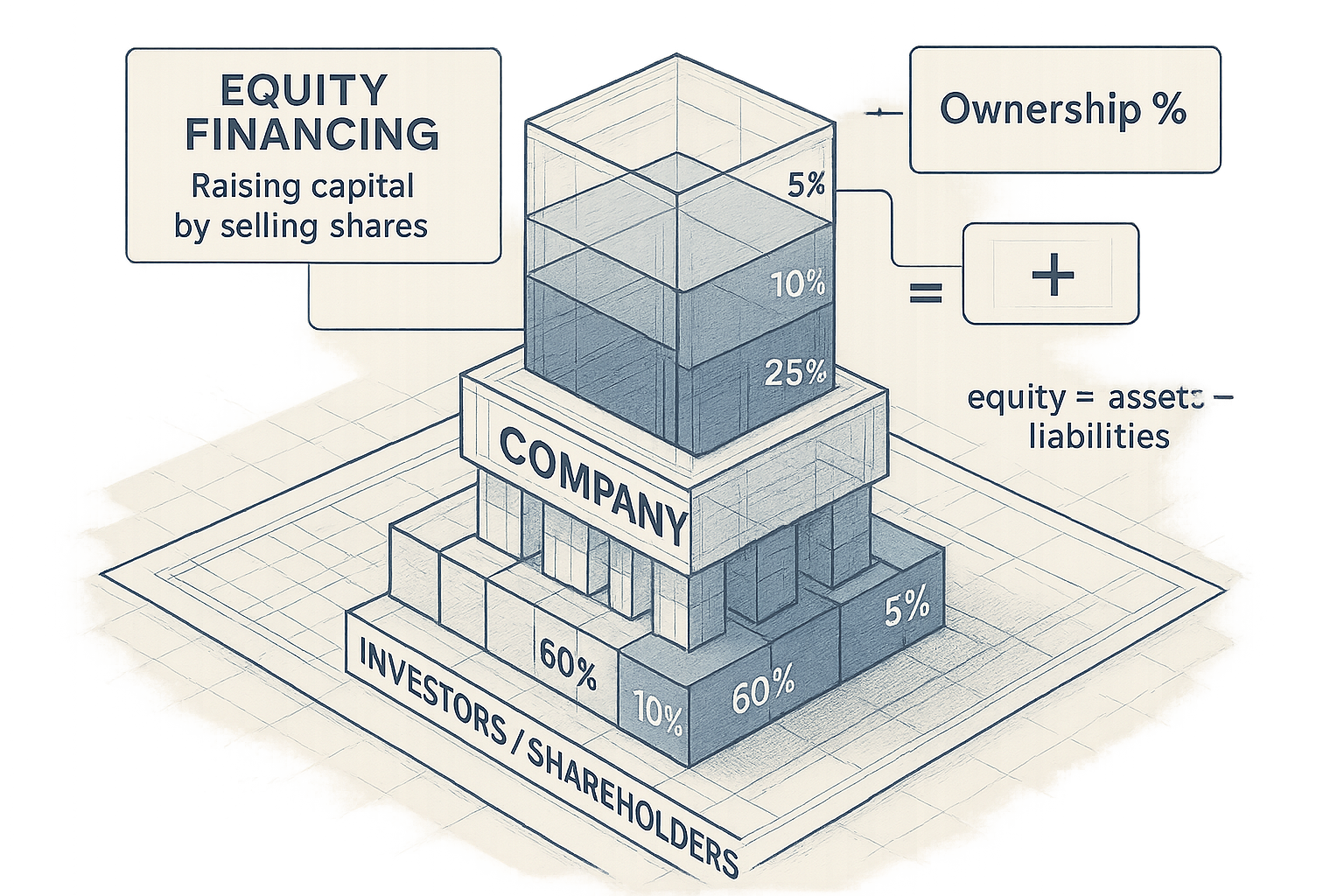
Equity financing is a capital-raising method where businesses sell ownership shares to investors in exchange for funding. The transaction converts cash into equity stakes, giving investors proportional ownership rights, profit-sharing claims, and often decision-making influence.
The fundamental equation is straightforward:
Investment Amount ÷ Post-Money Valuation = Ownership Percentage
When an investor provides $500,000 to a company valued at $5 million post-investment, they acquire exactly 10% ownership ($500,000 ÷ $5,000,000 = 0.10 or 10%).
This differs fundamentally from debt financing, where borrowed capital creates repayment obligations with interest but preserves ownership structure. Equity financing eliminates debt service requirements but permanently redistributes company ownership and future value.
The Math Behind Equity Transactions
Every equity financing round involves precise valuation mathematics:
Pre-Money Valuation: Company’s worth before new investment
Investment Amount: Capital provided by investors
Post-Money Valuation: Pre-money valuation + investment amount
Investor Ownership %: Investment ÷ post-money valuation
Founder Ownership %: Pre-money valuation ÷ post-money valuation
Consider a practical example:
- Pre-money valuation: $4 million
- Investment amount: $1 million
- Post-money valuation: $5 million
- Investor ownership: 20% ($1M ÷ $5M)
- Founder ownership: 80% ($4M ÷ $5M)
The founder’s absolute ownership decreases from 100% to 80%; this dilution represents the true cost of equity capital, measured not in interest payments but in surrendered ownership rights.
Understanding equity fundamentals provides the foundation for evaluating whether this trade-off creates value or destroys it.
How Equity Financing Works: The Step-by-Step Process
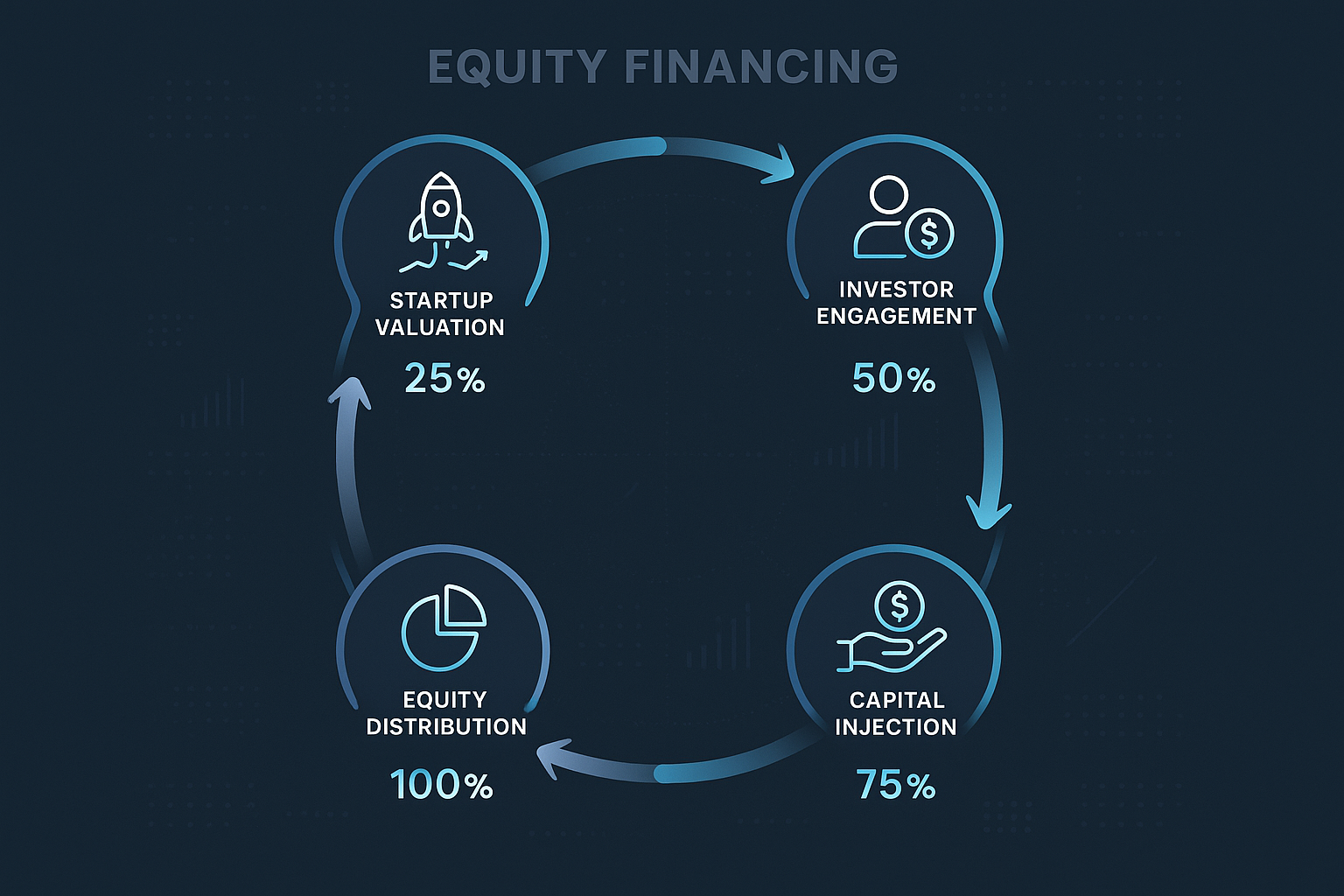
Equity financing follows a structured sequence that transforms investor capital into company ownership. Each stage involves specific calculations, negotiations, and legal mechanisms.
Step 1: Pre-Money Valuation Determination
Companies must establish their worth before selling shares. This pre-money valuation sets the baseline for calculating ownership percentages.
Valuation methods include:
- Comparable Company Analysis: Examining similar businesses’ valuations and applying relevant multiples
- Discounted Cash Flow (DCF): Projecting future cash flows and discounting to present value
- Venture Capital Method: Estimating exit value and working backward based on required investor returns
- Berkus Method: Assigning value to specific risk-reduction factors (prototype, team, partnerships)
Early-stage companies often use simplified approaches because they lack historical financial data. A seed-stage software startup might value itself at $3-5 million based on team quality, market opportunity, and early traction metrics rather than revenue multiples.
The pre-money valuation directly impacts dilution. Higher valuations mean less ownership surrendered for the same capital amount.
Step 2: Investor Sourcing and Due Diligence
Companies identify and approach potential equity investors through multiple channels:
Angel Investors: High-net-worth individuals providing $25,000-$500,000 in early-stage capital
Venture Capital Firms: Institutional investors deploying $1 million-$50 million+ across growth stages
Equity Crowdfunding Platforms: Digital marketplaces connecting startups with numerous small investors
Corporate Venture Arms: Strategic investors from established companies seeking industry exposure
Accelerators and Incubators: Programs providing capital plus mentorship and resources
Investors conduct thorough due diligence, examining:
- Financial statements and projections
- Market size and competitive positioning
- Intellectual property and legal structure
- Team backgrounds and capabilities
- Customer acquisition metrics and unit economics
This process typically requires 4-12 weeks for angel rounds and 3-6 months for institutional venture capital.
Step 3: Term Sheet Negotiation
Investors and founders agree on key terms through a term sheet—a non-binding document outlining the investment structure.
Critical terms include:
Valuation Cap: Maximum company valuation for conversion calculations
Investment Amount: Total capital provided
Ownership Percentage: Equity stake acquired
Liquidation Preference: Priority in exit proceeds (typically 1x invested capital)
Board Seats: Governance representation rights
Pro-Rata Rights: Ability to maintain ownership percentage in future rounds
Anti-Dilution Provisions: Protection against down-round dilution
A typical Series A term sheet might specify:
- Investment: $5 million
- Pre-money valuation: $20 million
- Post-money valuation: $25 million
- Investor ownership: 20%
- Liquidation preference: 1x non-participating
- Board composition: 2 founders, 2 investors, 1 independent
These terms significantly affect founder economics. A 2x participating liquidation preference means investors receive double their investment before founders get anything, then continue participating in remaining proceeds—dramatically reducing founder returns in moderate exit scenarios.
Step 4: Share Issuance and Capital Transfer
After the term sheet agreement, legal documentation formalizes the transaction:
- Stock Purchase Agreement: Defines share purchase terms and conditions
- Amended Articles of Incorporation: Updates authorized shares and share classes
- Investor Rights Agreement: Specifies information rights, registration rights, and protective provisions
- Right of First Refusal Agreement: Governs share transfer restrictions
- Voting Agreement: Establishes board election procedures
The company issues new shares to investors, simultaneously receiving capital into the company accounts. This share issuance dilutes existing shareholders proportionally.
If a company had 10 million shares outstanding and issued 2.5 million new shares to investors, the total shares would become 12.5 million. Original shareholders now own 10M ÷ 12.5M = 80% instead of 100%.
Step 5: Post-Investment Partnership
Unlike debt relationships that end with repayment, equity financing creates ongoing partnerships. Investors typically receive:
- Board observation or voting rights: Direct governance participation
- Information rights: Regular financial statements and operational updates
- Protective provisions: Veto rights over major decisions (acquisitions, additional financing, executive compensation)
- Strategic guidance: Industry connections, operational expertise, and mentorship
This partnership continues until a liquidity event—acquisition, IPO, or secondary sale—allows investors to convert ownership stakes into cash returns.
The relationship quality significantly impacts company success. Aligned investors add substantial value beyond capital; misaligned investors create friction that hampers execution.
Types of Equity Financing: From Angels to IPOs
Equity financing takes multiple forms across the company lifecycle stages. Each type serves different capital needs, involves distinct investor classes, and carries specific implications for ownership and control.
Angel Investment
Angel investors—typically successful entrepreneurs or executives—provide early-stage capital ranging from $25,000 to $500,000. They invest personal funds rather than institutional capital.
Typical Structure:
- Investment size: $50,000-$250,000
- Valuation: $1 million-$5 million pre-money
- Ownership acquired: 5%-20%
- Investment vehicle: Convertible notes or SAFE agreements
Angels often invest in pre-revenue companies based on team quality and market opportunity rather than financial metrics. They accept high risk in exchange for potential 10x-100x returns.
The math works because portfolio diversification offsets individual failures. An angel investing $25,000 each in 20 startups ($500,000 total) needs just 2-3 successful exits returning $1 million+ to generate strong overall returns despite 15+ failures.
Venture Capital
Venture capital firms deploy pooled institutional capital across multiple funding stages:
Seed Stage:
- Investment: $500,000-$2 million
- Valuation: $3 million-$10 million pre-money
- Purpose: Product development and initial market validation
Series A:
- Investment: $2 million-$15 million
- Valuation: $10 million-$50 million pre-money
- Purpose: Scaling proven business models
Series B/C:
- Investment: $10 million-$50 million+
- Valuation: $50 million-$500 million+ pre-money
- Purpose: Market expansion and competitive positioning
Venture capital follows power law economics—a small percentage of investments generate the majority of returns. Firms target portfolio companies capable of 100x+ returns to offset complete losses on 50%-70% of investments.
This return requirement drives VC preference for massive addressable markets and scalable business models. A company projecting $50 million annual revenue at maturity rarely attracts institutional venture capital because the exit value won’t support the required fund returns.
Equity Crowdfunding
Digital platforms enable companies to raise capital from numerous small investors through SEC-regulated equity crowdfunding:
Regulation Crowdfunding (Reg CF):
- Maximum raise: $5 million per 12-month period
- Investor limits: $2,200-$107,000 depending on income/net worth
- Platform examples: Wefunder, Republic, StartEngine
Regulation A+ (Reg A+):
- Tier 1: Up to $20 million
- Tier 2: Up to $75 million
- Fewer investor restrictions than Reg CF
Crowdfunding democratizes access to equity financing but involves significant marketing costs and ongoing shareholder management complexity. Companies with 500+ small shareholders face administrative burdens that concentrated ownership structures avoid.
The economics work best for consumer-facing brands that convert customers into investor-advocates who promote products while holding equity stakes.
Initial Public Offering (IPO)
IPOs represent the transition from private to public equity markets, enabling companies to raise substantial capital while providing liquidity for existing shareholders.
Typical IPO Economics:
- Capital raised: $50 million-$1 billion+
- Valuation: $500 million-$10 billion+
- Underwriter fees: 5%-7% of proceeds
- Legal and accounting costs: $2 million-$5 million+
The IPO process involves:
- Selecting investment bank underwriters
- SEC registration and disclosure preparation
- Roadshow presentations to institutional investors
- Price discovery and share allocation
- Public market trading commencement
Companies pursuing IPOs must demonstrate consistent revenue growth, clear paths to profitability, and sufficient scale to justify public market requirements. The median company going public in 2024 had approximately $200 million in annual revenue.
Public company status creates ongoing compliance costs ($1 million-$3 million+ annually) and quarterly earnings pressures that private companies avoid. This trade-off makes sense only when benefits, capital access, liquidity, acquisition currency, and brand visibility, exceed these substantial costs.
Understanding different capital structure options helps companies select appropriate financing vehicles for their specific situations.
Advantages of Equity Financing: When Ownership Trade-Offs Make Sense
Equity financing provides distinct benefits that make it superior to debt financing in specific circumstances. Understanding these advantages helps companies make evidence-based capital allocation decisions.
No Repayment Obligations or Interest Charges
The most immediate benefit: equity financing creates zero debt service requirements.
Companies receive capital without:
- Monthly principal and interest payments
- Predetermined repayment schedules
- Collateral requirements
- Personal guarantees
- Restrictive debt covenants
This preserves cash flow for operations and growth rather than debt service. A startup raising $2 million in equity financing retains 100% of that capital for business use. The same $2 million as a bank loan at 8% interest requires approximately $175,000 in annual debt service, capital unavailable for hiring, marketing, or product development.
The math becomes particularly compelling for early-stage companies with negative cash flow. Debt service obligations during pre-revenue periods accelerate cash burn and increase failure risk. Equity financing eliminates this pressure, providing patient capital that doesn’t demand returns until the company achieves profitability and exit opportunities.
Shared Risk with Aligned Partners
Equity investors absorb downside risk alongside founders. If the company fails, investors lose their entire investment with no recourse to recover capital.
This risk-sharing creates powerful alignment:
Debt financing: Lenders get paid regardless of the company’s success or failure (through collateral seizure or bankruptcy claims)
Equity financing: Investors profit only when the company succeeds and grows in value
This alignment means equity investors actively support company success through:
- Strategic guidance and operational expertise
- Industry connections and customer introductions
- Subsequent funding round participation
- Talent recruitment assistance
- Crisis management support
A venture capital firm with $5 million invested wants the company to achieve a $100 million+ exit, not merely survive. This creates incentives to provide substantial value-added support beyond capital.
The relationship resembles a partnership more than a transaction, a fundamental difference from lender relationships focused solely on repayment security.
Access to Expertise, Networks, and Resources
Quality equity investors provide resources beyond capital that accelerate growth and reduce failure risk.
Operational Expertise: Many angel investors and venture capitalists built and scaled companies themselves, offering pattern recognition from dozens of similar situations
Industry Networks: Investor connections facilitate customer introductions, partnership opportunities, and talent recruitment that would take years to develop independently
Follow-On Capital: Existing investors often participate in subsequent funding rounds, reducing future fundraising difficulty and providing capital continuity
Credibility Signaling: Investment from respected investors validates business quality, making customer acquisition, talent recruitment, and partnership development easier
The value extends beyond money. A study of venture-backed companies found that startups with top-tier VC investors achieved 20%-30% higher valuations at exit than comparable companies with lesser-known investors, even controlling for company quality differences[1].
This “smart money” premium reflects the tangible value investors add through networks, guidance, and credibility—value that pure capital provision cannot deliver.
Flexibility for Long Development Cycles
Some business models require extended periods before generating positive cash flow. Biotechnology companies spend 7-10 years developing drugs before FDA approval and revenue generation. Deep technology companies may need 5-7 years perfecting innovations before market readiness.
Equity financing provides patient capital suited to these timelines. Investors understand and accept long development periods because they target eventual large exits rather than near-term cash returns.
Debt financing fails in these contexts because lenders require repayment within 3-7 years regardless of business cycle timing. A biotech company cannot service debt from non-existent revenues, making equity the only viable financing option.
The flexibility proves equally valuable during market downturns or strategic pivots. Companies can redirect resources toward new opportunities without debt covenant violations or lender approval requirements.
Improved Balance Sheet Strength
Equity financing strengthens financial position by increasing assets without corresponding liabilities.
Key ratio improvements:
Debt-to-Equity Ratio: Decreases as equity increases without adding debt
Current Ratio: Improves as cash assets increase
Interest Coverage: Becomes infinite (no interest expense to cover)
These stronger ratios improve creditworthiness for future debt financing if needed. A company with $5 million in equity and zero debt can subsequently access debt financing on favorable terms because lenders see a substantial equity cushion protecting their position.
The balance sheet strength also enhances customer and partner confidence. Enterprise customers conducting vendor due diligence prefer financially stable suppliers unlikely to disappear mid-contract.
Disadvantages of Equity Financing: The True Cost of Capital
Equity financing involves significant trade-offs that make it inappropriate or suboptimal in many situations. Rigorous analysis of these disadvantages prevents costly mistakes.
Ownership Dilution and Profit Sharing
Every equity dollar raised permanently reduces founder ownership percentage and future profit claims.
The dilution mathematics compound across funding rounds:
Founding: Founder owns 100%
Seed Round: Sells 20% → Founder owns 80%
Series A: Sells 25% of the company → Founder owns 60% (80% × 75%)
Series B: Sells 20% of the company → Founder owns 48% (60% × 80%)
After three funding rounds, the founder retains less than half of the original ownership despite maintaining operational control.
The profit impact becomes clear in exit scenarios:
If the company sells for $100 million:
- 100% ownership = $100 million to the founder
- 48% ownership = $48 million to the founder
- Difference = $52 million surrendered through dilution
This $52 million represents the true cost of equity capital, not paid as interest but surrendered as ownership value. Whether this cost makes sense depends on a critical question: Would the company have achieved the $100 million valuation without the equity capital?
If the answer is no, if equity financing enabled growth from a $10 million outcome to $100 million, then 48% of $100 million ($48 million) exceeds 100% of $10 million. The dilution created value despite reducing the ownership percentage.
If the company had reached similar outcomes through bootstrapping or debt financing, the dilution destroyed founder value.
This calculation should drive every equity financing decision.
Loss of Control and Decision-Making Authority
Equity investors typically receive governance rights proportional to or exceeding their ownership stakes.
Common control mechanisms:
Board Seats: Investors occupy board positions with voting rights on major decisions
Protective Provisions: Veto rights over acquisitions, additional financing, executive compensation, and budget changes
Information Rights: Access to detailed financial and operational data
Drag-Along Rights: Ability to force founder participation in company sales
These provisions limit founder autonomy. A founder who previously made unilateral decisions now requires board approval and investor consensus.
The impact intensifies across funding rounds. After Series B, founders often hold minority board representation (2 founder seats, 3 investor seats, 2 independent seats). Strategic decisions require investor agreement even when founders disagree.
In extreme cases, investors can remove founders from operational roles. Steve Jobs’ 1985 removal from Apple, despite being a founder, demonstrates that equity investors can exercise control rights to override founder preferences.
This loss of control represents a non-financial cost that some founders find unacceptable, regardless of capital benefits.
Complex and Time-Consuming Fundraising Process
Equity fundraising requires substantial time and resources that distract from business operations.
Typical timeline and effort:
Preparation (4-8 weeks):
- Financial model development
- Pitch deck creation
- Data room assembly
- Valuation analysis
Investor Outreach (8-16 weeks):
- Investor identification and research
- Initial pitch meetings (50-100 meetings typical)
- Follow-up presentations
- Due diligence responses
Negotiation and Closing (4-8 weeks):
- Term sheet negotiation
- Legal documentation
- Final due diligence
- Capital transfer
Total process: 4-8 months of intensive founder attention.
During this period, founders split focus between fundraising and operations. Many companies experience operational slowdowns during fundraising because leadership attention diverts to investor meetings and due diligence.
The opportunity cost proves substantial. Eight months of founder time represents significant lost productivity that could have driven product development, customer acquisition, or revenue growth.
Pressure for High-Growth Exit Strategies
Equity investors—particularly venture capitalists—require large exits to generate target returns. This creates pressure for growth strategies and exit timelines that may not align with founder preferences.
The return mathematics drives this pressure:
A VC fund investing $5 million at a $20 million post-money valuation (25% ownership) needs the company to exit at $200 million+ to generate a 10x return ($50 million return on $5 million investment).
This return requirement pushes companies toward:
- Aggressive growth strategies with higher risk profiles
- Larger addressable markets requiring geographic or product expansion
- Exit timelines of 5-7 years, regardless of founder preferences
- Acquisition acceptance, even when founders prefer independence
Founders wanting to build sustainable, profitable businesses at a moderate scale often clash with investors seeking maximum growth and near-term exits.
A profitable company generating $10 million annual revenue with 30% margins might satisfy a bootstrapped founder earning $3 million annually. The same company disappoints VC investors who invested $10 million, expecting a $500 million exit.
This misalignment creates tension that damages company culture and decision quality.
Disclosure Requirements and Reduced Privacy
Equity investors receive extensive information rights requiring regular financial and operational disclosure.
Common requirements:
- Monthly financial statements
- Quarterly board meetings with detailed presentations
- Annual audited financials
- Cap table updates
- Material event notifications
Public companies face even more extensive requirements:
- Quarterly SEC filings (10-Q)
- Annual reports (10-K)
- Current event reports (8-K)
- Proxy statements
- Insider trading restrictions
This disclosure eliminates privacy. Competitors can access public company financials, strategic plans, and operational metrics through SEC filings.
The administrative burden also increases costs. Public companies spend $1 million-$3 million+ annually on compliance, investor relations, and reporting requirements.
Private companies with equity investors face lighter but still substantial reporting obligations that bootstrapped companies avoid entirely.
Understanding these trade-offs alongside the benefits of diversification and risk management helps founders make informed capital structure decisions.
Equity Financing vs Debt Financing: A Data-Driven Comparison
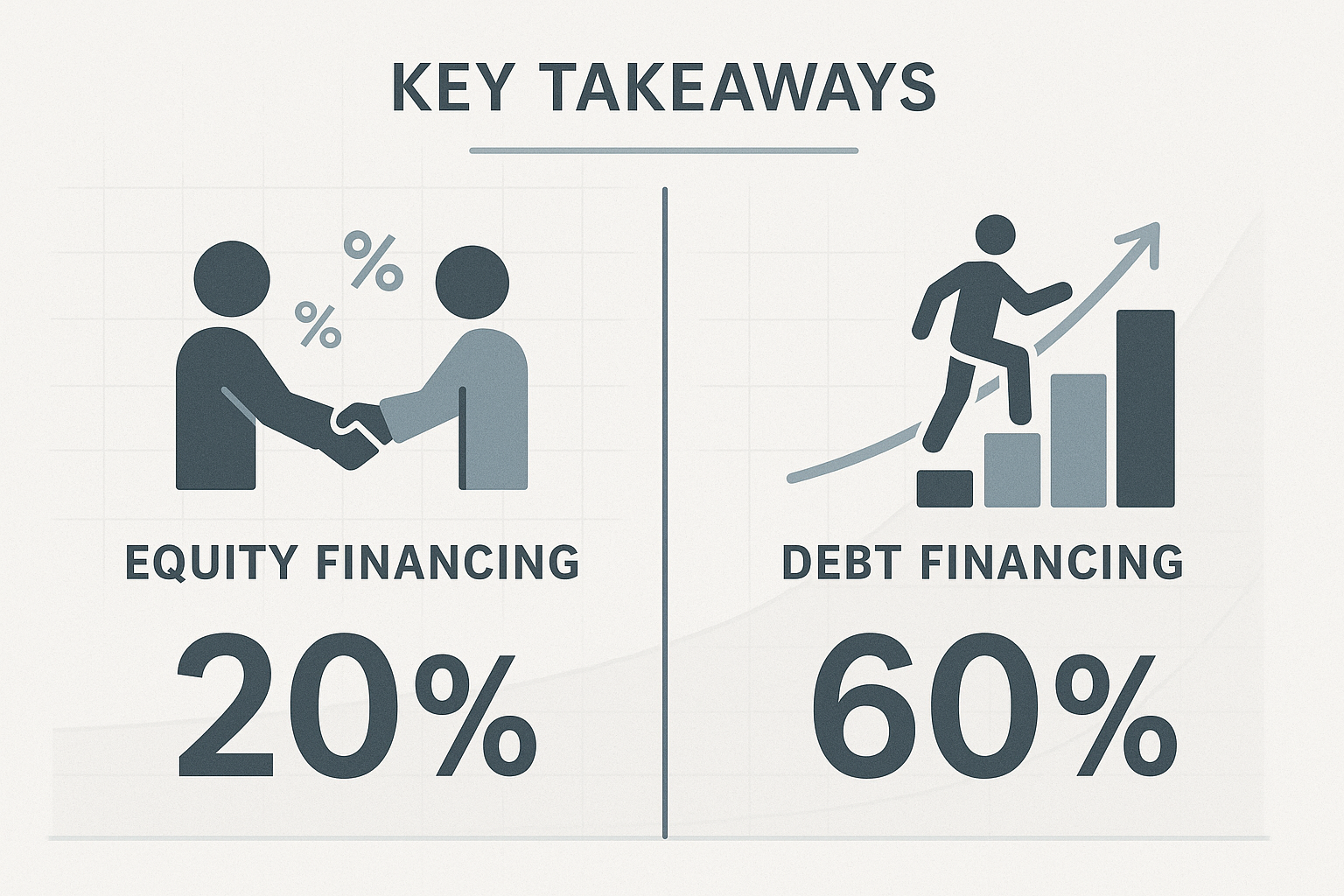
Choosing between equity and debt financing represents one of the most consequential capital structure decisions companies make. The optimal choice depends on specific company circumstances, growth stage, and strategic objectives.
Side-by-Side Comparison
| Factor | Equity Financing | Debt Financing |
|---|---|---|
| Repayment | No repayment required; investors exit through liquidity events | Fixed repayment schedule with principal and interest |
| Ownership | Dilutes ownership; investors become partial owners | Preserves ownership; lenders have no equity claims |
| Control | Investors gain governance rights and decision influence | Lenders have no operational control (but may impose covenants) |
| Cash Flow Impact | Zero ongoing cash requirements | Monthly/quarterly debt service reduces available cash |
| Risk Distribution | Investors absorb downside risk | Company bears full risk; default triggers collateral seizure |
| Cost of Capital | Dilution cost; typically 15%-30% expected annual returns | Interest rate; typically 5%-12% for established companies |
| Qualification | Based on growth potential and team quality | Based on assets, cash flow, and credit history |
| Timeline | 4-8 months typical fundraising process | 2-8 weeks for approval and funding |
| Best For | Early-stage, high-growth companies with long development cycles | Established companies with positive cash flow and assets |
When Equity Financing Makes Sense
Choose equity financing when:
1. Negative or Unpredictable Cash Flow: Companies cannot service debt without positive, stable cash flow. Pre-revenue startups and businesses with long development cycles require equity.
2. Limited Collateral Assets: Lenders require collateral. Software companies with minimal physical assets struggle to secure traditional loans.
3. High Growth Potential: When capital can generate returns exceeding dilution costs, equity creates value. A company that can deploy $5 million to grow from $50 million to $200 million valuation should accept 20% dilution.
4. Strategic Value-Add: When investors provide expertise, networks, and resources beyond capital, the total value exceeds pure financial cost.
5. Balance Sheet Strength: Companies wanting to preserve debt capacity for future needs benefit from equity financing that strengthens rather than weakens financial ratios.
When Debt Financing Makes Sense
Choose debt financing when:
1. Positive, Stable Cash Flow: Companies generating consistent profits can service debt while preserving ownership. A profitable business earning $2 million annually can support $500,000 in annual debt service.
2. Lower Cost of Capital: Debt interest rates (5%-12%) typically cost less than equity dilution (15%-30% expected returns). When available, debt preserves more value for owners.
3. Ownership Preservation: Founders unwilling to dilute control should use debt financing when cash flow supports it.
4. Tax Benefits: Interest payments are tax-deductible, reducing effective borrowing costs. A company in a 25% tax bracket paying 8% interest has an effective after-tax cost of 6%.
5. Short-Term Capital Needs: Temporary capital requirements (inventory financing, equipment purchases) suit debt better than permanent equity dilution.
Hybrid Approaches: Convertible Instruments
Many companies use convertible notes or SAFE (Simple Agreement for Future Equity) agreements that combine debt and equity characteristics:
Convertible Notes:
- Initially structured as debt with an interest rate
- Convert to equity at the future financing round
- Include valuation cap and discount rate
- Provide bridge financing between equity rounds
SAFE Agreements:
- Not debt (no interest or maturity date)
- Convert to equity at the future priced round
- Include valuation cap
- Simpler documentation than convertible notes
These instruments defer valuation negotiations while providing near-term capital. They work well for early-stage companies raising smaller amounts ($100,000-$1 million) before establishing clear valuations.
The conversion mathematics significantly impact founder dilution:
Example:
- SAFE investment: $500,000
- Valuation cap: $5 million
- Series A price: $10 million pre-money, $2 per share
SAFE converts at the lower of:
- Cap valuation: $500,000 ÷ $5M = 10% ownership
- Series A price with discount: Varies by discount rate
The valuation cap protects early investors from excessive dilution while providing companies with immediate capital.
Understanding debt-to-equity ratios and capital structure optimization helps companies balance these financing approaches.
Real-World Examples: Equity Financing Success Stories and Cautionary Tales
Examining actual equity financing outcomes reveals patterns that separate value-creating decisions from value-destroying mistakes.
Success Story: Airbnb’s Strategic Equity Raises
Airbnb raised approximately $6 billion across multiple equity rounds before going public in 2020 at a $47 billion valuation.
Funding Timeline:
- 2009 Seed: $600,000 at $2.4 million valuation
- 2010 Series A: $7.2 million at $67.5 million valuation
- 2011 Series B: $112 million at $1.3 billion valuation
- 2015 Series E: $1.5 billion at $25.5 billion valuation
- 2020 IPO: $47 billion valuation
Founder dilution was substantial; Brian Chesky owned approximately 11% at IPO compared to his founder stake. However, 11% of $47 billion ($5.2 billion) vastly exceeded 100% of the bootstrapped alternative valuation.
The equity capital enabled:
- Global market expansion across 220+ countries
- Technology infrastructure supporting millions of listings
- Trust and safety systems reducing fraud
- Marketing campaigns build brand awareness
- Talent acquisition, attracting world-class executives
Without equity financing, Airbnb would have remained a small marketplace unable to achieve network effects and global scale. The dilution cost was justified by the exponentially larger outcome it enabled.
Cautionary Tale: WeWork’s Valuation Collapse
WeWork raised over $12 billion in equity financing, reaching a $47 billion private valuation in 2019 before collapsing to approximately $8 billion and requiring a bailout.
What Went Wrong:
- Excessive Valuation: The $47 billion valuation implied unrealistic growth and profitability assumptions
- Misaligned Incentives: Founder Adam Neumann extracted hundreds of millions personally while the company burned cash
- Governance Failures: Investors failed to impose adequate controls despite massive capital deployment
- Business Model Weakness: Long-term lease obligations with short-term revenue created structural fragility
Employees and later-stage investors suffered massive losses as the valuation collapsed. Early investors like Benchmark Capital still generated returns, but later investors—particularly SoftBank—lost billions.
The lesson: Equity financing at excessive valuations creates unsustainable expectations and eventual value destruction. Valuation discipline matters as much as capital access.
Lesson: Bootstrapped Alternatives
Not all successful companies require equity financing. Mailchimp grew to a $12 billion acquisition by Intuit in 2021 without ever raising institutional capital.
Founders Ben Chestnut and Dan Kurzius maintained 100% ownership by:
- Growing organically from customer revenue
- Maintaining profitability throughout the company’s history
- Reinvesting profits into product development
- Accepting slower but sustainable growth rates
At exit, the founders received 100% of the $12 billion proceeds rather than a diluted percentage. This outcome exceeded what most venture-backed founders achieve despite slower growth.
The bootstrapped approach works when:
- Business models generate early revenue
- Capital requirements fit within cash flow generation
- Founders accept moderate growth rates
- Markets don’t require rapid scale for competitive positioning
Understanding when equity financing adds value versus when it merely dilutes ownership separates sophisticated capital allocation from default fundraising.
How to Prepare for Equity Financing: Practical Steps
Companies seeking equity financing should follow systematic preparation processes that maximize valuation, minimize dilution, and attract quality investors.
Step 1: Build a Compelling Financial Model
Investors evaluate opportunities through financial projections demonstrating growth potential and return possibilities.
Essential Model Components:
- Revenue Projections: Monthly forecasts for 3-5 years with clear assumptions
- Unit Economics: Customer acquisition cost (CAC), lifetime value (LTV), contribution margins
- Operating Expenses: Detailed breakdown of personnel, marketing, technology, and overhead costs
- Cash Flow Analysis: Monthly cash burn and runway calculations
- Sensitivity Analysis: Best case, base case, and worst case scenarios
The model should demonstrate:
- Path to profitability or sustainable growth
- Efficient unit economics (LTV: CAC ratio of 3:1 or better)
- Reasonable market penetration assumptions
- Clear use of funds and milestone achievement
Investors scrutinize assumptions rigorously. A revenue projection assuming 50% monthly growth without supporting evidence destroys credibility. Conservative assumptions with clear justification build trust.
Step 2: Develop a Professional Pitch Deck
The pitch deck serves as the primary tool for initial investor communication.
Standard Deck Structure (12-15 slides):
- Problem: Clear articulation of the customer pain point
- Solution: Product/service addressing the problem
- Market Opportunity: Total addressable market (TAM) and growth trends
- Product: Screenshots, demos, or detailed descriptions
- Traction: Revenue, users, growth metrics, customer testimonials
- Business Model: How the company makes money
- Competition: Competitive landscape and differentiation
- Go-to-Market Strategy: Customer acquisition approach
- Team: Founder backgrounds and key hires
- Financials: 3-5 year projections and key metrics
- Use of Funds: Specific allocation of capital being raised
- Ask: Investment amount and terms
Visual clarity matters. Dense slides with excessive text reduce comprehension and engagement. Professional design, clear data visualization, and concise messaging improve investor response.
Step 3: Assemble a Complete Data Room
Investors conduct thorough due diligence before committing capital. Organized documentation accelerates the process and builds confidence.
Data Room Contents:
- Corporate Documents: Articles of incorporation, bylaws, cap table, board minutes
- Financial Information: Historical financials, tax returns, and financial model
- Legal Agreements: Customer contracts, vendor agreements, leases, employment agreements
- Intellectual Property: Patents, trademarks, IP assignments
- Product Documentation: Technical specifications, roadmap, development status
- Market Research: Industry reports, competitive analysis, customer research
- Team Information: Resumes, organizational chart, compensation structure
Digital data rooms (Dropbox, Google Drive, specialized platforms) provide organized access with permission controls and activity tracking.
Complete, organized documentation signals operational sophistication and reduces investor concerns about hidden problems.
Step 4: Research and Target Appropriate Investors
Not all investors suit all companies. Strategic targeting improves success rates and investor fit.
Investor Selection Criteria:
- Stage Focus: Seed, Series A, growth-stage alignment
- Sector Expertise: Industry knowledge and relevant portfolio companies
- Geographic Preference: Local, regional, or global investment scope
- Check Size: Typical investment amounts matching capital needs
- Value-Add Capabilities: Specific expertise, networks, or resources
- Portfolio Compatibility: Complementary rather than competing portfolio companies
Research investor portfolios, investment theses, and partner backgrounds. A personalized outreach explaining why the specific investor fits the company generates a better response than mass generic pitches.
Warm introductions through mutual connections dramatically increase meeting success rates compared to cold outreach.
Step 5: Negotiate Terms Strategically
Term sheet negotiation extends beyond valuation to include provisions significantly affecting founder outcomes.
Key Negotiation Points:
Valuation: Pre-money valuation determines dilution percentage
Liquidation Preference: 1x non-participating protects investors without excessive founder penalty
Board Composition: Balanced representation preserves founder influence
Anti-Dilution Protection: Broad-based weighted average provides reasonable investor protection
Vesting: Founder vesting (typically 4 years with a 1-year cliff) aligns long-term commitment
Option Pool: Pre-money option pool inclusion reduces founder dilution
Understanding the mathematical impact of each provision prevents agreeing to terms that destroy value in common exit scenarios.
Example impact analysis:
Scenario: $50 million acquisition
Investment: $5 million at $20 million post-money (25% ownership)
Liquidation Preference: 1x participating vs. 1x non-participating
1x Non-Participating:
- Investors receive greater of: $5M (1x preference) or 25% × $50M = $12.5M
- Investors take $12.5M
- Founders receive $37.5M
1x Participating:
- Investors receive $5M preference + (25% × $45M remaining) = $5M + $11.25M = $16.25M
- Founders receive $33.75M
The participating preference costs founders $3.75 million in this scenario—a 10% reduction in proceeds from a single term.
Sophisticated negotiation of these provisions significantly impacts ultimate founder returns.
💰 Equity Financing Calculator
Calculate ownership dilution and investor returns
📊 Equity Financing Results
Ownership Distribution
💡 Key Insight:
Conclusion: Making Smart Equity Financing Decisions
Equity financing represents a powerful capital-raising tool that transforms investor money into ownership stakes, eliminating debt service requirements while creating aligned partnerships focused on long-term value creation.
The core mathematics are straightforward: Investment Amount ÷ Post-Money Valuation = Ownership Percentage. Yet the strategic implications extend far beyond this simple equation.
Equity financing makes sense when:
- Companies lack positive cash flow to service debt obligations
- Growth potential exceeds dilution costs, creating net value despite ownership reduction
- Investor expertise, networks, and resources provide value beyond pure capital
- Business models require patient capital through long development cycles
- Balance sheet strength matters more than ownership preservation
Equity financing destroys value when:
- Companies could achieve similar outcomes through bootstrapping or debt financing
- Excessive valuations create unsustainable growth expectations
- Founder-investor misalignment on strategy, timeline, or exit preferences
- Dilution costs exceed the incremental value capital enables
The decision requires rigorous analysis comparing alternative scenarios: What valuation could the company achieve with equity financing versus without it? Does the diluted ownership percentage of the larger outcome exceed the undiluted percentage of the smaller outcome?
A founder owning 40% of a $100 million company ($40 million) achieves better outcomes than owning 100% of a $20 million company ($20 million). The dilution created value.
Conversely, a founder owning 30% of a $50 million company ($15 million) achieves worse outcomes than owning 100% of a $20 million company through bootstrapping. The dilution destroyed value.
This mathematical framework, comparing diluted ownership of accelerated outcomes against undiluted ownership of organic outcomes, should guide every equity financing decision.
Next Steps for Founders Considering Equity Financing
- Build detailed financial models projecting outcomes with and without equity capital
- Calculate dilution costs across multiple funding rounds and exit scenarios
- Research appropriate investors matching your stage, sector, and strategic needs
- Prepare comprehensive materials, including a pitch deck, a financial model, and a data room
- Negotiate terms strategically, understanding the mathematical impact of each provision
- Maintain ownership discipline, preserving sufficient founder stakes to stay motivated through exit
Equity financing done well accelerates growth, attracts valuable partners, and creates outcomes impossible through alternative approaches. Equity financing done poorly dilutes ownership without commensurate value creation, surrenders control to misaligned investors, and destroys founder returns.
The difference lies in understanding the math behind money—calculating precisely when ownership trade-offs create value versus when they merely transfer it from founders to investors.
Master these calculations, and equity financing becomes a strategic tool for wealth building rather than a default fundraising approach. Make decisions based on data-driven analysis rather than conventional wisdom, and structure capital raises that maximize value creation while preserving appropriate founder incentives.
The companies that achieve exceptional outcomes treat equity financing as a calculated strategic decision, not an inevitable requirement. They raise capital when it creates value, decline it when it doesn’t, and negotiate terms that align all stakeholders toward shared success.
That disciplined approach—rooted in financial literacy and evidence-based decision-making—separates founders who build sustainable wealth from those who dilute themselves into insignificance.
References
[1] Investopedia – Equity Financing: What It Is, How It Works, Pros and Cons
[2] Corporate Finance Institute – Equity Financing
[3] Harvard Business Review – Understanding Venture Capital Economics
[4] National Venture Capital Association – 2024 Yearbook
[5] SEC – Regulation Crowdfunding Guidelines
[6] CB Insights – Venture Capital Funnel Analysis
[7] PitchBook – Venture Capital Valuations Report 2024
Author Bio
Max Fonji is the founder of The Rich Guy Math, a data-driven financial education platform teaching the mathematical principles behind wealth building, investing, and risk management. With a background in financial analysis and a commitment to evidence-based investing, Max translates complex financial concepts into clear, actionable insights for beginner and intermediate investors.
Educational Disclaimer
This article provides educational information about equity financing concepts and should not be construed as financial, legal, or investment advice. Equity financing decisions involve complex legal, financial, and strategic considerations that vary based on individual circumstances. Consult qualified financial advisors, attorneys, and tax professionals before making capital-raising decisions. Past performance of companies or investment returns does not guarantee future results. All investments involve risk, including potential loss of capital.
Frequently Asked Questions About Equity Financing
What is equity financing in simple terms?
Equity financing means selling ownership shares in your company to investors in exchange for capital. Instead of borrowing money that must be repaid with interest, you give investors a percentage of your business. They become partial owners who profit when the company grows in value and eventually sells or goes public.
How does equity financing differ from debt financing?
Equity financing exchanges ownership for capital with no repayment requirements, while debt financing borrows money that must be repaid with interest while preserving ownership. Equity investors share both risks and rewards, while lenders receive fixed returns regardless of company performance. Equity provides patient capital suited to long-term growth; debt requires regular payments that can strain cash flow.
What are the main advantages of equity financing?
The primary advantages include: (1) no repayment obligations or monthly payments, (2) shared risk with investors who lose money if the company fails, (3) access to investor expertise, networks, and strategic guidance, (4) improved balance sheet strength without adding debt, and (5) patient capital suited to long development cycles before profitability.
What are the main disadvantages of equity financing?
The key disadvantages are: (1) ownership dilution reducing founder control and profit share, (2) loss of decision-making autonomy as investors gain governance rights, (3) time-consuming and complex fundraising processes, (4) pressure for high-growth strategies and exits that may not align with founder preferences, and (5) disclosure requirements reducing privacy.
When should a company choose equity financing over debt?
Companies should choose equity financing when they: (1) have negative or unpredictable cash flow that cannot service debt, (2) lack collateral assets required for traditional loans, (3) have high growth potential where capital can generate returns exceeding dilution costs, (4) need strategic value from investors beyond just capital, or (5) operate in industries with long development cycles before revenue generation.
How much equity should I give to investors?
The equity percentage depends on your company’s pre-money valuation and the capital amount raised. Calculate: Investment Amount ÷ Post-Money Valuation = Ownership Percentage. Typical ranges: seed rounds (10%-25%), Series A (15%-30%), Series B (15%-25%). Minimize dilution by maximizing valuation, but avoid excessive valuations that create unsustainable expectations. Maintain enough founder ownership (typically 15%-25% post-dilution) to stay motivated through exit.
What is a good valuation for my startup?
Appropriate valuations depend on traction, market size, team quality, and competitive positioning. Pre-revenue startups typically range from $1 million-$5 million. Companies with early revenue and product-market fit range from $5 million-$20 million. Growth-stage companies with proven business models range from $20 million-$100 million+. Use comparable company analysis, examining similar businesses’ valuations at similar stages. Avoid overvaluation—it creates pressure and makes future fundraising difficult if you don’t meet growth expectations.
How long does equity financing typically take?
Expect 4-8 months for a complete equity financing process: 4-8 weeks for preparation (pitch deck, financial model, data room), 8-16 weeks for investor outreach and initial meetings, and 4-8 weeks for due diligence, negotiation, and closing. Angel rounds may move faster (2-4 months), while institutional venture capital typically takes longer (4-8 months). Plan accordingly and start fundraising before you need capital.
Related posts:
 What Is SmartPass? Raptor Digital Hall Pass Explained for K-12 Schools
 What Is the 3x Rent Rule & How to Calculate It (With Examples)
 Portfolio Income: Definition, Examples, Tax Rules, and Strategies
 Bookkeeping vs Accounting: What’s the Difference & Which Do You Need?
 What Is Profitability Analysis & How to Do It: Metrics, Example & Tips
 Emergency Fund vs Savings: What’s the Real Difference and Why It Matters