

A grace period is a short window of time after a payment due date during which you can pay a bill, loan, or credit card balance without incurring late fees or penalties. Understanding how grace periods work can help you avoid unnecessary charges, protect your credit score, and manage your finances more effectively.
Whether it’s a credit card, loan, or insurance payment, knowing the exact length and rules of your grace period can save you money and stress. The grace period exists because lenders want to encourage responsible borrowing behavior — a core part of how credit scoring models judge reliability.
In this comprehensive guide, you’ll learn exactly how grace periods work, when they apply, how to maintain them, and the precise calculations that show why this knowledge directly impacts your wealth-building capacity.
Key Takeaways
- Grace periods typically last 21-25 days from your statement closing date to your payment due date, during which no interest accrues on new purchases
- Paying your full statement balance by the due date maintains your grace period and results in $0 interest charges, regardless of how much you spent
- Carrying any balance from month to month eliminates your grace period on new purchases, causing immediate interest accrual from the transaction date
- Grace periods don’t apply to cash advances or balance transfers, which begin accruing interest immediately at higher APR rates
- The grace period doesn’t directly affect your credit score, but the payment behaviors it influences, like on-time payments and credit utilization, have a significant scoring impact
What Is a Grace Period?
A grace period is the interest-free time between your billing cycle closing date and your payment due date. During this window, credit card issuers don’t charge interest on new purchases, giving cardholders time to pay their balance without finance charges.
The Credit Card Accountability Responsibility and Disclosure (CARD) Act of 2009 requires issuers to provide at least 21 days between when they mail your statement and when payment is due. Most major card issuers extend this to 21-25 days as standard practice.
Here’s what defines a grace period:
- Minimum duration: 21 days by federal law
- Typical duration: 21-25 days in practice
- Application: New purchases only (when you qualify)
- Cost during grace period: $0 in interest charges
- Requirement to maintain: Pay the full statement balance by the due date
Where Grace Period Information Appears
Your credit card statement displays grace period details in multiple locations:
Payment due date (clearly marked on page 1)
Statement closing date (the day your billing cycle ended)
Minimum payment vs. statement balance (critical distinction)
Interest charge section (shows $0 if grace period maintained)
Terms and conditions (explain grace period policy)
Important distinction: The grace period applies to the time after your billing cycle ends, not during the cycle itself. Purchases made during your 30-day billing cycle don’t accrue interest during that cycle; they’re simply recorded. The grace period is the additional 21-25 days after the cycle closes.
How a Grace Period Helps You Avoid Interest
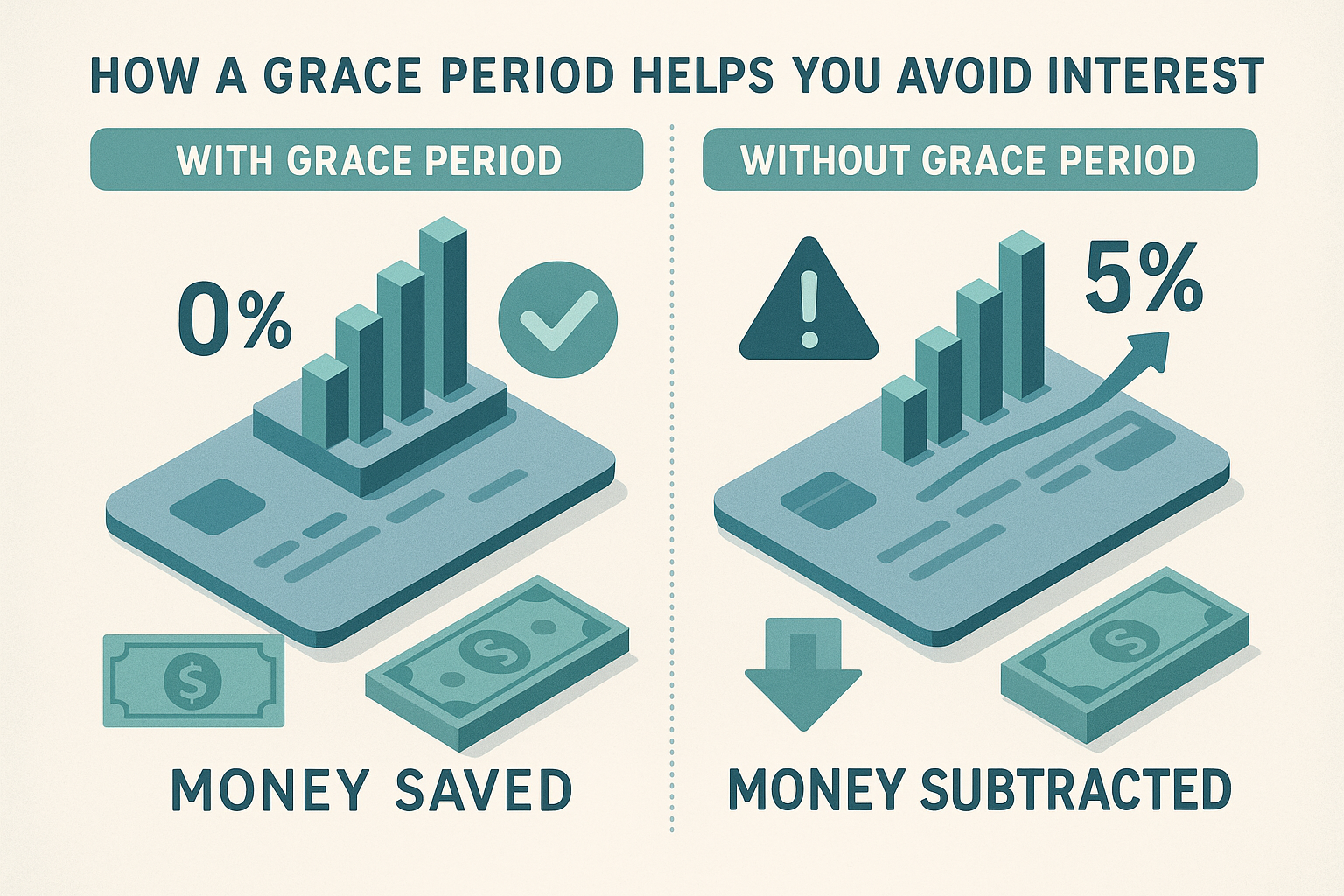
The grace period functions as an interest-free loan when used correctly. Understanding this mechanism reveals why credit cards can be valuable financial tools rather than debt traps.
The Zero-Interest Window
When you maintain your grace period by paying your full statement balance each month, here’s the mathematical reality:
Purchase on Day 1 of billing cycle → Statement closes Day 30 → Payment due Day 51-55 → Total interest-free time: 51-55 days
This creates a powerful financial advantage. Consider a $2,000 purchase at 18% APR:
- With grace period maintained: $0 interest
- Without a grace period (carrying balance): ~$30 in interest for one month
- Annual difference (on similar monthly spending): $360+ in interest charges
Pay Full Statement Balance, Not Minimum Payment
The grace period mechanism operates on a binary principle:
Full statement balance paid = Grace period continues = $0 interest on new purchases
Any amount less than the full balance = Grace period lost = Interest accrues from the purchase date
This is where the math behind money becomes critical. Your statement shows two numbers:
- Minimum payment (typically 1-3% of balance): Keeps account in good standing but triggers interest
- Statement balance (total amount): Maintains a grace period and avoids all interest
Example calculation:
- Statement balance: $1,500
- Minimum payment: $45 (3%)
- APR: 18% (1.5% monthly)
If you pay $45, you’ll pay ~$22.50 in interest this month, and your grace period disappears
If you pay $1,500, you’ll pay $0 in interest, and your grace period continues
The $1,455 difference in payment saves you $22.50 immediately and preserves your interest-free status for next month’s purchases.
Interest Accrual During vs. After Grace Period
During active grace period:
- Daily balance × Daily periodic rate × Days in cycle = $0 (grace period waives this)
- New purchases added to the balance without interest charges
- Statement generated showing total owed
After the grace period ends (balance carried forward):
- Daily balance × Daily periodic rate × Days in cycle = Interest charged
- New purchases begin accruing interest from the transaction date
- No interest-free period until the balance is paid in full for typically two consecutive months
This compound effect explains why credit card debt grows rapidly once the grace period is lost.
How Credit Card Billing Cycles Connect to Grace Periods
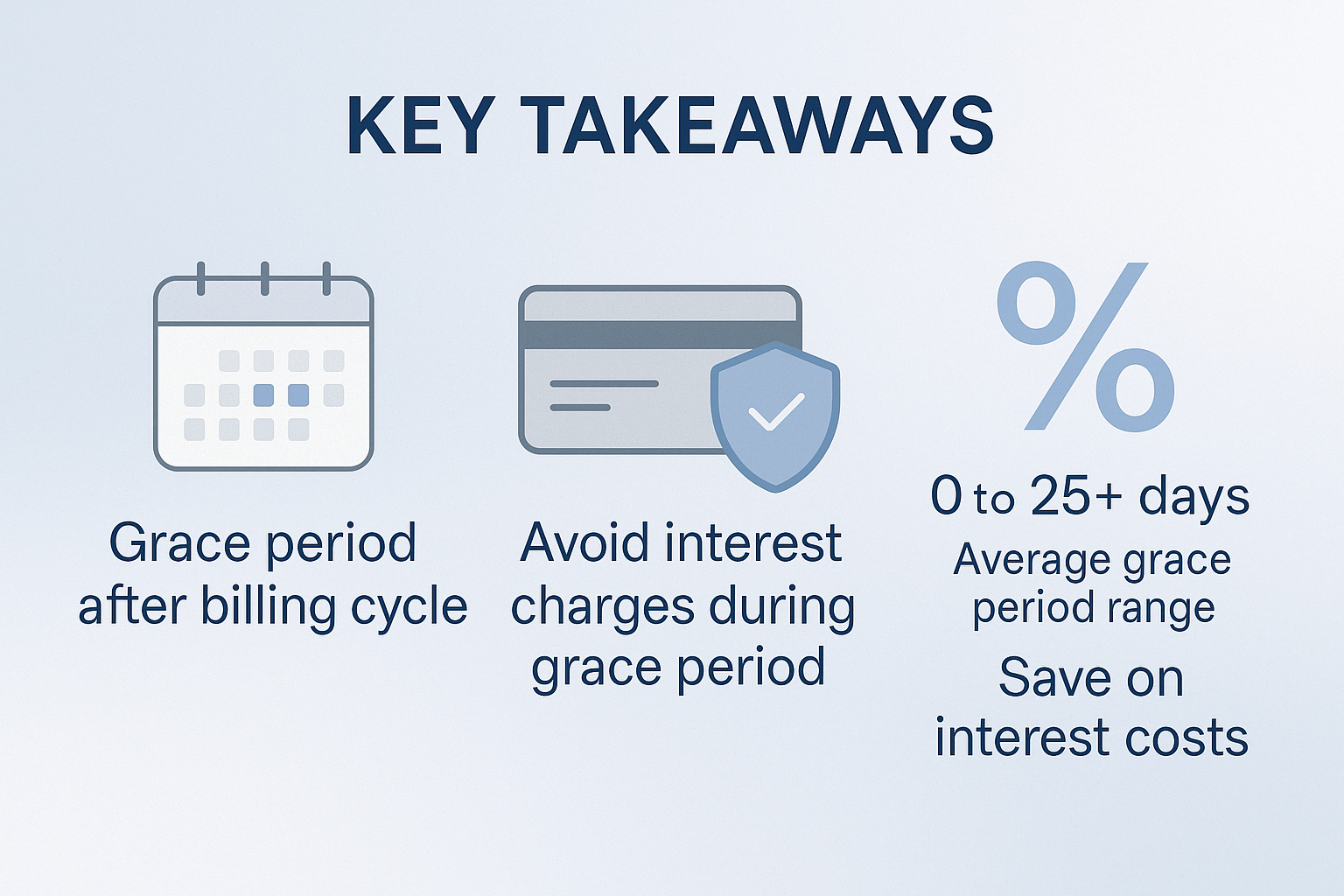
Understanding the relationship between billing cycles and grace periods requires examining the timeline that governs every credit card account.
The 30-Day Billing Cycle
Most credit cards operate on a 30-day billing cycle (some use 28-31 days depending on the month). During this period:
Day 1: Billing cycle begins (day after previous cycle closed)
Days 1-30: All purchases, payments, and transactions recorded
Day 30: Billing cycle closes; statement generated
Day 31: Grace period begins (if qualified)
The 21-25 Day Grace Period
After your billing cycle closes, the grace period clock starts:
Day 31-51 (or Day 31-55): Grace period active
Day 51-55: Payment due date
After due date: Late fees apply; grace period lost for future purchases
Complete Timeline Example
Let’s map a real-world scenario:
January 1-30: Billing cycle active
- January 5: Purchase $500 (electronics)
- January 15: Purchase $300 (groceries)
- January 25: Purchase $200 (gas)
- Total charges: $1,000
January 30: Statement closes
- Statement balance: $1,000
- Minimum payment: $30
- Payment due date: February 21 (22-day grace period)
January 31 – February 21: Grace period active
- No interest accruing on the $1,000 balance
- New purchases in the February billing cycle begin accumulating
- You have until February 21 to pay $1,000 and owe $0 interest
February 21: Payment received
- Scenario A: You pay $1,000 (full balance) → $0 interest charged, grace period continues for February purchases
- Scenario B: You pay $30 (minimum) → ~$15 interest charged, grace period lost on February purchases
Why the Timeline Matters for Financial Planning
This structure creates strategic opportunities for managing cash flow:
Maximum interest-free time: Make purchases on Day 1 of your billing cycle
- Day 1 purchase → Day 30 statement closes → Day 51-55 payment due
- Result: 51-55 days interest-free
Minimum interest-free time: Make purchases on Day 30 of your billing cycle
- Day 30 purchase → Day 30 statement closes → Day 51-55 payment due
- Result: 21-25 days interest-free
Understanding this timing allows you to optimize large purchases for maximum float time while maintaining zero interest costs, a practical application of the 50/30/20 rule budgeting framework.
When You Lose Your Grace Period
The grace period isn’t permanent; specific actions eliminate this interest-free window, often without cardholders realizing the consequences until interest charges appear.
Carrying a Balance Forward
The most common way to lose your grace period is by carrying any balance from one statement cycle to the next.
Mechanism:
- You receive a statement showing $1,200 balance
- You pay $500 (less than the full statement balance)
- Grace period immediately ends on new purchases
- Interest begins accruing on the remaining $700 plus all new purchases from the transaction date
Critical detail: Most card issuers require you to pay your balance in full for two consecutive billing cycles to restore your grace period. This means:
- Month 1: Pay full balance → Still no grace period on new purchases
- Month 2: Pay full balance again → Grace period restored for Month 3 purchases
Financial impact:
- Lost grace period on $2,000 monthly spending at 18% APR
- Monthly interest: ~$30
- Until grace period restored (2 months minimum): $60+ in unnecessary interest
Missing a Payment Deadline
Late payments trigger multiple consequences beyond just late fees:
Immediate effects:
- Late fee: $25-$40 typically
- Grace period eliminated
- Possible penalty APR activation (up to 29.99%)
- Negative mark on credit report if 30+ days late
Ongoing effects:
- Interest accrues on all balances immediately
- New purchases charged interest from the transaction date
- Grace period restoration requires two full payment cycles
- Credit score impact lasts 7 years for serious delinquencies
Example calculation:
- Balance: $3,000
- Regular APR: 18%
- Penalty APR: 29.99%
- Late fee: $40
Month 1 interest at penalty rate: ~$75
Late fee: $40
Total cost of one missed payment: $115+ (plus ongoing higher interest until penalty APR removed)
Cash Advances and Balance Transfers
These transactions never receive grace period protection, regardless of your payment history:
Cash advances:
- Interest begins accruing immediately from the transaction date
- Higher APR (typically 25-30%)
- Additional fee: 3-5% of the advance amount
- No grace period until the cash advance is fully repaid
Example:
- $500 cash advance
- Cash advance APR: 28%
- Cash advance fee: 5% ($25)
- Daily periodic rate: 0.0767%
Day 1 cost: $25 fee
Day 30 interest: ~$11.50
Total cost after 30 days: $36.50 (7.3% of the advance amount)
Balance transfers:
- Promotional 0% APR periods may apply
- Transfer fee: 3-5% typically
- After promotional period: No grace period on remaining balance
- New purchases may have different terms
Cards with No Grace Period
Some credit card products don’t offer grace periods at all:
Subprime credit cards (for rebuilding credit)
Secured credit cards (some issuers)
Store credit cards (select retailers)
Charge cards (different structure entirely)
Always verify grace period terms in your card agreement. The Schumer Box disclosure (standardized terms table) clearly states whether a grace period exists and its duration.
Understanding when you lose your grace period connects directly to maintaining low credit utilization and avoiding the debt cycle that prevents wealth building.
Does a Grace Period Affect Your Credit Score?
The grace period itself doesn’t appear on your credit report or directly influence your credit score, but the behaviors it encourages have a significant scoring impact.
Direct Impact: None
Credit bureaus (Equifax, Experian, TransUnion) don’t receive information about:
- Whether your card has a grace period
- Whether you’re currently in a grace period
- Whether you’ve lost or maintained your grace period
- How long does your grace period last
Your credit report shows:
- Current balance
- Credit limit
- Payment history (on-time vs. late)
- Account age and status
- Credit utilization ratio
Indirect Impact: Substantial
Grace period management influences credit score factors:
Payment history (35% of FICO score):
- Maintaining a grace period requires on-time full payments
- On-time payments build a positive payment history
- Missing payments (which eliminates the grace period) severely damages the score
- Impact: Payment history is the single largest scoring factor
Credit utilization (30% of FICO score):
- Paying the full balance monthly keeps utilization low
- Carrying balances increases the utilization ratio
- Optimal utilization: Below 30%, ideally below 10%
- Impact: High utilization from carried balances reduces score by 50-100+ points
Example scenario:
- Credit limit: $10,000
- Monthly spending: $2,000
- Statement balance: $2,000
Scenario A (grace period maintained):
- Pay $2,000 in full by the due date
- Reported balance: $0 (if paid before reporting date)
- Utilization: 0%
- Payment history: Positive
- Credit score impact: Neutral to positive
Scenario B (grace period lost):
- Pay $200 minimum
- Reported balance: $1,800 + new charges
- Utilization: 18%+ and climbing
- Payment history: Technically on-time but building debt
- Credit score impact: Negative due to rising utilization
The Compound Effect on Credit Health
Maintaining your grace period creates a positive feedback loop:
Full payments → Low utilization → Higher credit score
Higher score → Better credit offers → Lower APRs elsewhere
Lower APRs → Less interest if you do carry a balance
Strong payment history → Credit limit increases
Higher limits → Lower utilization ratio (if spending stays constant)
Losing your grace period creates the opposite spiral:
Partial payments → Rising balance → Higher utilization
Higher utilization → Lower credit score
Lower score → Fewer credit options → Higher APRs
Higher APRs → More interest → Harder to pay off
Growing debt → Potential late payments → Severe score damage
This dynamic explains why understanding the grace period is fundamental to the math behind money and long-term wealth building. The difference isn’t just the interest you pay—it’s the credit opportunities you preserve or lose.
Real Example: Keeping vs Losing Your Grace Period
Theoretical explanations become concrete when you see the actual numbers. This example demonstrates the financial difference between maintaining and losing your grace period over three months.
Scenario Setup

Card details:
- Credit limit: $5,000
- APR: 18% (1.5% monthly rate)
- Grace period: 25 days
- Monthly spending: $1,500 consistently
Scenario A: Grace Period Maintained
Month 1:
- Purchases: $1,500
- Statement closes: January 30
- Payment due: February 24
- Payment made: $1,500 (full balance) on February 20
- Interest charged: $0
- Grace period status: Active
Month 2:
- Purchases: $1,500
- Statement closes: February 28
- Payment due: March 25
- Payment made: $1,500 (full balance) on March 22
- Interest charged: $0
- Grace period status: Active
Month 3:
- Purchases: $1,500
- Statement closes: March 30
- Payment due: April 24
- Payment made: $1,500 (full balance) on April 20
- Interest charged: $0
- Grace period status: Active
Three-month totals:
- Total spending: $4,500
- Total interest paid: $0
- Total cost: $4,500
Scenario B: Grace Period Lost (Partial Payments)
Month 1:
- Purchases: $1,500
- Statement closes: January 30
- Payment due: February 24
- Payment made: $500 on February 20
- Remaining balance: $1,000
- Interest charged on $1,000: $15.00 (1.5% × $1,000)
- Grace period status: Lost
Month 2:
- Previous balance: $1,000
- Interest from Month 1: $15
- New purchases: $1,500
- New purchases start accruing interest immediately (no grace period)
- Average daily balance: ~$2,300
- Statement closes: February 28
- Payment due: March 25
- Payment made: $500 on March 22
- Interest charged: $34.50 (1.5% × $2,300)
- Grace period status: Still lost
Month 3:
- Previous balance: $2,000
- Interest from Month 2: $34.50
- New purchases: $1,500
- New purchases still accruing interest from the transaction date
- Average daily balance: ~$3,400
- Statement closes: March 30
- Payment due: April 24
- Payment made: $500 on April 20
- Interest charged: $51.00 (1.5% × $3,400)
- Grace period status: Still lost
Three-month totals:
- Total spending: $4,500
- Total payments: $1,500
- Total interest paid: $100.50
- Remaining balance: $3,100.50
- Total cost: $4,600.50 (and growing)
Comparative Analysis Table
| Metric | Grace Period Maintained | Grace Period Lost | Difference |
|---|---|---|---|
| Total Spending | $4,500 | $4,500 | $0 |
| Total Payments | $4,500 | $1,500 | $3,000 |
| Interest Paid | $0 | $100.50 | $100.50 |
| Remaining Balance | $0 | $3,100.50 | $3,100.50 |
| True Cost | $4,500 | $4,600.50+ | $100.50+ |
| Credit Utilization | 0% | 62% | 62% |
| Credit Score Impact | Positive | Negative | Significant |
The Compounding Problem
If this pattern continues for 12 months with the same spending and payment behavior:
Scenario A (grace period maintained):
- Annual spending: $18,000
- Annual interest: $0
- Final balance: $0
Scenario B (grace period lost):
- Annual spending: $18,000
- Annual payments: $6,000
- Annual interest: ~$1,350
- Final balance: $13,350
- Account approaching credit limit
- Credit score significantly damaged
This mathematical reality demonstrates why the grace period represents one of the most valuable features in consumer finance. The difference isn’t just $100.50 in three months—it’s the trajectory toward either financial flexibility or a debt spiral.
Understanding this calculation connects to broader budgeting principles and explains why paying full statement balances is non-negotiable for wealth building.
How to Keep Your Grace Period
Maintaining your grace period requires systematic habits and strategic account management. These evidence-based practices ensure you never pay unnecessary interest.
1. Pay Your Full Statement Balance Every Month
This is the non-negotiable foundation of grace period maintenance.
Implementation strategy:
Review the statement within 24 hours of receiving it
- Verify all charges are legitimate
- Note the statement balance (not minimum payment)
- Confirm payment due date
- Check for any unexpected fees or interest charges
Schedule payment immediately
- Don’t wait until the due date
- Build in a 3-5 day buffer for processing time
- Set a calendar reminder for 3 days before the due date as a backup
Pay statement balance, not current balance
- Statement balance = Amount needed to maintain the grace period
- Current balance = Includes new charges from the current cycle
- Paying the current balance is fine, but not required for the grace period
Common mistake to avoid: Paying the minimum payment amount prominently displayed on statements. This keeps your account in good standing but eliminates your grace period.
2. Set Up Automatic Payments
Automation removes human error from the equation and ensures perfect payment timing.
Automatic payment options:
Option A: Auto-pay full statement balance. Recommended
- Automatically pays the full balance by due date
- Guarantees grace period maintenance
- Requires sufficient checking account funds
- Best for: Disciplined spenders who monitor their checking balance
Option B: Auto-pay minimum payment. Not recommended for the grace period
- Keeps account current but loses the grace period
- Useful only as a backup if you manually pay the full balance
- Creates a false sense of security
Option C: Auto-pay fixed amount Conditional
- Useful if you charge similar amounts monthly
- Risk: The Amount may be less than the statement balance in some months
- Requires monitoring to ensure full balance is paid
Set up best practices:
- Link to a checking account with a consistent positive balance
- Set payment date 3-5 days before due date
- Enable email/text confirmations for each payment
- Review statements monthly, even with auto-pay active
- Maintain a backup manual payment method
3. Avoid Cash Advances and Balance Transfers
These transactions bypass grace period protection entirely.
Cash advance alternatives:
- Emergency fund (build 3-6 months expenses)
- Personal loan (lower APR than cash advance rate)
- Accounts receivable acceleration (if self-employed)
- Short-term 0% credit card offer (for planned expenses)
Balance transfer considerations:
- Promotional 0% APR can be valuable for existing debt
- The transfer fee (3-5%) is usually cheaper than continued interest
- Keep the transferred balance separate from new purchases
- Pay off before the promotional period ends
- Don’t make new purchases on the transfer card (may lose grace period)
4. Monitor Your Billing Cycle and Due Dates
Grace period management requires knowing your account timeline precisely.
Key dates to track:
Statement closing date (when billing cycle ends)
- Typically, the same date each month
- Determines which purchases appear on the current statement
- Useful for timing large purchases
Payment due date (end of grace period)
- Usually 21-25 days after the statement closing date
- Hard deadline for maintaining the grace period
- May shift slightly due to weekends/holidays
Statement delivery date (when you receive the statement)
- Electronic: Usually the same day as the closing date
- Paper: 1-3 days after closing date
- Triggers your payment scheduling process
Tracking system:
- Add all three dates to the calendar with reminders
- Set an alert 3 days before the payment due date
- Note the statement closing date for strategic purchase timing
- Review dates annually (some issuers adjust dates)
5. Keep Credit Utilization Low
While not directly related to grace period mechanics, low credit utilization creates buffer room and financial flexibility.
Optimal utilization strategy:
- Keep total utilization below 30% of credit limit
- Ideal target: Below 10% for maximum credit score benefit
- Make mid-cycle payments to reduce the reported balance
- Request credit limit increases (without a hard inquiry if possible)
Example:
- Credit limit: $10,000
- Monthly spending: $2,000
- Statement balance: $2,000
Standard approach: Pay $2,000 by the due date
- Reported utilization: 20%
- Grace period: Maintained
Optimized approach: Pay $1,000 mid-cycle + $1,000 by due date
- Reported utilization: 10% (if payment before reporting date)
- Grace period: Maintained
- Credit score: Additional benefit from lower utilization
This strategy combines grace period maintenance with credit score optimization, both essential for wealth building through access to favorable credit terms.
6. Use Spending Alerts and Budgeting Tools
Technology enables proactive grace period management.
Recommended alerts:
- Statement ready notification
- Payment due reminder (3 days before)
- Large purchase notification ($100+)
- Unusual activity alert
- Payment processed confirmation
- Approaching credit limit warning (80% utilization)
Budgeting integration:
- Link card to budgeting app (Mint, YNAB, Personal Capital)
- Categorize spending automatically
- Ensure monthly spending doesn’t exceed available funds
- Track the statement balance vs the checking account balance
- Set aside the statement balance amount immediately after purchases
This systematic approach ensures grace period maintenance becomes automatic rather than requiring constant attention.
Grace Period Interest Calculator
See exactly how much you save by maintaining your grace period
Grace Period Maintained
Grace Period Lost
Total Savings by Maintaining Grace Period
Conclusion
The grace period represents one of the most powerful yet underutilized features in consumer finance. Understanding its mechanics transforms credit cards from potential debt traps into sophisticated financial tools that cost nothing when managed correctly.
The math is unambiguous: paying your full statement balance by the due date results in $0 interest charges, regardless of how much you spend. This simple practice, enabled by the grace period, can save hundreds to thousands of dollars annually while building positive credit history and maintaining low utilization ratios.
Key principles to remember:
Grace periods typically last 21-25 days after your billing cycle closes
Full statement balance payment maintains the grace period; partial payment eliminates it
Lost grace periods require two consecutive full payments to restore
Cash advances and balance transfers never receive grace period protection
Grace period management indirectly impacts credit scores through payment history and utilization
Actionable next steps:
- Review your current credit card statement to verify your grace period terms and identify your payment due date
- Set up automatic full balance payments to eliminate the risk of human error or forgotten due dates
- Add billing cycle dates to your calendar with reminders 3 days before payment due dates
- Calculate your current interest costs if you're carrying balances, using the calculator above
- Create a payoff plan if you've lost your grace period, prioritizing two consecutive full payments to restore interest-free status
The grace period exemplifies the broader principle that the math behind money rewards understanding over ignorance. Those who grasp this mechanism pay nothing for credit card convenience; those who don't pay compounding interest charges that erode wealth building capacity.
Your credit card issuer has given you a powerful tool. Whether it costs you nothing or hundreds of dollars per year depends entirely on whether you use the grace period correctly.
Start today: check your next statement closing date, mark your payment due date, and commit to paying the full balance. That single decision eliminates interest charges and puts you on the path to mastering credit as a wealth-building instrument rather than a wealth-destroying liability.
References
[1] Federal Reserve. "Credit Card Accountability Responsibility and Disclosure Act of 2009." Board of Governors of the Federal Reserve System. https://www.federalreserve.gov/creditcard/
[2] Consumer Financial Protection Bureau. "What is a grace period for a credit card?" CFPB Consumer Resources. https://www.consumerfinance.gov/
About the Author
Max Fonji is a data-driven financial educator and the voice behind The Rich Guy Math. With expertise in evidence-based investing, risk management, and the mathematical principles underlying wealth building, Max translates complex financial concepts into clear, actionable insights. His analytical approach combines institutional-grade financial analysis with accessible teaching methods, helping readers understand not just what to do with money, but why the math works. Max's work focuses on compound growth principles, valuation frameworks, and the cause-and-effect relationships that determine long-term financial outcomes.
Educational Disclaimer
This article is provided for educational and informational purposes only and does not constitute financial, investment, tax, or legal advice. The information presented represents general principles and should not be considered personalized recommendations for your specific financial situation.
Credit card terms, grace periods, APRs, and policies vary by issuer and individual card agreements. Always review your specific card agreement and consult with qualified financial professionals before making financial decisions. Grace period policies can change, and individual circumstances may affect how these features apply to your accounts.
While the Rich Guy Math strives for accuracy, financial regulations, credit card terms, and industry practices evolve. Verify all information with your card issuer and relevant authorities. Past performance and historical examples don't guarantee future results.
No content on this site creates a client-advisor relationship. For personalized guidance, consult licensed financial advisors, tax professionals, or credit counselors familiar with your complete financial picture.
Frequently Asked Questions About Grace Periods
What exactly is a grace period on a credit card?
A grace period is the interest-free time between your billing cycle closing date and your payment due date, typically lasting 21–25 days. During this window, you can pay your full statement balance without incurring any interest charges on new purchases. Federal law requires at least 21 days between when your statement is mailed and when payment is due.
Do all credit cards have grace periods?
No. While most major credit cards offer grace periods, some cards—particularly subprime credit cards for rebuilding credit and certain secured cards—don’t provide this feature. Always check your card agreement’s Schumer Box disclosure to confirm whether a grace period exists and its specific terms.
How do I know if I still have my grace period?
Check your credit card statement for interest charges. If you see $0 in interest charges and you paid your previous statement balance in full, your grace period is active. If interest appears on new purchases, your grace period has been lost and typically requires paying your balance in full for two consecutive billing cycles to restore.
Can I get my grace period back after losing it?
Yes, but it requires discipline. Most card issuers require you to pay your statement balance in full for two consecutive billing cycles to restore your grace period. During this restoration period, interest continues to accrue on all balances and new purchases, making it expensive to regain this benefit.
Does making the minimum payment keep my grace period?
No. Paying only the minimum payment keeps your account in good standing and avoids late fees, but it eliminates your grace period on new purchases. You must pay the full statement balance by the due date to maintain interest-free status on new transactions.
Do balance transfers and cash advances have grace periods?
No. These transactions begin accruing interest immediately from the transaction date, regardless of your payment history or grace period status on purchases. Cash advances typically carry higher APRs (25–30%) and additional fees (3–5% of the advance amount), making them expensive financing options.
How does the grace period affect my credit score?
The grace period itself doesn’t appear on your credit report or directly affect your score. However, the payment behaviors it encourages—paying on time and keeping balances low—significantly impact your credit score through payment history (35%) and credit utilization (30%).
When does the grace period start and end?
The grace period begins the day after your billing cycle closes (statement closing date) and ends on your payment due date. For example, if your billing cycle closes on January 30, your grace period runs from January 31 through approximately February 21–25, depending on your card issuer’s specific terms.
Can I make purchases during the grace period?
Yes. Purchases made during the grace period belong to your next billing cycle, not the current one. These new purchases will appear on your next statement and receive their own grace period, provided you pay your current statement balance in full by the due date.
What happens if I pay my balance a few days late?
Late payment triggers multiple consequences: a late fee ($25–$40), possible penalty APR activation (up to 29.99%), loss of grace period, and potential negative credit reporting if payment is 30+ days late. Even a few days late eliminates your grace period and may trigger fees, though credit reporting typically doesn’t occur until 30 days past due.
Related posts:
 Credit Utilization Ratio Explained: What It Is, How It Works, And How To Improve It
 How Long Do Late Payments Stay on Credit Report? The Complete 7-Year Timeline Explained
 Statement Balance: What It Is and How It Works Complete Guide
 Statement Balance vs Current Balance: Which One Should You to Pay
 Credit Card APR Explained: What It Is And How Interest Really Works
 How Long Does It Take to Build Credit? Real Timeline Explained