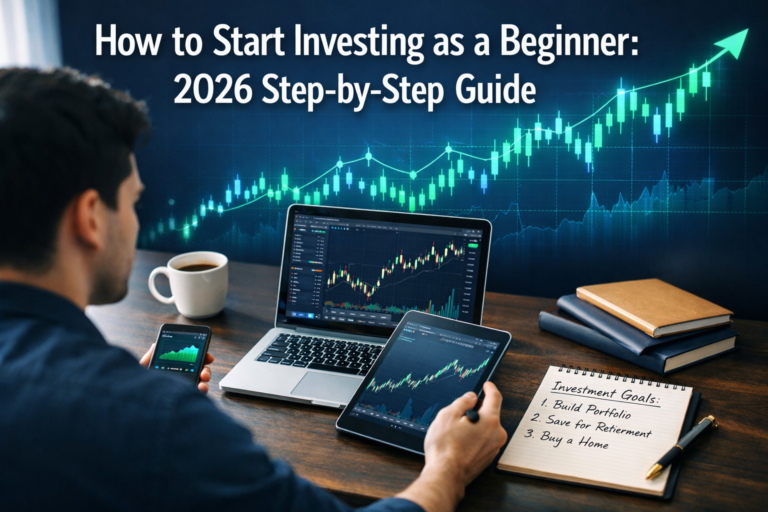

If you’ve ever wondered how to start investing but felt overwhelmed, you’re not alone. The truth is, you don’t need thousands of dollars, an MBA in finance, or insider knowledge to begin. You just need a clear plan, a little discipline, and the willingness to get started today.
This guide walks you through exactly how to start investing, even if you’re a total beginner with a small budget, so you can grow wealth over time without feeling lost or taking unnecessary risks.
1. Know Why You’re Investing
Before opening an account or buying your first stock, get crystal clear on why you’re investing. Are you:
- Saving for retirement?
- Building a down payment for a house?
- Preparing for your child’s education?
- Creating passive income streams?
Your goals and time horizon will shape your investment choices. Short-term goals require safer, liquid investments, while long-term goals allow for more growth-oriented investments like stocks.
2. Start with Your Employer’s 401(k) or Retirement Plan
If your employer offers a 401(k) or similar retirement plan, that’s often the easiest way to start.
- Employer match = free money – If your employer matches your contributions (e.g., dollar-for-dollar up to 5%), you should invest at least enough to get the full match.
- Contributions are often taken directly from your paycheck, so you invest automatically without thinking about it.
- You get tax advantages, either tax-deferred growth (traditional 401(k)) or tax-free withdrawals (Roth 401(k)).
Example:
If you earn $50,000/year and your employer matches 5%, that’s $2,500/year of free money—before your investments even grow.
3. Open an Investment Account
If you don’t have an employer plan—or want to invest beyond it—open one of these accounts:
- Roth IRA: Great for young investors; contributions grow tax-free.
- Traditional IRA: Contributions may be tax-deductible; withdrawals are taxed later.
- Brokerage Account: Flexible, no contribution limits, but no special tax benefits.
Popular beginner-friendly brokers:
Fidelity, Vanguard, Charles Schwab, Robinhood, E*TRADE, and Betterment.
4. Automate Your Investing
One of the biggest secrets to successful investing is automation.
- Set up automatic deposits from your paycheck or bank account into your investment account.
- Apps like Acorns, Wealthfront, and Betterment make this simple.
- Automatic investing removes emotions from the process and builds wealth quietly in the background.
5. Keep It Simple with Index Funds & ETFs
If you’re new to investing, you don’t need to pick individual stocks.
- Index Funds: Track a specific market index like the S&P 500, giving you instant diversification.
- ETFs (Exchange-Traded Funds): Similar to index funds but trade like stocks.
Why they’re great:
- Low fees (some under 0.05% annually)
- Diversification across hundreds of companies
- Easy to manage
Example: The Vanguard S&P 500 ETF (VOO) invests in 500 of the largest U.S. companies, giving you broad exposure in one purchase.
6. Understand Risk and Time Horizons
Your risk tolerance depends on your age, goals, and financial stability.
- Short-term (0–3 years): Keep money safe—high-yield savings, CDs, or Treasury bills.
- Medium-term (3–10 years): Mix of stocks and bonds.
- Long-term (10+ years): Heavier stock allocation for growth potential.
Rule of thumb: The younger you are, the more time you have to recover from market dips, so you can take more risk.
7. Diversify Your Portfolio
Never put all your eggs in one basket. Spread your investments across:
- Asset classes: Stocks, bonds, real estate, and cash.
- Sectors: Technology, healthcare, energy, consumer goods, etc.
- Geographies: U.S., international, and emerging markets.
Diversification helps protect you when one investment or sector underperforms.
8. Start Small Fractional Shares Are Your Friend
You don’t need $500 to buy Amazon stock anymore. Many brokers let you buy fractional shares.
Example:
If Amazon trades at $150/share, you can invest $15 and own 0.1 shares.
This is perfect for starting with as little as $5–$100 and still getting exposure to top companies.
9. Monitor & Rebalance Your Investments
Over time, certain investments will grow faster than others, shifting your asset allocation.
- Example: You start with 80% stocks and 20% bonds. After a great stock year, you might have 90% stocks and 10% bonds.
- Solution: Sell some stocks or buy more bonds to get back to your target allocation.
Check your portfolio at least once a year to keep it balanced.
10. Stay Consistent, Compounding Will Do the Rest
The biggest factor in building wealth isn’t timing the market; it’s time in the market.
If you invest $200/month at 8% average annual return:
- After 10 years: ~$36,000
- After 20 years: ~$118,000
- After 30 years: ~$273,000
This growth is the magic of compound interest, earning returns on both your contributions and your previous gains.
Beginner’s Investment Checklist
| Step | Action Item |
|---|---|
| 1 | Set your financial goals |
| 2 | Join your employer’s 401(k) (get the match!) |
| 3 | Open an IRA or brokerage account |
| 4 | Automate contributions |
| 5 | Invest in index funds or ETFs |
| 6 | Diversify across sectors & geographies |
| 7 | Start small, even with fractional shares |
| 8 | Rebalance annually |
| 9 | Stay invested long-term |