Statement closing date is the day your credit card issuer ends a billing cycle and calculates your statement balance. All purchases, payments, and credits posted before this date appear on that statement, while transactions after it roll into the next cycle. Knowing your statement closing date is critical because it affects your reported credit card balance, credit utilization ratio, interest charges, and credit score.
This article is part of our complete Credit Cards Guide, where we break down APRs, interest, rewards, fees, and how to use credit cards the smart way.
Most cardholders focus only on the payment due date. That’s a costly mistake. The math behind credit scoring reveals that what matters most isn’t when you pay; it’s what balance shows on your statement closing date. This is when the snapshot of your credit usage gets sent to Experian, Equifax, and TransUnion.
Key Takeaways
- Statement closing date marks the end of your billing cycle and determines the balance reported to credit bureaus, directly affecting your credit score
- Credit utilization is calculated on your closing date, not your due date. Paying after the statement closes won’t help that month’s credit report
- Optimal credit utilization thresholds are under 10% for excellent scores, with diminishing returns above 30%
- Strategic payments before your closing date can boost your credit score by 20-100 points within 30-60 days
- Different issuers report on different schedules; knowing your specific closing date enables precise credit optimization
What Is a Statement Closing Date?
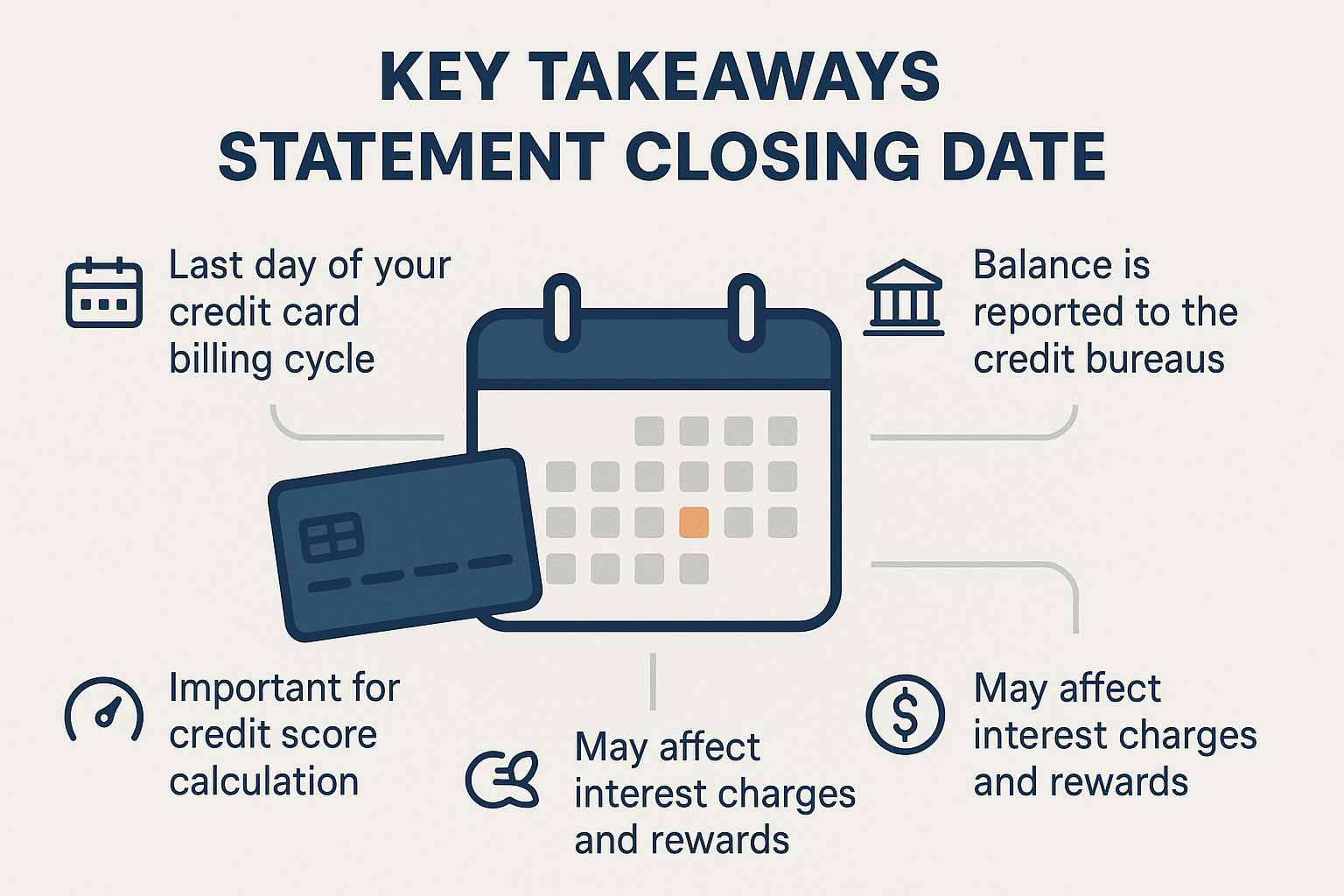
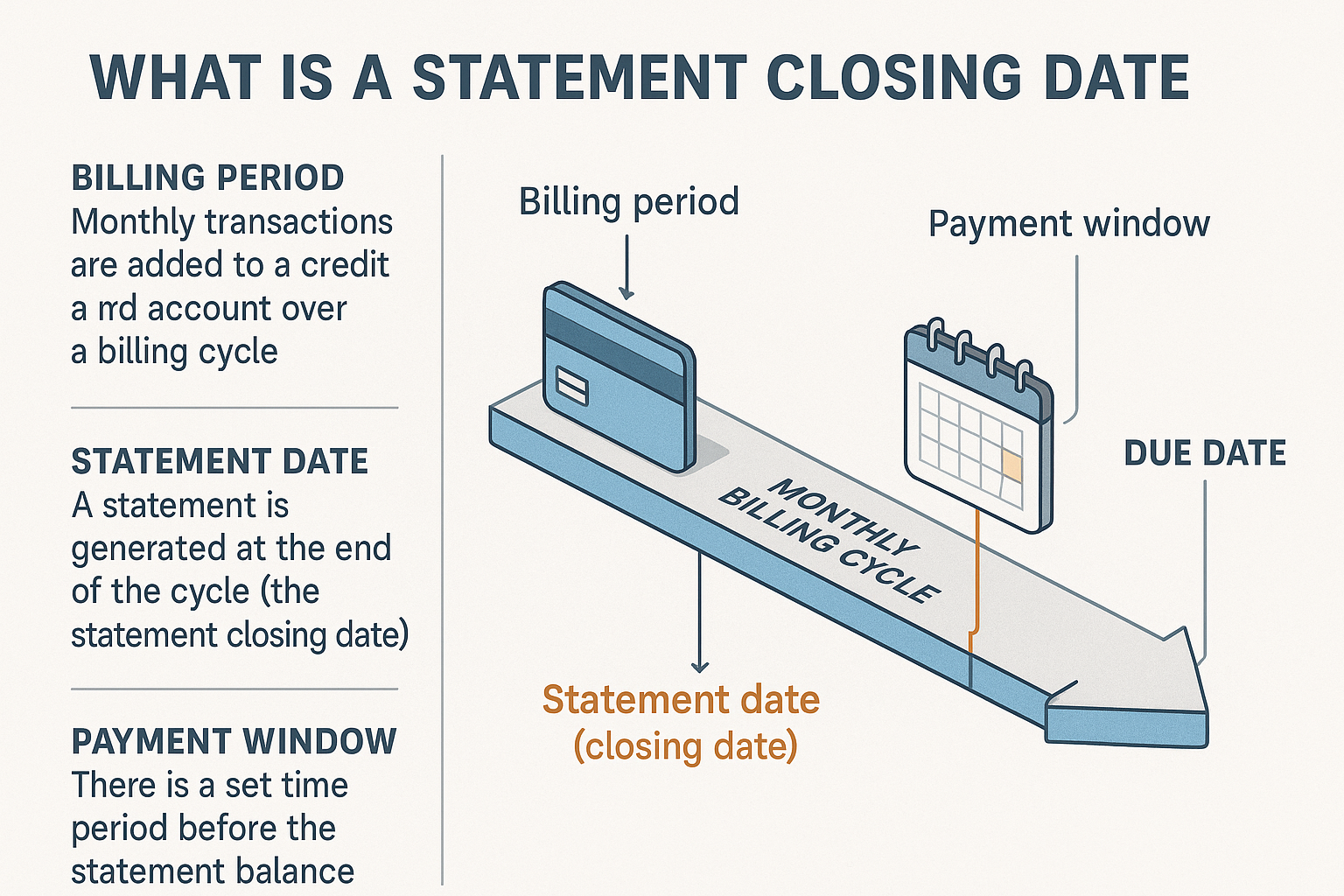
A statement closing date is the final day of your credit card billing cycle, typically a 28-31 day period, when your issuer calculates your statement balance, minimum payment, and interest charges. This date triggers the creation of your monthly billing statement.
Think of it as the financial equivalent of taking a photograph. Everything that was processed before this date appears in the picture. Everything after moves to the next month’s snapshot.
The Billing Cycle Explained
Your billing cycle runs continuously from one closing date to the next. If your statement closing date is the 15th of each month, your billing cycle runs from the 16th of one month through the 15th of the next month.
Here’s what happens during a typical billing cycle:
- Days 1-30: Transactions process and post to your account
- Day 30 (Closing Date): Issuer calculates statement balance, minimum payment, and interest (if applicable)
- Day 30-31: Statement generated and mailed/emailed to you
- Days 31-51: Grace period for payment (21-25 days minimum by federal law)
- Day 51: Payment due date, when your payment must arrive to avoid late fees
The closing date remains relatively consistent each month, though it may shift by a day or two depending on weekends and the number of days in the month.
Statement Closing Date vs Billing Cycle End
These terms are functionally identical. The statement closing date marks the end of your billing cycle. Some issuers use “cycle ending date” or “closing date” on statements; they all mean the same thing.
What gets calculated on your closing date:
- Statement balance: Total of all posted transactions during the cycle
- Minimum payment due: Usually 1-3% of balance or $25-35, whichever is greater
- Interest charges: Applied if you carried a balance from the previous month
- Credit utilization: Percentage of available credit you’re using
- Credit bureau reporting: Balance sent to Experian, Equifax, and TransUnion
When Interest Starts Accruing
This is where many cardholders get confused. Interest calculation follows specific rules based on whether you carry a balance.
If you pay your full statement balance by the due date:
- No interest charges on purchases (grace period applies)
- New purchases continue to have a grace period next month
- Cash advances and balance transfers may still accrue interest from day one
If you carry any balance past the due date:
- Interest accrues daily on the average daily balance
- You lose the grace period on new purchases
- Interest continues until you pay the full balance for two consecutive months
The annual percentage rate (APR) gets divided by 365 to calculate your daily periodic rate. A 20% APR translates to approximately 0.0548% per day. On a $5,000 balance, that’s $2.74 in interest charges daily, or $82.20 monthly.
Understanding APY vs APR helps clarify how interest compounds and why paying before the closing date matters for both credit scores and interest minimization.
Statement Closing Date vs Payment Due Date
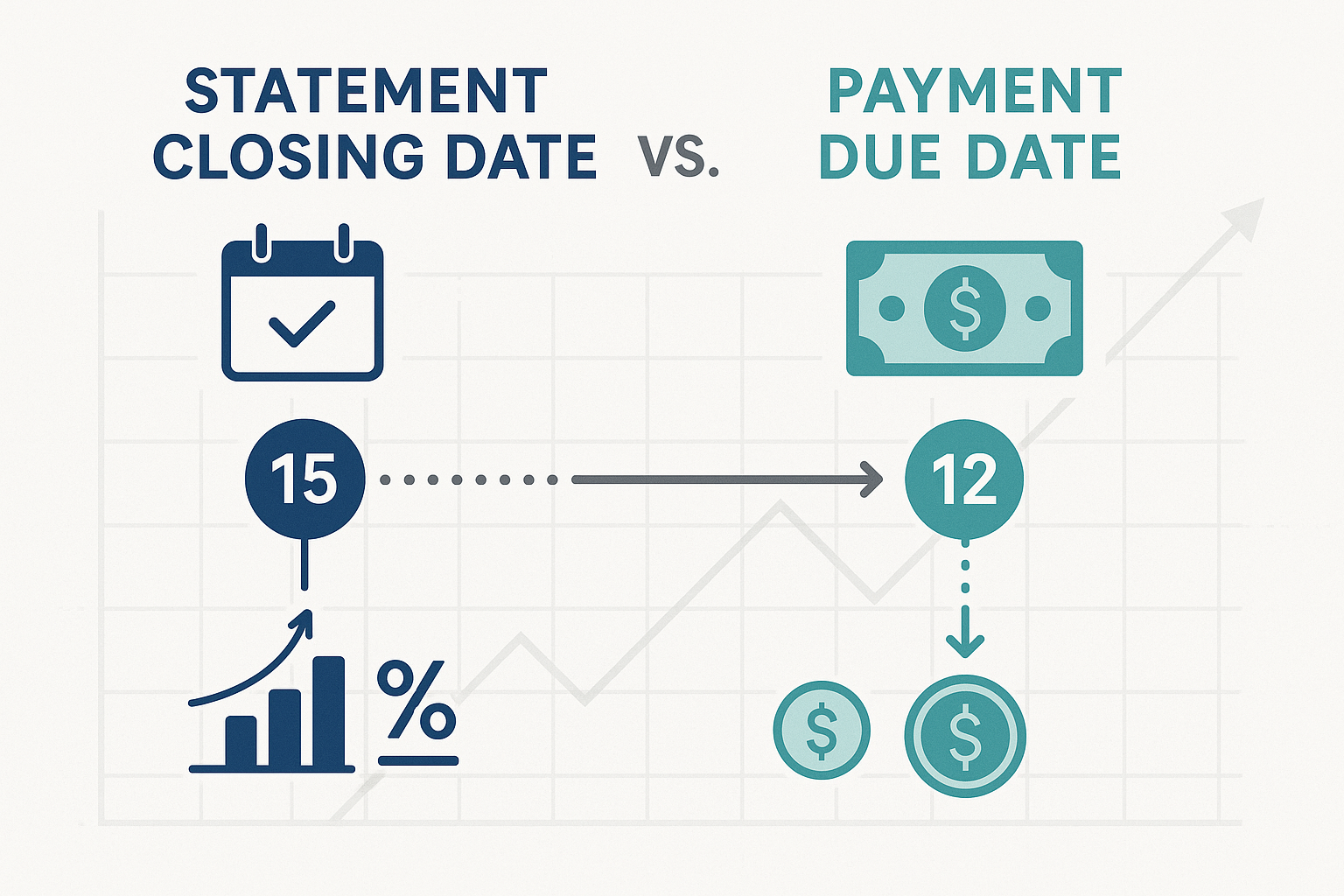
These two dates serve completely different functions in your credit card lifecycle. Confusing them costs cardholders points on their credit scores and dollars in unnecessary interest.
The Critical Timeline
Federal regulations require credit card issuers to provide at least 21 days between your statement closing date and payment due date. Most issuers provide 21-25 days. This window is your grace period—the time during which you can pay your balance without incurring interest charges (assuming you paid last month’s balance in full).
Example timeline for a typical credit card:
| Date | Event | Balance Status | Credit Impact |
|---|---|---|---|
| March 1-31 | Billing cycle active | Transactions posting | None yet |
| March 31 | Statement closing date | $3,200 statement balance calculated | Reported to bureaus |
| April 1-2 | Statement generated | Statement balance: $3,200 | Already reported |
| April 10 | You make $3,000 payment | Current balance: $200 | No impact until next cycle |
| April 25 | Payment due date | Remaining $200 due | Payment history recorded |
Why Credit Reporting Happens on the Closing Date
Credit card issuers report account information to credit bureaus on or shortly after your statement closing date, not your due date. This timing is crucial because it determines what balance appears on your credit report.
The reporting process works like this:
- Closing date arrives (e.g., March 31)
- Issuer calculates statement balance ($3,200 in our example)
- Within 1-3 days, the issuer transmits data to Experian, Equifax, and TransUnion
- Credit bureaus update your file with the new balance
- Your credit utilization recalculates based on this reported balance
- Your credit score adjusts within 24-48 hours of the bureau update
This means paying your balance on the due date (April 25 in our example) does nothing for the credit report that already went out on March 31. The bureaus already recorded your $3,200 balance and calculated your utilization accordingly.
The Math Behind This Timing
Consider two cardholders with identical $10,000 credit limits and spending patterns:
Cardholder A (pays on due date only):
- Spends $3,000 during billing cycle
- Statement closing date: $3,000 balance
- Reported utilization: 30%
- Pays $3,000 on due date
- Credit score impact: Moderate negative (30% utilization)
Cardholder B (pays before closing date):
- Spends $3,000 during billing cycle
- Pays $2,900 three days before the closing date
- Statement closing date: $100 balance
- Reported utilization: 1%
- Pays the remaining $100 on the due date
- Credit score impact: Minimal (1% utilization)
Both cardholders spent the same amount and paid in full. But Cardholder B’s credit score could be 20-50 points higher simply due to payment timing.
Payment Due Date Consistency
Your payment due date typically remains the same each month; if it’s the 18th in January, it will be the 18th in February, March, and so on. This consistency helps with budgeting strategies and automatic payment scheduling.
However, your statement closing date may shift by a day or two depending on:
- Number of days in the month (28-31)
- Weekend and holiday adjustments
- Issuer-specific policies
Most issuers aim to keep closing dates consistent (e.g., always the last day of the month or always the 15th), but minor variations occur.
How the Statement Closing Date Affects Your Credit Score
Your statement closing date creates the single most important data point in your credit file each month: your reported balance. This balance drives your credit utilization ratio, which accounts for approximately 30% of your FICO score.
Credit Utilization: The Second Most Important Factor
Credit utilization measures how much of your available credit you’re using. The formula is simple:
Credit Utilization = (Total Balances ÷ Total Credit Limits) × 100
FICO and VantageScore calculate utilization at two levels:
- Per-card utilization: Balance on each card divided by that card’s limit
- Overall utilization: Total balances across all cards divided by total credit limits
Both matter, but per-card utilization often carries more weight. A single card at 90% utilization will hurt your score even if your overall utilization is 10%.
The Utilization Thresholds That Matter
Credit scoring models use specific thresholds that trigger score changes. Understanding these numbers enables strategic optimization.
Utilization tiers and typical score impacts:
| Utilization Range | Score Impact | Example ($10,000 limit) |
|---|---|---|
| 0-2% | Optimal | $0-$200 balance |
| 3-9% | Excellent | $201-$900 balance |
| 10-29% | Good | $1,000-$2,900 balance |
| 30-49% | Fair (moderate penalty) | $3,000-$4,900 balance |
| 50-74% | Poor (significant penalty) | $5,000-$7,400 balance |
| 75%+ | Very poor (severe penalty) | $7,500+ balance |
The most dramatic score improvements occur when moving from above 30% to below 10%. A cardholder with 45% utilization who reduces to 8% can see a score increase of 40-80 points within one reporting cycle.
Why Your Score Drops Even When You Pay in Full
This phenomenon confuses thousands of cardholders monthly. You pay your balance in full every month, never carry debt, never pay interest, yet your score fluctuates or remains lower than expected.
The explanation lies in timing:
Your statement closing date captures a snapshot of your balance at that specific moment. If you regularly spend $4,000 monthly on a card with a $5,000 limit, your utilization reports as 80%, even though you pay it off completely every month.
Real example with numbers:
Sarah has a Chase Sapphire Preferred with a $8,000 limit. She uses it for all expenses to maximize rewards:
- Monthly spending: $5,600 average
- Payment behavior: Pays full balance on due date every month
- Statement closing date: 28th of each month
- Payment due date: 21st of following month
What happens:
- March 1-28: Charges $5,600 in purchases
- March 28 (closing date): Statement balance = $5,600
- Reported utilization: 70% ($5,600 ÷ $8,000)
- April 21: Sarah pays $5,600 in full
- Credit score impact: Significant penalty for 70% utilization
Sarah never carries a balance or pays interest, but her credit score treats her as a high-risk borrower because of the high utilization snapshot on her closing date.
The Numeric Impact on Credit Scores
Research from FICO and credit bureau data reveals specific score impacts from utilization changes:
Utilization reduction score gains (approximate):
- 50% → 30%: +10 to 25 points
- 50% → 10%: +30 to 60 points
- 30% → 10%: +15 to 35 points
- 30% → 2%: +20 to 45 points
- 10% → 0%: +5 to 15 points
These ranges vary based on your overall credit profile, including payment history, credit age, and credit mix. Someone with a thin credit file may see larger swings, while someone with decades of perfect payment history may see smaller movements.
Multiple Cards Compound the Effect
If you have three credit cards, each reports independently. High utilization on even one card can drag down your score.
Example scenario:
- Card 1: $500 balance / $5,000 limit = 10% ✓
- Card 2: $200 balance / $10,000 limit = 2% ✓
- Card 3: $4,800 balance / $5,000 limit = 96% ✗
Overall utilization: $5,500 / $20,000 = 27.5% (acceptable)
Per-card utilization: One card at 96% (severe penalty)
The scoring algorithm penalizes both the high per-card utilization and flags the account as potentially risky. Your score suffers despite reasonable overall utilization.
This is why understanding your statement closing dates across all cards matters. Strategic payment timing across multiple accounts can optimize your entire credit profile simultaneously.
Statement Balance vs Current Balance
Your credit card account displays two different balance figures at any given time. Understanding the distinction between these numbers is essential for credit score optimization.
Statement Balance Defined
Your statement balance is the total amount you owed on your statement’s closing date. This number appears on your monthly billing statement and remains fixed until the next statement is generated.
This is the balance that:
- Gets reported to credit bureaus
- Determines your credit utilization for that reporting cycle
- Must be paid by the due date to avoid interest (assuming you paid last month in full)
- Calculates your minimum payment requirement
Example:
- Statement closing date: April 15
- Purchases from March 16 – April 15: $2,847.63
- Statement balance: $2,847.63
- This balance appears on your credit report as of April 15-16
Current Balance Defined
Your current balance is the real-time total of all charges and payments on your account right now. This number changes constantly as new transactions post and payments processed.
The current balance includes:
- Your statement balance
- Plus: All new purchases since the last closing date
- Plus: Any interest or fees charged
- Minus: Any payments you’ve made since the last closing date
Example continuing from above:
- Statement balance (from April 15): $2,847.63
- New purchases April 16-25: $487.22
- Payment made April 20: -$2,000.00
- Current balance (as of April 25): $1,334.85
Which Balance Matters for Credit Bureaus
Credit bureaus receive and record your statement balance only. Your current balance is irrelevant to your credit report unless it happens to match your statement balance on the closing date.
This creates a critical strategic opportunity. You can manipulate what gets reported by managing your balance before the closing date arrives.
The reporting sequence:
- Throughout the month, your current balance fluctuates with spending and payments
- Closing date arrives: Issuer takes a snapshot of your current balance at that moment
- That snapshot becomes your statement balance
- Statement balance gets reported to bureaus
- Your credit utilization is calculated from this reported balance
Strategic implication:
If you make a large payment the day before your closing date, you reduce the balance that gets reported, even though you could still carry and pay that balance later without interest charges.
How to Strategically Manage Current Balance
The optimal strategy involves monitoring your current balance as your closing date approaches and making strategic payments to reduce what gets reported.
Method 1: Pre-closing date payment
Track your spending throughout the month. A few days before your closing date, make a payment to bring your current balance down to your target utilization level.
Example:
- Credit limit: $10,000
- Target utilization: 5% ($500)
- Current balance five days before closing: $3,200
- Strategic payment needed: $2,700
- Result: $500 reports to bureaus (5% utilization)
Method 2: Multiple small payments
Instead of one large payment before closing, make several smaller payments throughout the month. This keeps your current balance consistently low.
Example:
- Weekly spending: ~$800
- Weekly payment: $800
- Current balance throughout the month: $0-$800
- Balance on closing date: $200-$800
- Reported utilization: 2-8%
This approach requires more active management but ensures you never have a high balance snapshot, even if your closing date shifts by a day or two.
The Grace Period Still Applies
Here’s the critical point many cardholders miss: Paying down your balance before the closing date doesn’t mean you must pay your entire statement balance immediately.
You can use this two-step strategy:
- Before closing date: Pay enough to reach your target utilization
- By due date: Pay the remaining statement balance to avoid interest
Example:
- April 10: Current balance is $4,000
- April 12: Closing date approaching
- April 11: Make $3,500 payment
- April 12 (closing date): $500 balance reports to bureaus
- May 7 (due date): Pay the remaining $500 (or let autopay handle it)
You still get the full grace period. You still avoid all interest charges. But your credit report shows only $500 instead of $4,000.
This strategy is particularly powerful for those who use credit cards for all spending to maximize rewards. You can maintain high monthly spending without the credit score penalty of high utilization.
Understanding the relationship between assets and liabilities helps frame credit card balances properly; they’re liabilities that should be managed strategically, not just minimized.
How to Use the Statement Closing Date to Increase Your Credit Score Fast
Strategic timing of payments relative to your statement closing date can produce rapid credit score improvements—often 20-100 points within 30-60 days. This section provides the exact methodology.
Step 1: Identify All Your Statement Closing Dates
Most cardholders don’t know their closing dates. Finding this information takes less than five minutes per card.
Where to find your statement closing date:
- Monthly statement: Look for “closing date,” “statement date,” or “cycle ending date” (usually top right corner)
- Online account: Navigate to the statements or account details section
- Mobile app: Check account summary or statement history
- Customer service: Call the number on your card and ask directly
- Automatic calculation: Due date minus 21-25 days (approximate)
Create a simple tracking document:
| Card | Issuer | Closing Date | Due Date | Credit Limit | Target Balance |
|---|---|---|---|---|---|
| Card 1 | Chase | 28th | 21st | $10,000 | $500 |
| Card 2 | Amex | 3rd | 26th | $15,000 | $750 |
| Card 3 | Citi | 15th | 8th | $5,000 | $250 |
Step 2: Calculate Your Target Utilization
Optimal utilization depends on your credit score goals and current profile.
Target utilization by objective:
- Maximum score optimization: 0-2% per card, 1-5% overall
- Excellent score maintenance: 3-9% per card, 5-15% overall
- Good score improvement: 10-15% per card, 10-20% overall
- Moderate improvement: 20-29% per card, 15-25% overall
Calculation example:
Card with $8,000 limit, target 5% utilization:
- $8,000 × 0.05 = $400 target balance
- If current balance is $2,800, pay $2,400 before closing date
- Result: $400 reports to bureaus
Step 3: Implement the Pre-Closing Payment Strategy
This is where theory becomes action. The timing of your payment relative to the closing date determines success.
Optimal timing window:
Make your utilization-reduction payment 2-5 days before your closing date. This window ensures:
- Payment has time to process and post
- Balance updates before the snapshot
- No risk of missing the closing date due to processing delays
Implementation methods:
Method A: Single strategic payment
- Monitor balance as closing date approaches
- Calculate payment needed to hit target utilization
- Submit payment 3 days before closing date
- Verify payment posted before closing date
- Pay remaining statement balance by due date
Method B: Continuous low balance
- Make payments weekly or bi-weekly
- Keep running balance at or below target utilization
- No need to time payments precisely
- Closing date snapshot automatically captures low balance
Method C: Hybrid approach
- Make regular payments throughout month
- Make final adjustment payment 3 days before closing
- Ensures precision regardless of spending fluctuations
Step 4: The Multiple Payment Strategy for Maximum Impact
If you have multiple credit cards, coordinate closing dates to create a rolling optimization schedule.
Example with three cards:
- Card 1 closes on the 5th: Make payment by the 2nd
- Card 2 closes on the 15th: Make payment by the 12th
- Card 3 closes on the 28th: Make payment by the 25th
This creates three separate reporting events throughout the month, each optimized for low utilization. Your credit score updates multiple times monthly as each card reports.
Real Case Study: 67-Point Increase in 45 Days
Subject: Marcus, 34, small business owner
Starting credit score: 688 (FICO 8)
Goal: Qualify for mortgage (720+ needed)
Timeline: 45 days before mortgage application
Starting situation:
- Card 1: $4,200 / $5,000 limit = 84% utilization
- Card 2: $8,900 / $10,000 limit = 89% utilization
- Card 3: $2,100 / $8,000 limit = 26% utilization
- Overall utilization: 66% ($15,200 / $23,000)
Strategy implemented:
Month 1 (Days 1-30):
- Identified all closing dates (5th, 18th, 27th)
- Calculated target: 5% per card
- Card 1 target: $250 (paid $3,950 on the 2nd)
- Card 2 target: $500 (paid $8,400 on the 15th)
- Card 3 target: $400 (paid $1,700 on the 24th)
- New overall utilization: 5% ($1,150 / $23,000)
Results:
- Day 35: Credit score updated to 723 (+35 points)
- Day 45: Credit score updated to 755 (+67 points total)
- Mortgage application approved with 3.75% rate vs. 4.25% initially quoted
- Savings over 30-year mortgage: ~$31,000
Key success factors:
- Precise timing of payments before each closing date
- Reduction across all cards simultaneously
- Maintained low utilization for two consecutive reporting cycles
- No new credit applications during optimization period
The 30/10/2 Rule for Score Optimization
A practical framework for utilization management:
- 30% = Threshold: Never exceed this on any card
- 10% = Target: Aim for this or lower for good scores
- 2% = Optimal: Best for maximum score potential
Application example:
$12,000 total credit across three cards:
- 30% threshold: Never carry more than $3,600 total
- 10% target: Keep total balances around $1,200
- 2% optimal: Maintain around $240 for peak scores
Automation and Maintenance
Once you’ve optimized your utilization, maintain it with systems:
Calendar reminders:
- Set recurring reminders 3 days before each closing date
- Review balances and make adjustment payments if needed
Automatic payments:
- Schedule automatic payments for 3 days before closing dates
- Set payment amount to bring balance to target level
- Still maintain autopay for due date as backup
Spending alerts:
- Enable balance alerts at 5%, 10%, and 20% of limit
- Trigger immediate payment when approaching thresholds
This systematic approach transforms statement closing dates from an obscure banking detail into a powerful credit optimization tool. The math is simple: lower reported balance = lower utilization = higher credit score.
Common Mistakes to Avoid
Understanding what not to do is as important as knowing the optimal strategy. These mistakes cost cardholders points on their credit scores and dollars in unnecessary interest charges.
Mistake 1: Confusing Closing Date with Due Date
This is the most common and costly error. Cardholders assume the payment due date is when their balance gets reported to credit bureaus.
The confusion:
- Closing date: When balance gets reported
- Due date: When payment must arrive to avoid late fees
The consequence:
You spend $3,000 on a card with a $5,000 limit throughout the month. Your closing date is the 15th, and your due date is the 10th of the following month.
- March 15 (closing date): $3,000 balance reports (60% utilization)
- April 10 (due date): You pay $3,000 in full
Your credit report already shows 60% utilization. The bureaus don’t care that you paid it off 26 days later. The damage to your score already occurred.
The fix:
Mark your closing dates in your calendar with higher priority than due dates. Set reminders for 3-5 days before each closing date to review and adjust balances.
Mistake 2: Paying Only on the Due Date
Many cardholders set autopay for the due date and forget about their credit cards until the next statement. This passive approach guarantees suboptimal credit scores.
Why this fails:
If you use your card regularly for spending, your balance on the closing date (which comes before the due date) will reflect all that month’s spending. High spending = high reported balance = high utilization = lower score.
Example:
- Monthly spending: $2,500
- Credit limit: $5,000
- Autopay: Full balance on due date
- Result: 50% utilization reports every month
The fix:
Implement a dual-payment system:
- Pre-closing payment: Reduces balance to target utilization
- Due date payment: Autopay handles remaining balance
This requires minimal additional effort (one extra payment monthly) but can improve scores by 20-50 points.
Mistake 3: Letting Large Balances Report “Just This Once”
Cardholders sometimes rationalize: “I’ll let this high balance report this month, but I’ll pay it off, so it won’t matter.”
The reality:
Credit scores have no memory of your intentions. A single month of 80% utilization can drop your score 30-60 points. While the score will recover when utilization drops next month, you’ve created an unnecessary dip.
When this matters most:
- Applying for a mortgage in the next 60 days
- Seeking a credit limit increase
- Applying for a new credit card with a signup bonus
- Refinancing auto loans
- Renting an apartment (landlord’s check credit)
Real scenario:
Jennifer planned to apply for a mortgage in October. In August, she put $6,800 on a card with a $7,000 limit (97% utilization) for a family vacation, planning to pay it off in September.
- August closing date: 97% utilization reports
- Credit score drops from 742 to 681
- September: Pays off balance, utilization drops to 3%
- Credit score recovers to 738 by mid-October
- Problem: Mortgage application in early October shows 681 score
- Result: Higher interest rate costs $18,000 over loan life
The fix:
If you must make a large purchase on a credit card, pay it down before the closing date—even if you need to pay it from savings and then replenish savings after the due date. The temporary cash flow adjustment protects your credit score.
Mistake 4: Assuming Autopay Solves Utilization
Autopay prevents late payments and protects your payment history. But it does nothing for credit utilization optimization.
The misconception:
“I have autopay set up for the full balance, so my credit is fine.”
The reality:
Autopay typically processes on or shortly before the due date—which is 21-25 days after the closing date. Your high balance already reported to bureaus before autopay even triggered.
The math:
- Closing date: 1st of the month
- Due date: 25th of the month
- Autopay: Processes on 25th
- Balance reported: Whatever was on the card on the 1st
- Autopay impact on credit report: Zero
The fix:
Use autopay as a safety net for payment history, not as your primary credit management tool. Combine autopay with manual pre-closing payments for utilization optimization.
Mistake 5: Ignoring $0 Balances
Some cardholders believe reporting a $0 balance is optimal. While 0% utilization is better than 50%, it’s not necessarily better than 2-5%.
The counterintuitive reality:
Credit scoring models want to see that you actively use credit responsibly. Reporting $0 balances on all cards every month can actually result in slightly lower scores than reporting small balances (1-5% utilization).
The scoring logic:
- $0 on all cards = “Inactive credit user” or “Not using available credit”
- Small balances = “Active, responsible credit user”
The data:
Studies of FICO score optimization show:
- All cards at $0: Score of 780
- All cards at 2-5%: Score of 785-795
- Difference: 5-15 points
The fix:
Allow small balances ($10-50) to report on one or two cards. This demonstrates active credit use while maintaining excellent utilization ratios.
Practical implementation:
- Let one card report with a small subscription charge ($15 Netflix, $10 Spotify)
- Pay all other cards to $0 before closing
- Pay the small balance after it reports, but before the due date
Mistake 6: Not Tracking Closing Dates Across Multiple Cards
Each card has its own closing date. Without tracking, you can’t optimize strategically.
The problem:
You made a large payment to reduce utilization, but you paid the wrong card at the wrong time:
- Card A closes on the 5th (you paid it on the 8th—too late)
- Card B closes on the 20th (you paid it on the 3rd—unnecessary early payment)
The fix:
Create a simple spreadsheet or calendar system:
Card A (Chase): Closes 5th → Pay by 2nd
Card B (Amex): Closes 18th → Pay by 15th
Card C (Citi): Closes 28th → Pay by 25th
Set recurring calendar reminders for 3 days before each closing date.
Mistake 7: Forgetting About Pending Transactions
Transactions that are pending on your closing date may or may not be included in your statement balance, depending on the issuer.
The variability:
- Some issuers include pending transactions in the closing balance
- Others only include fully posted transactions
- The policy varies by issuer and sometimes by transaction type
The risk:
You calculate your balance at $500 three days before closing. But you have $800 in pending transactions. Depending on your issuer’s policy, your reported balance could be $500 or $1,300.
The fix:
When calculating your pre-closing payment:
- Check your current balance
- Add all pending transactions
- Calculate payment based on the total of current + pending
- Make payment to bring the total (including pending) to the target level
Alternatively, make your strategic payment 5-7 days before closing to ensure all transactions have posted and cleared.
How Different Card Issuers Handle Statement Closing Dates
Credit card issuers follow different policies for setting closing dates, reporting to bureaus, and processing payments. Understanding issuer-specific patterns enables more precise optimization.
American Express
Closing date patterns:
- Typically, the last day of the month or the 3rd of the following month
- Relatively consistent month-to-month
- Clearly labeled on statements as “Closing Date.”
Reporting behavior:
- Reports to all three bureaus (Experian, Equifax, TransUnion)
- Usually reports within 24-48 hours of the closing date
- Known for fast reporting—often same day as closing
Payment processing:
- Payments made before 8 PM ET typically post the same day
- Weekend payments may not post until Monday
- Pending transactions are usually excluded from the statement balance
Strategic considerations:
Amex’s fast reporting means you have less margin for error. Make payments at least 3 days before closing to ensure processing. Their consistent end-of-month closing dates make planning easier.
Unique features:
- Amex allows you to change your closing date (once every 12 months)
- You can request a specific date that aligns with your pay schedule
- Charge cards (not credit cards) report differently—full balance expected monthly
Chase
Closing date patterns:
- Varies by account—often mid-month (around the 15th-20th)
- It can be any day of the month, depending on when you opened the account
- Remains consistent month-to-month with minor adjustments for weekends
Reporting behavior:
- Reports to all three bureaus
- Typically reports 2-3 days after the closing date
- Consistent and predictable reporting schedule
Payment processing:
- Payments made before midnight ET post same day if submitted early (before 5 PM ET)
- Later payments may post next business day
- Pending transactions are generally excluded from the statement balance
Strategic considerations:
Chase’s mid-month closing dates work well for cardholders paid bi-weekly or semi-monthly. The 2-3 day reporting delay provides a small buffer, but don’t rely on it—still pay 3 days early.
Unique features:
- Chase allows closing date changes through customer service
- Some cardholders report successful changes to align with payday
- Chase’s mobile app clearly shows both the statement and the current balance
Citibank
Closing date patterns:
- Highly variable—can be any day of the month
- Often, the same date you opened the account
- Stays consistent month-to-month
Reporting behavior:
- Reports to all three bureaus
- Usually reports within 1-2 days of the closing date
- Among the fastest reporters in the industry
Payment processing:
- Payments made before 5 PM ET typically post the same day
- After 5 PM ET may post next business day
- Pending transactions handling varies by card type
Strategic considerations:
Citi’s fast reporting (sometimes within 24 hours) requires precision. Make payments 4-5 days before closing to account for processing time and potential delays.
Unique features:
- Citi allows closing date changes online through account settings
- You can select from available dates (usually 10-15 options)
- Changes take effect in the following billing cycle
Capital One
Closing date patterns:
- Often, the same date appears across multiple Capital One cards for the same customer
- Typically mid-to-late month
- Very consistent month-to-month
Reporting behavior:
- Reports to all three bureaus
- Usually reports on the closing date itself or within 24 hours
- Known for reliable, consistent reporting
Payment processing:
- Payments made before 8 PM ET are posted the same day
- Very fast payment processing system
- Pending transactions are typically excluded from the statement balance
Strategic considerations:
Capital One’s same-day reporting means your payment must clear before the closing date—not just be submitted. Make payments at least 3 days early, or 4-5 days if paying by bank transfer.
Unique features:
- Capital One’s mobile app shows “Next Statement Date” prominently
- Allows closing date changes through customer service
- Often synchronizes closing dates across multiple cards for the same customer
Discover
Closing date patterns:
- Typically, the same date each month
- Often aligns with the date you opened the account
- Clear labeling on statements and in the app
Reporting behavior:
- Reports to all three bureaus
- Usually reports 1-2 days after the closing date
- Consistent and predictable
Payment processing:
- Payments made before 5 PM ET are posted the same day
- Weekend payments post on Monday
- Pending transactions are excluded from the statement balance
Strategic considerations:
Discover’s slightly delayed reporting (1-2 days) provides a small buffer, but the standard 3-day early payment rule still applies for safety.
Unique features:
- Discover allows closing date changes once per year
- Customer service is highly rated for helping with closing date optimization
- The app clearly distinguishes between the statement and the current balance
Bank of America
Closing date patterns:
- Varies by account and card type
- Often early-to-mid month
- Consistent month-to-month
Reporting behavior:
- Reports to all three bureaus
- Typically reports 2-4 days after the closing date
- Slightly slower than some competitors
Payment processing:
- Payments made before 5 PM ET are posted the same day
- Later payments post next business day
- Pending transactions are usually excluded
Strategic considerations:
Bank of America’s slower reporting provides a slightly larger buffer, but don’t rely on it. The 3-day early payment rule remains optimal.
Unique features:
- Closing date changes are available through customer service
- Some cardholders report difficulty getting changes approved
- BofA’s “Preferred Rewards” program doesn’t affect closing dates or reporting
Typical Reporting Patterns Across Issuers
Despite issuer-specific variations, some patterns hold across the industry:
Timing:
- 85% of issuers report within 1-3 days of the closing date
- 10% report on the closing date itself
- 5% report 4-7 days after the closing date
Consistency:
- Closing dates remain consistent month-to-month (±1-2 days)
- Reporting day-of-week may vary, but the timeline from closing stays consistent
- Major holidays may delay reporting by 1-2 days
Bureau updates:
- All major issuers report to all three bureaus (Experian, Equifax, TransUnion)
- Updates don’t always hit all three bureaus simultaneously
- Typical spread: all three bureaus updated within 3-5 days of each other
Payment processing:
- Same-day posting requires submission before 5-8 PM ET (varies by issuer)
- Weekend payments typically post Monday
- ACH transfers take 1-3 business days
- Debit card payments post faster than bank account transfers
How to Optimize Across Multiple Issuers
If you have cards from different issuers, create a master calendar:
Example optimization schedule:
| Date | Issuer | Card | Action |
|---|---|---|---|
| 1st | Amex | Gold Card | Review balance, pay if needed |
| 12th | Chase | Sapphire | Review balance, pay if needed |
| 15th | Citi | Double Cash | Review balance, pay if needed |
| 25th | Capital One | Venture | Review balance, pay if needed |
This staggered approach:
- Spreads credit reporting throughout the month
- Prevents all cards from reporting high balances simultaneously
- Creates multiple opportunities for score updates
- Aligns with different pay schedules if you have multiple income sources
Understanding issuer-specific patterns transforms closing date management from guesswork into precision. The math behind credit scoring rewards those who understand the system’s mechanics and timing.
💳 Statement Closing Date Impact Calculator
Calculate how your balance on closing date affects your credit score
📊 Your Personalized Strategy
📅 Your Action Timeline
Final Takeaway
Your statement closing date is the most important in your credit card billing cycle, more important than your due date for credit score purposes. This single date determines what balance gets reported to credit bureaus and directly impacts your credit utilization ratio, which accounts for approximately 30% of your credit score.
The math is straightforward:
Lower reported balance = lower utilization = higher credit score. A cardholder with a $10,000 credit limit who reports a $500 balance (5% utilization) will have a significantly higher credit score than one who reports a $3,000 balance (30% utilization), even if both pay their balances in full every month and never pay a penny in interest.
The strategy is simple:
- Identify your statement closing dates for all credit cards
- Calculate your target utilization (ideally 1-10% per card)
- Make strategic payments 3-5 days before each closing date to reduce balances to target levels
- Pay remaining statement balances by due dates to avoid interest charges
- Monitor and adjust monthly as spending patterns change
The impact is measurable:
Cardholders who implement this strategy typically see credit score improvements of 20-100 points within 30-60 days, depending on starting utilization levels. These improvements translate directly to better interest rates on mortgages (saving $20,000-$50,000 over a 30-year loan), auto loans, and other credit products.
The effort is minimal:
Once you’ve identified your closing dates and set up a payment schedule, maintaining optimal utilization requires 5-10 minutes monthly per card. The return on this small time investment, measured in credit score points and dollars saved, is exceptional.
Understanding the statement closing date transforms credit card management from reactive (paying bills when due) to strategic (optimizing credit reporting for maximum score benefit). This knowledge is part of the broader financial literacy framework that enables data-driven decision-making and long-term wealth building.
The statement closing date isn’t a trick or loophole; it’s simply how the credit reporting system works. Those who understand the system’s mechanics can optimize their position within it. Those who don’t will continue wondering why their scores don’t reflect their responsible payment behavior.
Your next steps:
- Log in to each credit card account today and identify your statement closing dates
- Create a calendar reminder for 3 days before each closing date
- Calculate your target utilization (5% is a good starting point)
- Make your first strategic payment before your next closing date
- Monitor your credit score 30-40 days later to see the impact
The data-driven approach to credit management, like all aspects of wealth building, rewards those who understand cause and effect, measure results, and optimize systematically. Your statement closing date is the lever that controls your credit utilization reporting. Now you know exactly when and how to use it.
References
[1] Consumer Financial Protection Bureau. (2025). “Credit Card Billing Cycles and Grace Periods.” CFPB.gov.
[2] Federal Reserve. (2025). “Consumer Credit – G.19 Report.” FederalReserve.gov.
[3] FICO. (2025). “Understanding Your Credit Utilization Ratio.” MyFICO.com.
Author Bio
Max Fonji is a data-driven financial educator and the founder of The Rich Guy Math. With a background in financial analysis and a passion for evidence-based investing, Max translates complex financial concepts into clear, actionable insights. His work focuses on helping individuals understand the mathematical principles behind wealth building, credit optimization, and long-term financial success.
Educational Disclaimer
This article is provided for educational and informational purposes only and should not be construed as financial, legal, or credit repair advice. Credit score impacts vary based on individual credit profiles, and the ranges provided are estimates based on industry data and research. Always consult with a qualified financial advisor or credit counselor before making significant financial decisions. The Rich Guy Math is not a credit repair organization and does not provide credit repair services. Individual results may vary, and past performance or examples do not guarantee future outcomes. All credit card terms, closing dates, and reporting practices are subject to change by issuers. Verify current terms with your specific credit card issuer.
What happens if I miss my statement closing date?
Missing your statement closing date isn’t something you can “miss”—it happens automatically. What you might miss is the chance to reduce your balance before the date. If you don’t pay down your balance before the closing date, your current balance becomes your statement balance, it gets reported to credit bureaus, your utilization is calculated from that number, and your score adjusts within 24–48 hours.
The consequence: High balance on the closing date = high utilization reported.
The recovery: Utilization has no memory. If you report 80% this month and 5% next month, your score fully recovers.
Recovery timeline:
Next closing date: ~30 days
Reporting: 1–3 days after closing
Score update: 24–48 hours later
Total recovery: ~32–35 days
Can I change my statement closing date?
Yes, many issuers allow this. Policies vary, but most allow one change per 12 months.
Issuers that allow changes: American Express, Chase, Citi, Capital One, Discover, Bank of America (availability varies).
Why adjust your closing date? Align with payday, coordinate multiple cards, or optimize cash flow.
How to request: Call customer service, ask for a new closing date, provide 2–3 options, and confirm when it takes effect (usually next cycle).
Limitations: Only certain dates available; effect starts next cycle; usually 1 change per 12 months.
Does paying before the statement closing date affect my grace period?
No. Paying before your closing date does not reduce or remove your grace period.
How it works: The grace period is the time between your closing date and due date (21–25 days). Paying early lowers the balance that becomes your statement balance, helping your utilization, and you still get full grace period privileges.
Example:
Closing date: March 15
Due date: April 10
If you pay $2,000 before closing, your statement balance is smaller—but your grace period remains fully intact.
How long does it take for a payment to reflect on my credit report?
The update depends on where you are in the billing cycle.
Complete timeline:
Payment processing: 1–3 days
Next closing date: 1–30 days
Issuer reports: 1–3 days later
Score updates: 24–48 hours later
Total: 3–35 days
Best case: Pay a few days before closing → appears in ~6 days.
Worst case: Pay after closing → might take 32–40 days.
Key point: Payments only affect your credit report when they change the balance at your closing date.
Should I pay my credit card before or after the statement closing date?
For credit score optimization: pay before the closing date.
Pay BEFORE closing when: You’re applying for credit soon, utilization is above 10%, or you want the highest score possible.
How much to pay: Reduce balance to 1–10% utilization.
Example:
Limit: $10,000
Balance: $3,500
Pay before closing: $3,000 → reports $500 (5%)
Pay AFTER closing when: Your score is already excellent, not applying for credit soon, and utilization is already low.
The Hybrid Approach: Pay to 5% 3 days before closing → autopay the rest on the due date.
What if I have multiple credit cards with different closing dates?
Each card reports independently, so your utilization fluctuates throughout the month.
The opportunity: You can optimize your score multiple times per month.
Step-by-step strategy:
1. Map all closing dates (e.g., Chase 5th, Amex 18th, Citi 27th).
2. Set target utilization per card (1–5%).
3. Create a payment schedule (pay 2–3 days before each closing date).
4. Automate due date payments to avoid interest.
Advanced rotation strategy: If you can’t pay all to low utilization, rotate which card reports low each month.
Does a $0 balance hurt my credit score?
No—but it may not be optimal. Credit scoring models want to see active credit usage.
Data shows:
All cards $0: 775–785
One card 1–5%: 785–795
All cards 1–5%: 780–790
The optimal setup: One card reports a small balance (1–5%), others report $0.
Two methods:
1. Designated small-balance card (a low-cost subscription).
2. Rotating small balances across cards monthly.
Exception: Before a mortgage or major loan, $0 (or very close to it) may give a tiny score boost.